The Beauty of Imperfection

It seems reasonable to think that imperfection offers a more authentic representation of the world. Plato maintained all of our physical reality, all objects are but flawed copies, imperfect representations of the Forms existing beyond the physical world. To be of this world is to be imperfect. In our reality, perfection can’t exist and is, therefore, without meaning.

I guess, then, what we need to understand is that as we work to improve, we must realize perfection will never be achieved, and that fact is the very thing that gives what we do value.

It’s good, sometimes to rationalize our inadequacies.

What Good is Critical Thinking

Wondering lately about what it means to exercise critical thinking. Daily occurrences will produce events that require judgements. Often such mental requests should be denied, go unanswered because as soon as they’re thought about they {the critical assessments) will take hold, become of greater importance than if they would have been ignored or denied and more than likely such critical assessments are of little importance anyway, requiring, nevertheless, intellectual energy almost always better spent on positive actions.

A lesson I must concentrate on relearning.

An Inauspicious Beginning

I went to the store this morning; collected what I needed and proceeded to checkout only to realize I’d forgotten my wallet.

Am ominous foreboding appears; what terrible occurrence will be next, I wonder. Will the dermatologist I visit later in the day need to autopsy a suspicious mole? Will the engine dash icon reoccurring with maddening irregularity require roadside assistance? Will all the tables be full at Bridgeman’s requiring a painful wait for our planned breakfast? Will Elon Musk become a trillionaire?

So many uncertainties. Must I accept that angst will always be a constant companion? Is stoic oversight the best solution to maintaining a peaceful existence?

Silly isn’t it to dwell on such insignificance when I know everything will be better tomorrow morning. For a while anyway. Until angst sets in once again.

Transcendence

Our first camping trip of the season with our small camper has me noticing the variety of large camping trailers and vans filling the parks this month. I’m struck by the names of some of these large mini-homes that are being directed into the nicely designed private campsites the state parks offer.

I’m wondering how the campers who are bringing these camping luxuries are thinking about the experience they’re expecting to have. Names like Transcend, Escape, Flight and the like suggest a vision the owner might have of finding his way beyond everyday existence to an alternative reality, at least for a few days, where the children will be happy and occupied where one can sit near an open campfire in contemplation, exchanging pleasantries with equally serene neighbors while enjoying well-functioning wifi access, warm toilets and showers.

Reality, of course will eventually set in as one tires of the long walk to the restrooms, replenishing the camper’s water reservoir, chopping wood and starting fires; the bed could be a bit more comfortable. It’s time to return home, let one’s colleagues know about roughing it while enjoying ‘the great outdoorsman’ status.

I guess it’s no wonder why so many people do it.

Virtue

I’ve been reading Aristotle’s Ethics lately. In it, he spends considerable time defining what it means to be virtuous. His investigations consider how one’s feelings or actions determine how one measures up virtue-wise, the general rule being the exercise of moderation in one’s behavior, avoiding excess on the one hand but acting when action is called for, providing it’s the right action to the right person to the right extent at the right time with the right motive in the right way.

As I think about it, it seems to me excessive behaviors are not something I might be accused of but perhaps I am a bit lax when it comes to social action. Even so, I wonder if I want the label. Assuming virtuosity as a personal trait seems a bit pretentious. I guess, though, there’s nothing wrong in having pride in one’s good behavior, but I have to wonder how capable I am of getting all the ‘rights’ right.

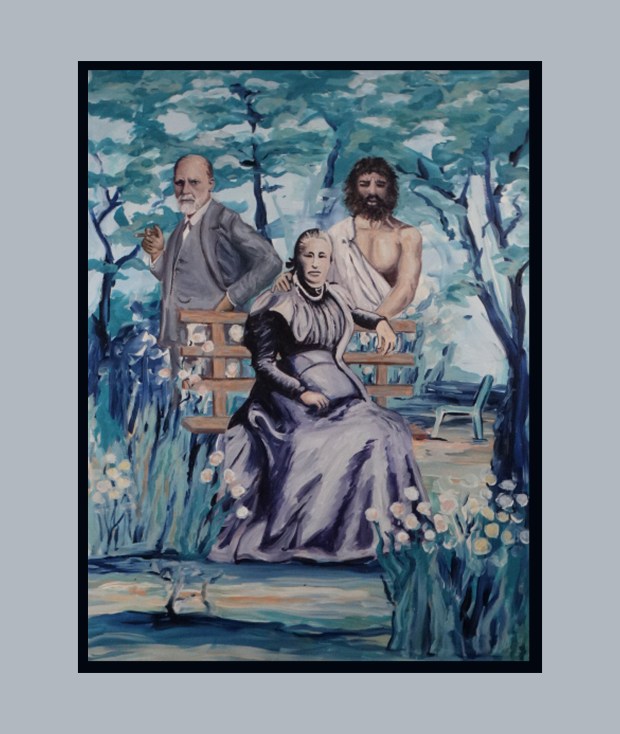
Sigmund

In the late 19th century, Sigmund Freud developed his theories on the nature of the human psyche. The primary motivation for most everyone’s behavior, he determined, was the sex drive. Beginning in early childhood, oral and anal fixations, then phallic and genital fascination defined the libido, the personality and life-force through the id, ego and superego: the realization of desire than tempered with age.

Problems of social adjustment were often caused, he surmised, by suppression of one’s natural sex drive, so, through psychoanalysis, he believed he could cure his troubled patients by making them aware of their latent sexuality.

Certain personality disorders Sigmund traced back to a childhood infatuation with his mother from whom the patient’s sexual inhibitions originated, an illness he labeled an Oedipal Complex after the tragic Greek figure Oedipus who fell in love with his mother and killed his father.

Anecdotally, it turns out Sigmund was his mother’s favorite and while he did produce progeny, it appears his sexual activity was short-lived.

A Short Chat

The increasing use of chatbots these days has me wondering if my modest blog might be thought of as AI produced. Careful as I am-using spell-check and avoiding redundancies, not delving into contexts I know nothing about-it seems my short musings ought to be seen as human produce.

To underscore the obvious, the absence of intricate nuance must make it clear, dear reader, this writer is receiving no help from artificial sources. But, maybe, to be certain no doubt exists as to the origin of my modest posts, a convoluted sentence or two ought to verify these texts human touch.

Good enough? Happy reading.

Stupidogenics

VI’ve been reading about the concerns educators are having regarding technology in the classroom. While the distraction of smart phones can be reasonably curtailed, a more insidious issue is the use of AI to manage homework. Chat GPT, for instance, can produce assigned essays without the need for students to hardly think about the topic. In a test study, students who used the AI app were unable to answer questions about what exactly the produced document said.

Apparently, the problem isn’t restricted to the classroom. The business world, too, is in danger of AI relieving businessmen and women of having to think. Executives may use Chat GPT to produce reasoned argument/policies acceptable in the moment but potentially damaging to corporate goals.

So, it appears, using AI bypasses the need for contextual understanding opening the door to belief in conspiracy theory and the acceptance of disinformation for the multitude of users who find in it justification for their chosen narrative.

It would appear that artificial intelligence may be turning us into a stupidogenic society.

Cancel Culture

I’ve been thinking lately about some of the public individuals who have been fading from view, have virtually disappeared from the cultural narrative in recent months (or years). Some of these folks have found themselves in disfavor for a variety of reasons: perceived racial bias, sexual improprieties, sometimes simply political incorrectness or holding views found to be inappropriate by the more sensitive of our cultural judges.

I can think of a particularly clever and insightful comedian, a creative radio personality, a talented dramatic actor and several pols who suffer the sins of behaving badly in a moral or ethical sense. There appears to be a particularly virulent group of vigilantes sifting through the pasts of those deemed suspicious seeking condemning information. I suppose condemnation may be in order in some particularly egregious cases even though the perpetrator may have contributed to the public good most of his/her life.

It all makes me think back, wonder if there’s anything there, in my past, that might be brought up, maybe by a disgruntled neighbor or former friend, that I might find embarrassing were it to be revealed.

And, of course, there is.

Love

There’s something about the word ‘love’ that makes me cringe. Not the word so much as the idea, how it’s used and what it’s intended to mean. It seems, these days, to be overused and without thoughtfulness.

Well, there are different ways to think about it. Erotic love begins with mutual adoration, the two sensing the one of union. Things can turn; conceivably one lover might enter the thralls of so deep a passion, an emotional realm so overwhelming, rational thought will cease, cause unexplainable fluctuations of feeling that may even lead to deep hatred.

When applied to familial affection, extreme emotional fluctuation would appear to be the rule. Children and parents fighting, at each other tooth and nail one instance then enjoying a pleasant togetherness in front of the TV set the next.

Then, there’s the idea of agape; love of God and mankind. It seems to me likely anyone attempting such love will inevitably fall short which, I guess, will reinforce the sinfulness they know they can never escape, which on the positive side will eliminate the sin of pride.

Better, I think, to leave the term alone, not use it, and keep one’s emotions under control.

Blessed by the Holy Father