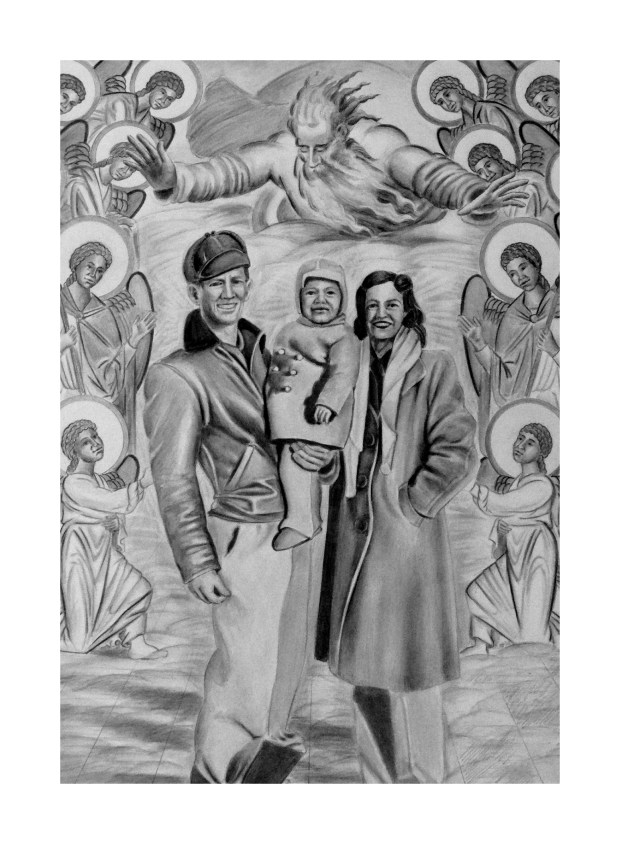
Hannah Arendt: Defining Fascism
The majority of the American population maintains political values that fall between ‘the forty yard lines’. Certain beliefs, while dominant, are overridden in the media by louder voices; elements wishing to impose, nefariously, interests that, if forced upon the country, would undermine democracy.
This far right focus on education, undermining public schools, is on top of their agenda. They will argue public schools are indoctrinating youth with Critical Race Theory and Diversity Equity, Inclusion programs, they argue, without basis, produce atheism and moral relativism.
Once their dishonest condemnation of public schools is sold they, with considerable financial support by like-minded donors, will pursue the legal installation of voucher programs that will allow them to tap public money to support the Christian Academies that, they believe, will indoctrinate all youth into their narrow Christian beliefs.
The criminal danger that must not be ignored here is the indoctrination they desire is exclusive, meant to instill their beliefs in a diverse population. The indoctrination, on the other hand, public education is accused of is inclusive, meant for all citizens’ children.
In the 1930’s, in Germany, a self-serving elite gained power through suppression of the press and creation of a scapegoat (the Jewish population) on which to blame any perceived ills that the fascist regime saw to be pre-ordained as they moved toward establishment of a totalitarian state.
In today’s America we see a federal government reducing civil services, working to suppress the press and attempting to erode constitutional restraints while aiming to instill an extreme nationalism on a population increasingly alienated by the destruction of the pluralistic policies on which the country was built. Repeated falsehoods of illegal voters and stolen elections intended to deny democracy in favor of the fascism meant to turn America into a totalitarian state.
Hannah Arendt foresaw the dangers in Germany and, as a Jew, realized the need to seek refuge. Her thoughtful discourse on the subject stands as a warning that fascistic tendencies must continue to be opposed and suppressed.
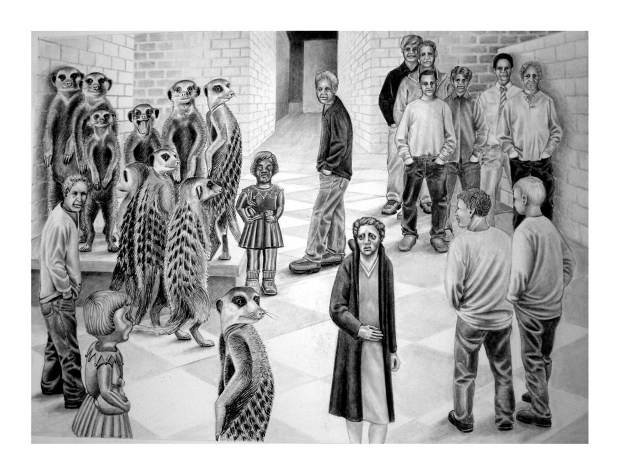
I’ve been thinking lately about the multitudes of good and sincere people in the world who have arrived at dramatically conflicting views as to the nature of reality.
Most all of us rely on what we consider to be unimpeachable support sources for our views and usually a contingent of like-minded others that reinforce our beliefs. The evangelical Christian, the Qanon conspiracy buff and the liberal mainstreamer will tend to approach daily occurrences with sets of premises and then conclusions that are quite different. Such conflicting perspectives are the stuff of the social divisiveness manifesting itself these days; the dilemma of free thought in a free society free from coercive oversight, I guess.
I have no answers other than responding with patient tolerance in the knowledge that most everyone deserves respectful acknowledgement of their usually carefully considered views. The hope is that we can all spot disinformation when it presents itself. Hopefully, we can think past the response of the recently interviewed lady asked why she embraces her position on a current controversial idea. ‘I know it’s not true’, she said, ‘but it’s consistent with my beliefs.’

I’ve been thinking about the George Orwell novel 1984, how the totalitarian regime in the book implemented catch phrases to secure the minds of the populace. ‘War is Peace’ is used to establish a permanent enemy, a scapegoat, that can be blamed for any and all ills that befall the citizenry. ‘Freedom is Slavery’ discourages individualism tribalism in order to keep everyone bound to the collective. ‘Ignorance is Strength’ encourages the subservient populace to forego intellectual reflection, follow the dictates of those in power, not think about things to hard and they will realize contented peace. The message is, I guess, that given such ideas along with sufficient deterrents a totalitarian regime turns people into sheep without them realizing it.
It does seem a bit familiar these days but I guess as long as a free exchange of ideas remains in place reasonable responses can happen.

I’ve been thinking about what draws people, predominantly young men, to these exclusive anti-social organizations.
Without intending to simplify the phenomenon I muse that many of these young men have reached adulthood without a sense of direction, have found themselves powerless, lacking functional legitimacy and are spiritually, intellectually and socially lost, have become fodder for extremist groups bent on grasping political power through often devious misinformation, knowing the vulnerability of their prey.
Sad to think American society has deteriorated to such an extent that it lacks a path to social success for everyone.

I’ve been thinking lately about the increasing numbers of people who attach themselves to groups that organize on the basis of condemnation of certain others. The groups I’m thinking about profess to be Christian organizations, but whose Christian ideals don’t include acceptance of non-white races or those of differing sexual orientation or equality of the sexes. Such groups believe there Americal would be better off without these others and, given the opportunity condemn and harass them.
Consider the Christian Nationalists whose narrow interpretation of their Bible determines the US is a Christian nation first and foremost, other faiths do not belong and given the power these people would drive the others from the country.
Then there are the Orthodox Christians, followers of the Eastern Church, emphasizing male dominance, are antisemitic, anti-gay rights and inclined toward violent rhetoric spread through the social media. The 4th of July this year saw hundreds of masked members of the Patriot Front march in Washington DC. These folks are an alt-right group opposed to a pluralistic society and distain a social inclusive America.
All such organizations are hate groups. Rather than seek common ground they oppose social unity, displaying an arrogance they support with Biblical cherry-picking and a sense of racial superiority, attitudes one can only assume is generated from fear of the Other.
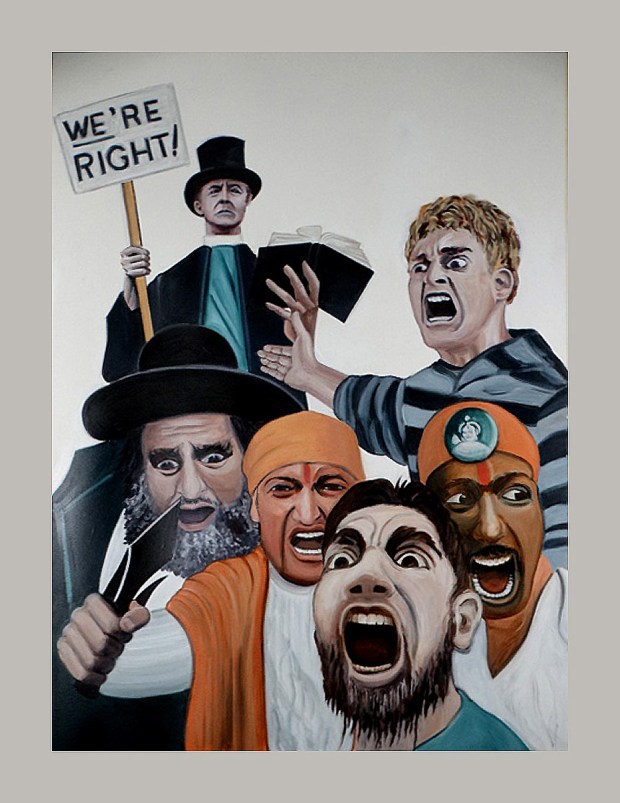
Wondering lately about what it means to exercise critical thinking. Daily occurrences will produce events that require judgements. Often such mental requests should be denied, go unanswered because as soon as they’re thought about they {the critical assessments) will take hold, become of greater importance than if they would have been ignored or denied and more than likely such critical assessments are of little importance anyway, requiring, nevertheless, intellectual energy almost always better spent on positive actions.
A lesson I must concentrate on relearning.

I’ve been reading about quantum mechanics, not so much what it is but rather how the theoretical physicists of the early 20th C attempted to explain it. Years were spent attempting to derive mathematical explanations for how tiny invisible sub-atomic entities exist, interact and behave, and what form they assume in time and space.
The elusiveness of the endeavor led some theoretical physicists to determine that quantum existence was a closed system beyond the known structure of physical science, an idea refuted by brilliant thinkers such as Albert Einstein.
Still, the observed behavior of sub-atomic entities defied explanation. They could be waves or particles, their position and momentum impossible to determine with certainty. The thought experiment offered by Erwin Schrodinger emphasized the counterintuitive dilemma by suggesting photons presented into a closed box in which a cat was placed with a cyanide capsule triggered by particle but not wave suggested multiple scenarios: a cat dead in one, alive in another not reduced to a single truth until viewed by an observer, exacerbating the mystery of what quanta truly are, which leaves us within an unknowable realm beyond the reasoned three-dimensional world our limited intellects can conceive.
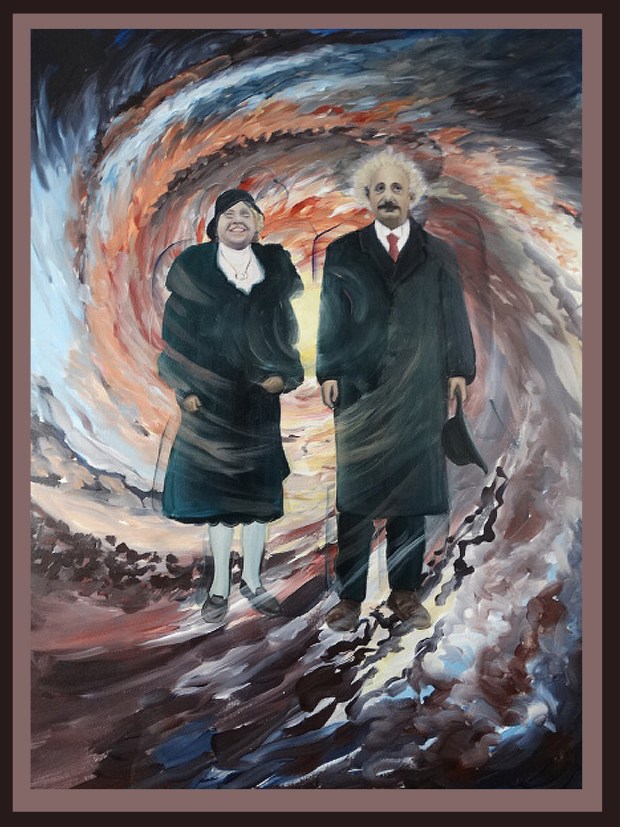
During the Middle Ages pogroms in various European countries disenfranchised Jewish populations, murdering and exiling thousands of people making them, in effect, homeless. Around the same time the papacy launched the Crusades against Muslim control of Jerusalem, a ‘holy war’ that permitted heinous atrocities against ‘enemies of Christ’. In the 15th Century Catholic authorities in Spain demanded Jews and Moslems to convert, refusal led to torture and burnings at the stake.
This infighting between religions, all adhering to a singular God, was a result, I guess, of mis-interpreted Biblical scriptures, studied in attempts to trace their religious origins back to Abraham through his sons and grandsons in order to determine who inherited God’s blessing as the chosen ones as dictated in the covenant passed down by God to Abraham.