Stupidogenics

VI’ve been reading about the concerns educators are having regarding technology in the classroom. While the distraction of smart phones can be reasonably curtailed, a more insidious issue is the use of AI to manage homework. Chat GPT, for instance, can produce assigned essays without the need for students to hardly think about the topic. In a test study, students who used the AI app were unable to answer questions about what exactly the produced document said.

Apparently, the problem isn’t restricted to the classroom. The business world, too, is in danger of AI relieving businessmen and women of having to think. Executives may use Chat GPT to produce reasoned argument/policies acceptable in the moment but potentially damaging to corporate goals.

So, it appears, using AI bypasses the need for contextual understanding opening the door to belief in conspiracy theory and the acceptance of disinformation for the multitude of users who find in it justification for their chosen narrative.

It would appear that artificial intelligence may be turning us into a stupidogenic society.

Cancel Culture

I’ve been thinking lately about some of the public individuals who have been fading from view, have virtually disappeared from the cultural narrative in recent months (or years). Some of these folks have found themselves in disfavor for a variety of reasons: perceived racial bias, sexual improprieties, sometimes simply political incorrectness or holding views found to be inappropriate by the more sensitive of our cultural judges.

I can think of a particularly clever and insightful comedian, a creative radio personality, a talented dramatic actor and several pols who suffer the sins of behaving badly in a moral or ethical sense. There appears to be a particularly virulent group of vigilantes sifting through the pasts of those deemed suspicious seeking condemning information. I suppose condemnation may be in order in some particularly egregious cases even though the perpetrator may have contributed to the public good most of his/her life.

It all makes me think back, wonder if there’s anything there, in my past, that might be brought up, maybe by a disgruntled neighbor or former friend, that I might find embarrassing were it to be revealed.

And, of course, there is.

Dignity

I was reading a while ago about the idea that all anyone really wants from life, in terms of one’s existence within a social perspective, is dignity: the knowledge that one is recognized as being of value as a person, not just a member of humankind but someone of intrinsic worth.

I wonder, as we look out upon the people, we see on the street going about their daily tasks: bus riders returning from work, clerks, administrators, colleagues, if we take the time to see them as what they are, if we recognize our common humanity, afford them dignity.

We all are, after all, strugglers, strivers, driven to seek a modicum of success that will provide a sense of security for us and our families. It’s good, I think, to realize sometimes everyone’s in need. Cooperation, compassion, and empathy are things we can all provide and receive.

Love

There’s something about the word ‘love’ that makes me cringe. Not the word so much as the idea, how it’s used and what it’s intended to mean. It seems, these days, to be overused and without thoughtfulness.

Well, there are different ways to think about it. Erotic love begins with mutual adoration, the two sensing the one of union. Things can turn; conceivably one lover might enter the thralls of so deep a passion, an emotional realm so overwhelming, rational thought will cease, cause unexplainable fluctuations of feeling that may even lead to deep hatred.

When applied to familial affection, extreme emotional fluctuation would appear to be the rule. Children and parents fighting, at each other tooth and nail one instance then enjoying a pleasant togetherness in front of the TV set the next.

Then, there’s the idea of agape; love of God and mankind. It seems to me likely anyone attempting such love will inevitably fall short which, I guess, will reinforce the sinfulness they know they can never escape, which on the positive side will eliminate the sin of pride.

Better, I think, to leave the term alone, not use it, and keep one’s emotions under control.

Blessed by the Holy Father

Preppers and the End Times.

I’ve been reading, lately about the vast numbers of American preparing for the Apocalypse. Some sources estimate as many as 10% of the US population harbors deep survivalist instincts informing them civilization is teetering, nearing collapse, and preparation need be made for surviving the end times.

Well maybe all these folks don’t foresee ‘End Times’ exactly, maybe the extravagant preparations being made: building bunkers that include gyms, pools, libraries and shooting ranges complete with moats skimmed with flammable liquid, is just a use of expendable income for an insurance policy that will ease the fear our tumultuous times are imposing. But, considering the political craziness that perpetuates an Us vs Them mentality, it’s not hard to imagine ‘The Four Horseman’ ushering in the demise of civilization and there’s plenty of literature that adds believable detail to what an apocalypse will look like.

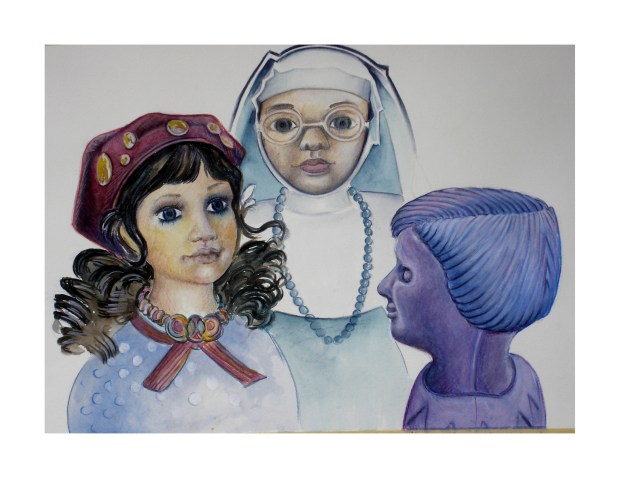
Time to reread ‘A Canticle for Liebowitz’ offering, as it does, a light at the end of the civilization terminating tunnel in the person of a young child, maybe she’s a GenAlpha who will be able to correct some of our mistakes.

Sister Chloe

Evolutionary Upheaval

I’ve been thinking lately about the monumental impact the discoveries of Charles Darwin had on the religious communities of the early 20th century.

The early Christian conception of mankind as being created by God in his image were found to be in total contradiction to Darwin’s evolutionary theories. His discoveries of the evolutionary changes to finch populations on the Galapagos Islands as their habitat changed were irrefutable. Subsequent connections realized between humankind and simian populations exacerbated the matter. Christian revivalists preaching ‘Hellfire and Damnation’ condemned evolutionary thinking, creating fury among the conservative religious community.

Still an issue, I guess, for some, but morality as a uniquely human trait that spurs love of neighbor and awareness of a presence beyond the physical should ease the matter, although such understanding does require nuanced thinking.

The Disappearance of Truth

What to believe? It appears many of us (more than 50% of the U. S. population some sources estimate) get our news through social media, a source of information through which anyone can post thoughts of their own, ideas that may or may not be consistent with reality.

Expecting, as we do, our daily consumption of news to be based on fact, social media offers instead biases of opinion sometimes meant to deceive or to shock. Motivated by self-interest, unedited, the scroll of ideas repeated over and over will take hold, algorhythms feeding intuitions, reinforcing what the individual consumer believes to be true, bad enough in itself but made many times worse by exacerbating societal divisiveness.

We owe it to ourselves to dig deeper into the news of the day, to seek the facts beyond our intuitive inclinations, as uncomfortable as that may be. Moral truth is out there to be found.

Knowing the Ineffable

I’ve been reading about the religious concept ’Via Negativa’, the idea that the only way to really know God is to obliterate any association one might imagine about a supreme being with tangible realities like personhood, embodiment, even singularity, that to truly grasp the enormity of the concept of an ineffable Other is to eliminate the limitations imposed by naming or envisioning being.

I guess the idea is to sense the presence of the un-nameable, non-entity in one’s surrounding environment and personal interactions every waking moment is to achieve true spiritual enlightenment.

I must say such an idea is intriguing and not totally unfamiliar sensing as I do, well, maybe not in every waking moment, but occasionally, something more in my surroundings and personal relationships than mere physical or psychic reality would suggest.

It’s good, I think, to have alternate ways to contemplate a personal spirituality beyond the limitations of conventional religion.

Eternal Optimism

I’ve been reading, lately, about the primary concepts of stoicism. Among them is premeditatio malorum, which means, I guess, to ponder potential ills in order to keep in mind that bad things may occur at any time to prepare one for the eventual worst-case scenarios that life may impose. The idea seems to be that by living under a slightly dark cloud, one isn’t surprised and overwhelmed when bad things occur.

The concept seems counter-intuitive to the naïve paean to eternal optimism: “things could always be worse” which most of us intone pretty much all the time, even through the pain of the oppressive pandemic. The notion reminds me of Voltaire’s satirical ‘Candide’ where the eternal optimist Pangloss maintains we live in the “best of all possible worlds” even as one terrible event after another fall upon our hero.

But, there are other important stoic concepts to keep in mind, like starting each day with a morning meditation, ending each day in reflection, practicing moderation in all things, speaking less and thinking more among them. All of which suggests stoic practice has many benefits even if eternal optimism isn’t among them.

Upon Reflection

I’ve been reading about the history of the mirror: how the idea of ‘reflection’ took on new meaning over time.

Humankind has, of course, been aware of the reflected image since pre-historic man first gazed into a still pond. The dangers of such a discovery became apparent in Greek mythology when Narcissus, realizing his beauty, became obsessed with his reflection, fell into despair his love of self could never be requitted, killed himself and was reborn as a flower (curious but fitting, I suppose).

By the Renaissance pretty much everyone had access to mirrors. It didn’t turn all Italians narcissistic but the focus on personal appearance brought about by the availability of the reflected image profoundly affected the way people everywhere thought about themselves. Gazing into a mirror makes the gazer aware of his (or her) unique oneness. Social relationships become more complex. The individual, aware of her (or his) physical attributes easily assumed an expectation of relative worth beyond the status assigned by other means such as social rank, wealth or useful contribution to society. Visual presentation: grooming habits, manner of dress hair styling became increasingly significant and for some cultures border(ed) on the ridiculous.

Maybe what we need is a new kind of mirror; something like the ‘mirror, mirror on the wall’ of Snow White, that lets us look into ourselves, see our motivations and desires, moral integrity maybe. It might be eye opening.