Plato, Aristotle and Medieval Christianity

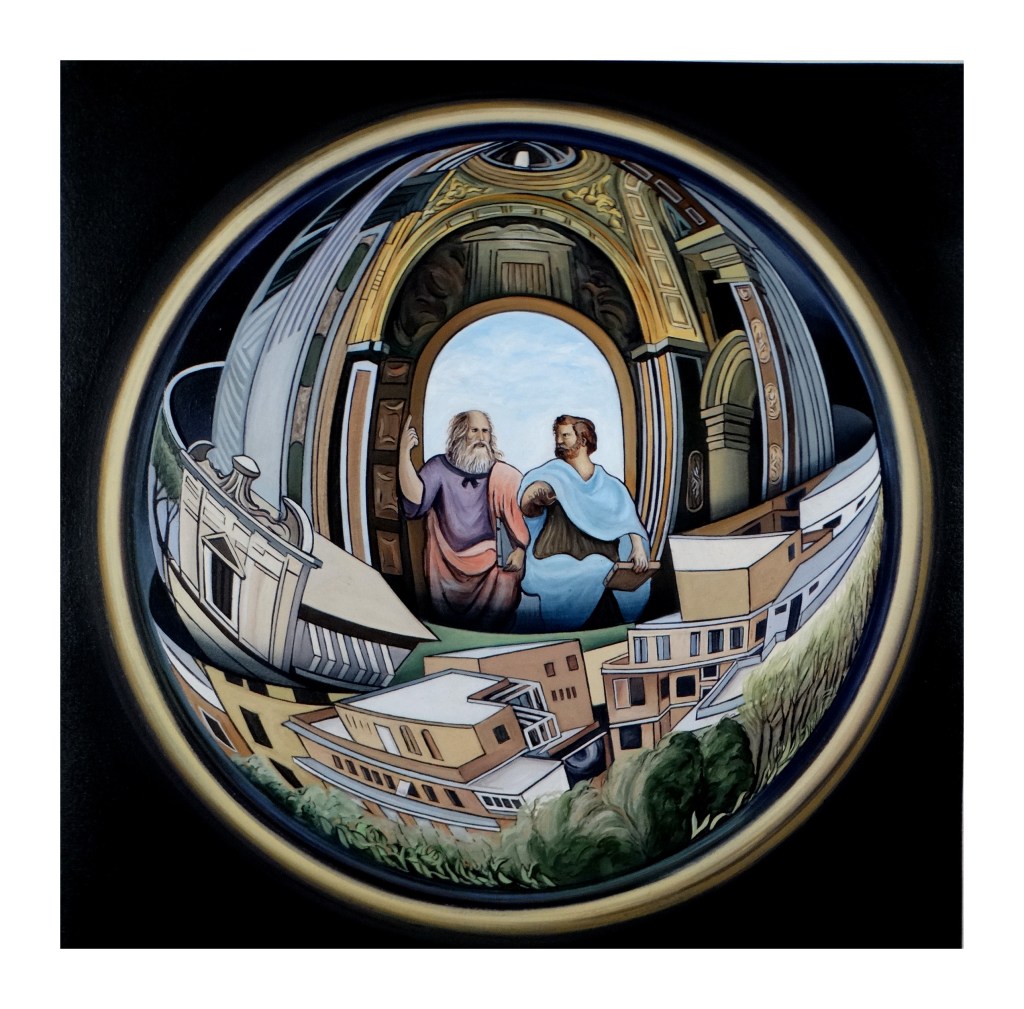
I’ve been reading about the influence Plato and Aristotle had on the medieval Christian church. The thoughts of these two Greek philosophers were responsible for doctrinal controversy within the church hierarchy.

Plato, whose concept of ‘Ideal Forms’, on which the flawed material world was derivative provided some in the early church insight to see Plato as foretelling the existence of the Christian God, a God beyond rational understanding, a God unknowable before the Christ, to be accepted and revered through faithful observance. Thomas Aquinas, empiricist, thoughtful inquirer, found Aristotle’s sensate investigations proof of an ordered, natural world made that way by an omnipotent God. The contradictory thinking produced on the one hand the necessity of ‘blind faith’, the faithful encouraged to accept the mystery that is God, and, on the other an enquiring laity whose faith and rational understanding was based on knowledge.

The philosophical controversy still exists to this day but at the time paled in comparison to the power struggles and corruption within the medieval church.
A Dark Age

I’ve been reading about the intellectual world in Western Europe as it existed in the early centuries of the second millennium.

With the fall of Roman Civilization 600 years earlier, scholarship had declined, knowledge of the past had been reduced to monastic reproductions of Latin texts providing the church the opportunity to re-imagine the historical narrative to its own advantage, limiting it to a closed Christian perspective and its reliance on the ‘Word of God’ to explain the complexities of the natural world.

This constrictive culture led the few scholars of the time, whose concern for self-preservation amid accusations of heresy, to temper any announcements of research findings setting back intellectual development for centuries.

The eventual breaking free of such a restrictive situation can only be attributed to the indomitable human spirit, even though it did take a long time.

Patron Saint of the Internet

I’ve been reading that in the year 2000 Pope John Paul II proposed that St. Isidore be declared patron saint of the internet. In the 7th century Isidore wrote a book that was widely reproduced and read. At the time the book, Etymologies, was nearly as popular as the Bible. In Etymologies Isidore determined derivations of words from Greek to the vernacular but what made up the bulk of the twenty volumes was his compilation of what he considered to be the entirety of human knowledge.

Much of the contents of Isadore’s tome has been determined to be imaginative conjecture and has been dismissed by scholars as the perpetuation of myth and the conveyance of misinformation. Reason enough, I suppose, that he should be associated with the internet.

Keystone Species

I’ve been reading that biologists have determined that certain predators are key to preserving diversity in various eco systems: starfish, for example, serve the function by consuming mussels that would otherwise destroy the diversity in tide pools and fresh water largemouth bass are a keystone species in freshwater streams controlling the populations of minnows that would otherwise over-graze plant life. In the waters off western Alaska sea otters control the populations of sea urchins that can devastate kelp forests.

The lesson to be learned, I guess, is that keystone species are necessary to control populations of system threatening species in order to maintain healthy diverse eco-systems. I wonder whether a keystone species might exist somewhere that could control the species most responsible for threatening the health of the earth.

Brain Fog

I’ve been reading, lately, that an increasing number of people are having a serious problem thinking. The complaint, made primarily by young adults, is of an inability to mentally focus and make decisions. In explanation, researchers point to the prevalence of ‘long covid’ as being a primary culprit causing what suffers refer to as ‘brain fog’: a condition affecting their ability to function at work.

I find myself wondering as I observe these Gen-Zers and Millennials, ubiquitous smart phones in hand while in airpod oblivion, what the true cause of their ‘brain fog’ might be.

Christian Apologetics

I’ve been reading, lately, Penzees, written by the 17th century philosopher Blaise Pascal. The work goes into great detail defending and advocating belief in Christianity. Rationale for such belief centers on the idea man is morally flawed and sinful making existence psychologically painful. Why else, the apologist argues, do we avoid the reality of the here and now through pre-occupation with the past or anticipation of the future, or by other constant diversions that keep us from facing the inevitable: the realization of a finite existence that will end in extinction.

The solution to this dilemma, we are directed, is in admitting our shortcomings, relinquishing our pride and our fear of the enormity of existence. If we do this, we can create a space, a place for God.

The philosopher offers strong argument. We all, if we think about it, live with our uncertainties and fears. Belief in a benevolent God will surely bring peace of mind to those able to embrace it. There are caveats, I suppose. One may find, upon commitment that remaining in ‘good faith’ may be somewhat more involved than a simple declaration of belief.

Premonitions of Doom

I’ve been lately experiencing premonitions of doom. I reason it’s the time of year: an extended run of cold gray days, nature receding into dormancy. But maybe not. Maybe negative life-changing events, beyond my control, are on the horizon. I can imagine all sorts of horrible scenarios involving violence or accident. Pure evil may even enter in.

My life has been reasonably free of negative occurrences; I can’t remember experiencing serious personal disaster. Family passings have been expected, serious health issues haven’t materialized. Maybe I’m due.

I guess such feelings are why some people embrace religion.

Confrontation

A recent heated confrontation has me thinking about my history of passionate exchanges. As I remember my teen years, confrontation was youthful exuberance fed by a black/white world view, nuances not yet present in my developing brain. Hot-blooded exchanges, aggressive verbal attacks were fed by moral outrage at perceived social injustices. To be honest such passions manifested in private, usually from the safety of my bedroom.

These days I try to avoid confrontation, am better able (thanks to blood-pressure meds) to temper animosities, remaining silent and suppressing my inclination to speak out in the heat of the moment. Even so, I am surprised sometimes when my temper flairs and I’m unable to withhold strong response. I guess certain behaviors are simply in one’s nature.

Fishing Trip Revisited

I’ve been thinking about the fishing trip I was on this past summer, how difficult, unpleasant I found it to be. The small boat on rough water and lack of the sonar devices most everyone else on the lake had made me thinking of the David Foster Wallace essay title: ‘A Supposedly Fun Thing I’ll Never Do Again’. I found myself humming Taj Mahal’s ‘Going Fishin’ to pass the time.

Now, as many things viewed in retrospect, I remember a not unpleasant experience resulting eventually in reasonable success. I think now of the small plaque in the fish camp’s cleaning building that offered the fisherman’s common plaint: ‘Tell Your Own Lies’. Multiple meanings in that, I guess.

Delayed Gratification

I’ve been thinking lately about how satisfying one’s desires ought to be thought about as one ages. The delayed gratification test given to young children involving one marshmallow now or two awhile later is meant, I guess, to determine a child’s sense of discipline, discernment and desires.

The idea of having it now or saving for later should, I think, be nuanced later in life as we age and our tastes and health are factored into what waiting means. At some point, when all possibilities are considered, it seems reasonable to consume and enjoy immediately.