Surviving the Wilds

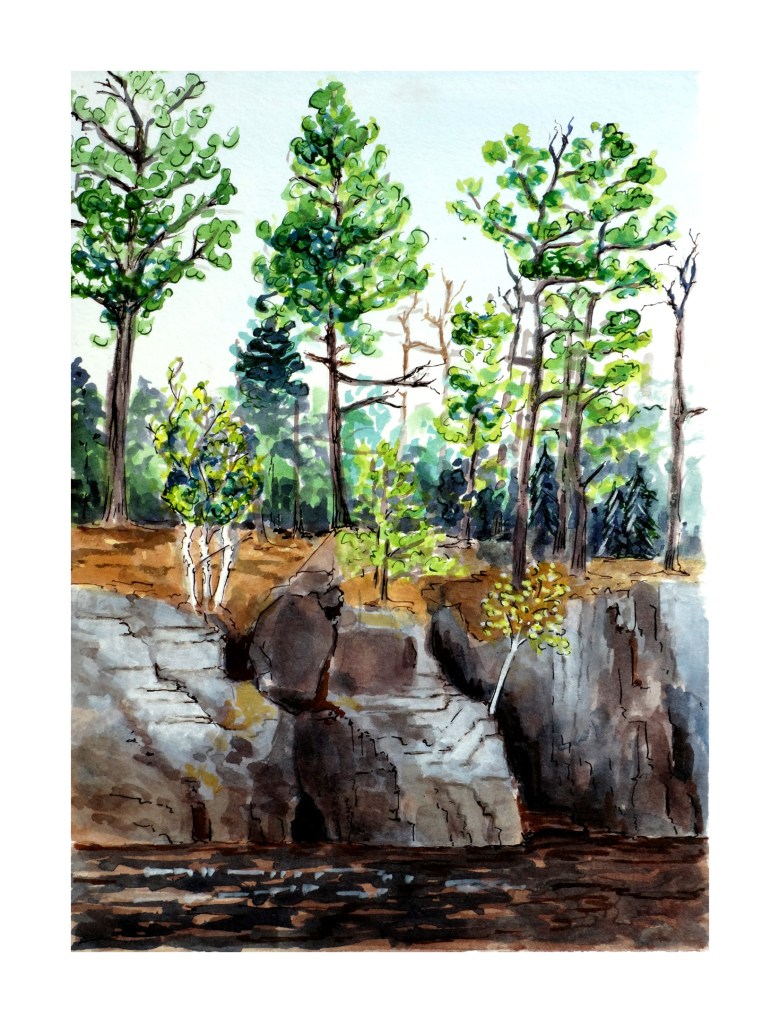
In the midst of a camping trip when conditions become somewhat adverse, one’s mettle is tested. What to do: pack up and go home or remember the pioneers and early explorers who underwent extreme hardships, hostile natives, an unbalanced diet; men (and women) who we remember for their heroism and important accomplishments opening, as they did, the continent for settlement.

I think these things as I sit in the comfort of my pop-up camper listening to the soft purr of the generator suppling power to my various electronic devices.

The mosquitos and rain are pretty daunting, though.
landscape 1

Conspiracy Theory

I’ve been reading lately about humankind’s inclination to embrace conspiracy theory. When on finds oneself facing what appears to be insurmountable problems it is not uncommon to imagine the existence of a conspiratorial force interfering with and blocking one from resolving problems.

Usually, such ideas of conspiracy are short lived, disappear when difficulties subside, but, in extreme cases, when living in incomprehensible uncertainty, the human imagination may take hold, enhance the powers of malevolent entities, and allow imagined evils to grow, create false realities and extend beyond individual problems to suppose secretive governmental power structures and even cast doubt on the understood nature of the physical universe.

Proponents of conspiracy theories exploit the psychological power of belief and reinforce power over disciples by cherry-picking misleading Biblical texts or in some cases creating ‘sacred texts’ of their own. The truly committed may establish schools to insure their children are believers as well.

I worry the beliefs the flat earthers, election deniers and government conspiracy nuts impose on their children will produce skewed realities, individuals unable to grasp and address the existential issues becoming more real every day.

Realizing the Ungraspable

I find myself visited lately by an idea, a figment of imagination that, during times of contemplation come and go, hint at an ellusive potential for understanding; thoughts of solutions and resolutions appear, slip and fade replaced by new enigmas always wavering on the edge of consciousness remembered clearly then lost, evaporating, caroming into then out of view; ideas within sight for an instant but ungraspable, mind fluctuating from one ill-defined thought to another, the intangeable true reality beyond reach. Something of value may be there twisting into then out of focus. How long must I wait for the idea to appear.

Remembering College

I recently found myself sitting in the student union of the college from which I matriculated forty years ago. I got lost in the maze of corridors finding my way; it’s all quite unrecognizable, but the ghost whispers of remembrance conjure vague memories of classes, activities, acquaintances and competitive exchanges. I remember the hierarchy of college authority, an authority based on what one knows, sometimes, but sometimes on pure bravura. Wondering why, why students seek more school whether the commitment is for the pure love of learning, aimed at future employment or just four more years of little responsibility. Maybe it’s the assumption of future success; maybe the belief is, to paraphrase Woody Allen: ” all one needs to do to succeed in life is just show up.”

On this weekend day the campus is mostly deserted. It feels cold and alien despite the big light filled windows, the carpeting and comfortable chairs. Huge public money goes into these edifices, the intention being to produce productive citizens. I wonder if that’s happening.

On the upside, four years of liberal arts education will likely produce more liberal voters.

The ‘Unwoke’

I’ve been thinking lately about the ‘Woke’ movement and the hot-button issues of social inequality. The thinking goes, I guess, that any pretense of a liberal acknowledgement of social disparities has no foundation in fact since the white powers that be exist within an innate racist, sexist and homophobic psyche. As a result, a political dualism has occurred: while championing equality for all as the ideological ideal a system favorable to the white heterosexual majority is being maintained.

Unfortunately, the volatility of the demonstrative ‘Woke’ proponents will continue to fail to move the unwoke who reside in a state of quiet disinterest and private preoccupation. There is hope, I suppose, in the changing demographic with people of color as well as those seeking trans-gender identities increase in numbers.

Revenge of the Sabine Women

I’ve been reading about an event that occurred during the founding of the city of Rome. Apparently, 8th C BC Rome was primarily male, populated by the soldiers and mercenaries who secured the region from the various tribes in the area. The story goes that in order to grow the population Romulus concocted a plan to lure the tribal Sabines to the city, killed the men and raped the women who then became the mothers of the next generation of Roman citizens.

The reason the event was not forgotten over time was because quite a number of artists found the imagined scene compelling. From the Baroque to Cubism, Rubens to Picasso artists depicted the chaotic scene. None of them imagined an alternative ‘rest of the story’ I guess.

Must there be a Why?

I’ve been reading about the billiard ball analogy often applied to the rule of cause and effect. The idea is that when a propelled ball (the cause) strikes its target, the trajectory of the struck ball (the effect) is without question as it moves in a straight line until encountering resistance, change direction: movements predictable within the basic laws of physics.

Such theory is simplistic in application to human experience where the obvious complexity of possible causes (personal biases, religious beliefs) isn’t easy to apply to human experience, especially in cases of spur of the moment, spontaneous actions. In contemplating such behaviors we’ll always seek explanations, assume a disturbed mind or an innate animal nature. But perhaps some actions occur without cause or reason, immaculate in their spontaneity like the Big Bang of creation. Maybe we’re better off sometimes not seeking causes.

Dichotomies

I’ve been thinking about how language so often simplifies things, reduces complexities to opposites; consider definitions of race (black, white) or political perspectives, just to name two.

Dichotomies, conceptual opposites, seem to be primary to definition for many of us. Not sure whether such thinking is the result of a desire for a basic grasp of contemporary issues or just laziness. In any case it’s a phenomenon exacerbated by the media that tend to project sound bites, click bait to attract followers, I guess. And then there’s our inherent biases, the intuitive inclinations that lead us to champion or demonize.

Philosophers have been contemplating the idea of dualism for a long time as an issue of body vs mind, leading some (Plato, for example) to entertain the notion of an eternal soul, the mind being incorporeal, which might explain a lot about religious participation.

Maybe humankind is destined to live a heaven/hell existence. In practice, though, finding common ground would seem to be more practical.

Chatbots

I’ve been reading about a new on-line application for students to resource that will complete written assignments for them. Given subject and context, ChatGPT will not only produce an essay or term paper of desired length but will write it in a manner consistent with the sort of language and syntax expected of a student of average intelligence. The technology is apparently leading some instructors and schools to re-think their curricula, which, I guess, means substituting oral responses or in-class spur of the moment essays for more conventional written work.

Just wondering what a chatbot might do with my brief musings, what the AI, given a few samples of past posts would deem consistent, whether it would find it necessary to throw in a misspelling or two, maybe a sentence fragment; a few unnecessary semi-colons.

Well, I don’t think I’ll go there; what would I do with all the spare time?

Moral Truth

I’ve been reading about the conflicting philosophical thinking occurring among the dons of Oxford in the early 20th century. Conventional exegesis centered on issues of morality, how to think about the idea of the ‘Good’ in action and deed, whether there existed an intrinsic moral intuition directing man’s behaviors.

In opposition to such thinking, others maintained issues of morality were beyond the realm of obtainable knowledge, had no truth value, since such knowledge is dependent on the opinion, state of mind, of the individual thinker. The only knowledge obtainable, the logicians determined, will be found in mathematically verifiable constructs, truths within the bounds of scientific investigation. The Ethicists responded that man’s behaviors are much richer, rely on moral constructs and consist of a multiplicity of remembrances and inputs not reducible to mathematical formula.

I guess the atrocities of World War II must have brought the discussion of Good and Evil back to the philosophical table for everyone.