Alone in the Wilderness (part 3)

Another think I miss while alone in the wilderness is distraction. Other than the occasional animal rustling or bird song there are no distractions here. I can’t even get a cell phone signal.

The awareness of not being distracted makes me think I must be distracted a lot usually. I wonder how much of my life I spend distracted.

Which is one reason I didn’t mind falling in the water while trying to get into my canoe so much. It temporarily distracted me. Wilderness is so in your face, so absolute, such stark reality.

So, to deal with stark reality I brought along some distractions in the form of reading material and, obviously, writing pad.

One of the books is Wittgenstein’s Mistress by David Markson. The person telling the story in this book reminds me somewhat of myself. She goes on and on about whatever comes into her head. She tells in the book about having once been mad. I don’t think she ever fully recovered by the end of the book.

I don’t know what that says about me.

landscape4


Alone in the Wilderness (part 2)

I’ve been alone in the wilderness now for more than twenty-four hours. Other than the occasional canoe passing by I’ve seen or talked with no one.

Nothing particularly unusual has happened here other than last evening I fell in the lake trying to get into my canoe. I spent considerable time after that rigging up lines to dry things out which they pretty well were by morning.

So, I was thinking about what I miss being in the wilderness and one of the first things that came to mind is music which when I’m not in the wilderness I am usually listening to or is at least playing in the background.

I find it interesting how some musicians’ names seem to fit their profession so well. Take Esa-Pekka Salonen or Luigi Boccherini or Antonine Dvorak. When I say these names out loud I just want to repeat them over and over because they’re so rhythmic sounding (well, maybe not Antonine Dvorak so much).

The composer I’m thinking of now is Aaron Copeland who I guess doesn’t have a particularly rhythmic sounding name but his music seems to suit the wilderness. It seems to me Appalachian Spring would be really good background music for where I presently am. I’m not in Appalachia and it’s not spring but never the less.

I do know the title of that work really doesn’t refer to the season but rather a water source. I found this out only recently. Even so I still am inclined to think of the season when I hear the piece. Also I think of Jody Foster who sang Simple Gifts in an episode of Kung Fu for David Carradine who played Kwai Chang Caine even though he’s Caucasian.

The movie that I think of when I think of Jody Foster is Taxi Driver with Robert DeNiro. In it she plays an adolescent prostitute.

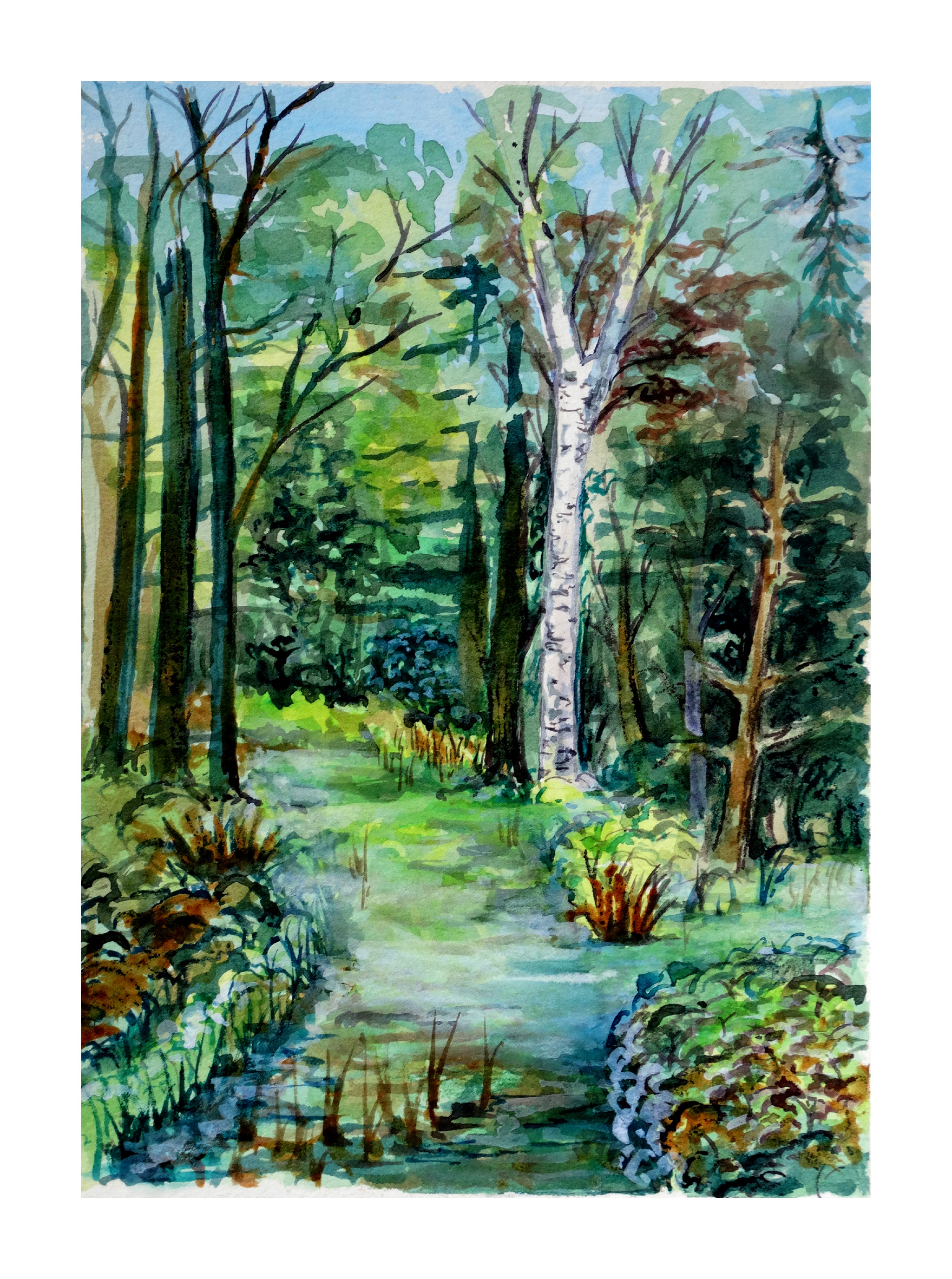
landscape6


Alone in the Wilderness (part 1)

I’m all alone in the wilderness. At least it’s someplace I would call wilderness. I know for a fact no one lives within miles of here and there aren’t any roads within miles of here either.

That’s not to say there aren’t people around. I saw four people just minutes ago but they aren’t within sight now. For all intents and purposes I’m all alone. At least I have been for the last three hours and seventeen minutes which is how long ago I entered the wilderness.

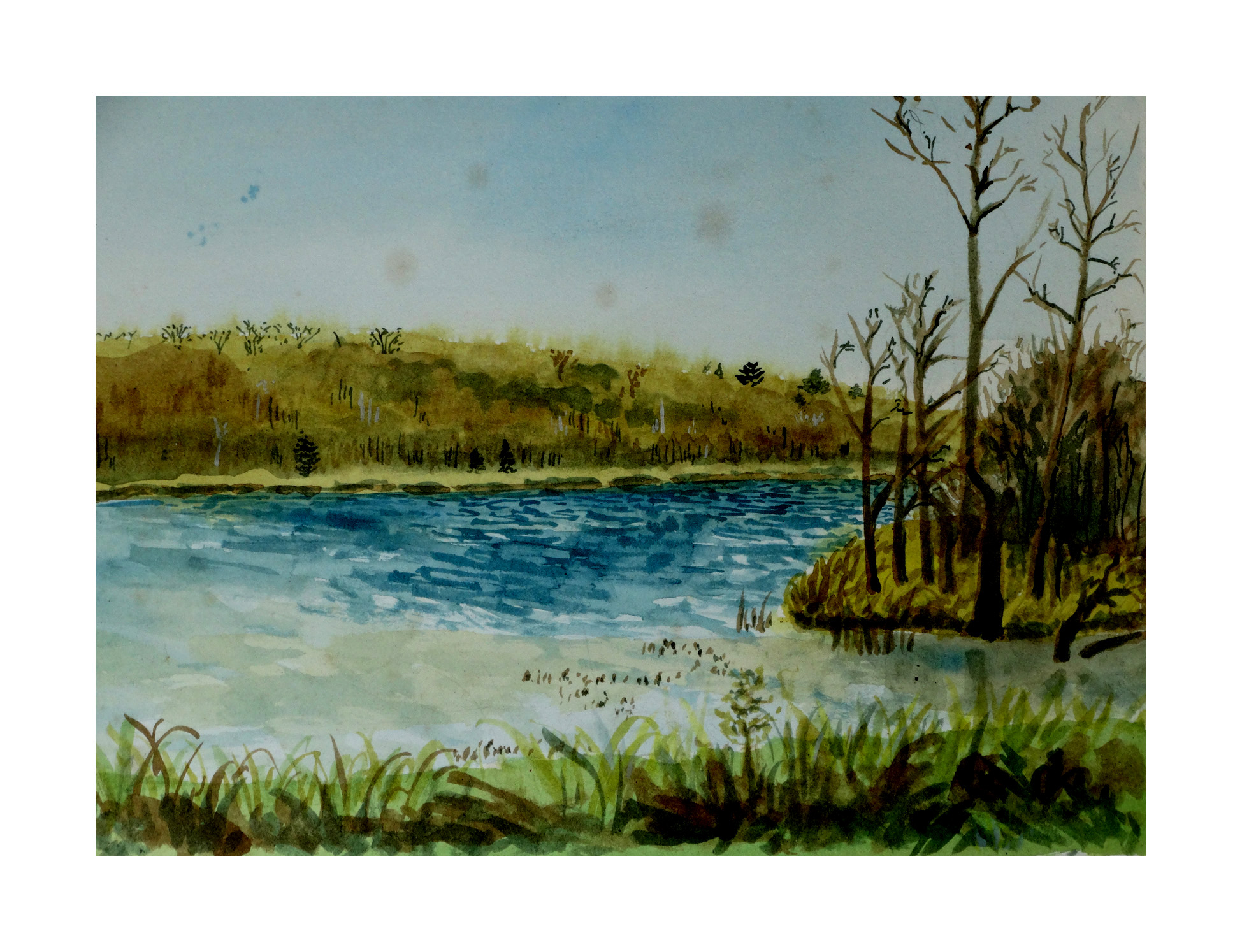
Right now I’m looking out across a lake.

Although it’s been a couple of minutes since I wrote that last sentence I’m still looking across the same lake in so far as I haven’t moved from the spot I was at when I wrote the last sentence. It’s a beautiful scene; the sun sparkling off of the water, the variety of greens in the trees on the far bank, the multi-colored rock outcroppings reaching down into the dark water. It could be a painting.

Of course I know it couldn’t really be a painting because then what I’d be looking at would be some sort of pigment spread on canvas or paper or something rather than the real water and rocks and trees I’m seeing.

That’s not to say if what I was looking at was a painting that the painting wouldn’t be real. It is real in my imagination in so far as I can imagine this scene as a painting.
So I guess there’s no reason to think that the painting I’m imagining of the scene that I’m looking at is any less real than the water, trees and rocks.

landscape7


The Great Revivals

Brother Abraham, the Semitic cleric and Biblical scholar, was telling me the other day about the great Revival Movements of the late 19th and early 20th centuries. He said the movements began as a reaction to the scientistic attitudes brought about by Enlightenment thinking which the faithful found to be atheistic and involved a return to the fundamental beliefs of Christian doctrine and an irrefutable belief in the inerrancy of the Bible.

The revival meetings, Abraham told me, were heavy on emotional content with lots of singing and praising and pretty light on intellectual substance which, I guess, was a real crowd pleaser because the revival meetings became quite popular with a lot of people finding God and looking forward to the next event.

The good brother said that these fundamentalist Christians were for the most part dispensational premillennialists, which means, among other things, that God will make good on his promise to establish Jewish dominion over the world, which, Abraham said, will certainly be good for him and that he’s looking forward to it.

As I think about what these meetings might have been like, I think I could have enjoyed the energy and reverie, the coming together of like-minded people in a celebratory gathering. As long as no one asked me whose fault it was that apple got picked.

revival2


God-likeness

I was thinking back to my school days recently.  Doll school was really a lot less about acquiring information than it was about seeking truth and the nature of doll existence.  We spent a lot of time contemplating the big questions, you know, like, does the universe have a purpose, What can we know for sure, Why is there something instead of nothing, does evolution explain human nature, does the free market erode moral character?

One day we got to talking about Plato’s belief that universal, Ideal forms underlay all our observable phenomena; that the things we see around us as well as we, ourselves, are imperfect representations of these transcendent perfect Ideals.  So that, the apple there on the table is a manifestation of the Ideas of redness, roundness, hardness and if we were to bite into it sweetness or tartness-it is an imperfect representation of the Idea of Appleness.

Our professor, Leonard D., then got us thinking about what universal ideals were existent in each of us; imperfect as we know we are, he asked, what are some of the ideal forms each of us exhibit?

My immediate thoughts were to my physical appearance which I am fully aware are far from ideal, at least in terms of Beauty although that does seem to be a bit relative to the times.  But certainly there is more to me than that.  There’s my personality and intellect: I think I’m reasonably intelligent, pretty compassionate, somewhat humble and unassuming and mostly friendly.  And then there’s my sense of responsibility and social participation: I pretty well keep things clean and orderly and I usually do my best to be a functional member of our doll community.

So, when I tried to envision Ideal universal DeiDei-ness, I supposed she might be more beautiful, smarter, more caring, friendlier and altogether more god-like, which got me wondering what it meant to think of myself in terms of god.  Should I be humbled by the realization of my obvious inadequacies or do I think of my relative god-likeness as an ego boost?

Well, that was all quite some time ago but I still think about the dilemma occasionally and how my behavior might reflect one position or the other.  I’ve pretty much come to the conclusion there are places and times for both behaviors.

birthofvenus3

Migrating South

Granny Applehead has been talking about joining the migration of the elderly to the warmer climes of the south.  She says that, as one’s metabolism slows down with age warmth is a primary need for any sort of comfort to exist.  She yearns for the nice dry walks and roadways and the easy availability of golf carts allowing a mobility that the ice, cold and snow prohibit.

Besides, she says, a retirement community offers the benefits of social interaction with others of one’s own age and, often, sensibility.  Structured days playing mahjong, drinking tea and attending concerts and lectures are pleasant distractions from our ever present aches and pains.  Everything about it points toward enjoying quality time in our autumnal years and prepare us for the day when the warmth of the cremation furnace will return us, dust to dust, to our mother earth from whence we came.

She jokes with her friends that she might instead opt for Plastination so that her children will be able to enjoy her personage gathering dust in the corner of the living room (boy, does that sound familiar).  It seems kind of morbid to me but I guess it’s just her way of making lite of the impending reality; the unknowns of death everyone must face.

granny3

Beyond Space and Time


Free-thinking Frank was telling me the other day about this group-a movement really-of skeptics dedicated to the task of debunking all things paranormal like ESP, UFO sightings, conversing with the deceased, telekinesis, and anything else they see as magical thinking.  They’re a conscientious bunch, Frank says, avoiding generalization and attending to the particular, which means they pretty much take all claims seriously.

Employing the scientific method these skeptics seek out verifiable data and eye-witnesses with consistent, non-contradictory accounts but for the most part are seeking normal and natural explanations for the anomalous phenomena thought of as paranormal.  Frank said these skeptics find religious claims dubious as well but aren’t inclined to consider them for analysis since they rely so heavily on non-falsifiable premises.

All in all, Frank said he thought the skeptics are on the right track attempting as they are to clear the air of the fog of magical thinking, you know, putting people on the path of verifiable truth.

As I thought about it, I wasn’t so sure; I found myself skeptical of the skeptics.  It seems to me science has relinquished its claim to the ground of truth these days.  The space-time continuum among other things has really messed with our intuitive sense of the cosmos.  Do our processes of thought even correspond to the structure of nature?

So, for me, it’s time to re-examine the paranormal.  The first thing I’m going to do is dig out my birth chart and see what the stars have in store for me.


evolvingworlds3

Thoughts on an After-Life

I’ve been reading lately about the various ways different cultures and people think about after-life. Many of the various after-life conceptions identify an inner spirit or soul within each individual that is in some way immortal and will live on in a place determined by their conduct in the life they’ve just left. Some contend the deceased will be reborn taking a living form, animal or human, consistent with their previous moral, ethical existence.

Some researchers have hypothesized what the after-life might be like. One suggests that after death the soul floats into the atmosphere where it lives off of the ultra-violet rays from the sun. Another believes after death the self will find itself in a dream word of memories and mental images. Still another thinks the mind will merge into a collective consciousness the downside being it will relinquish its personality.

But, the idea about what the after-life will be like that I like best is that each person will experience a world of her own, unique to herself and consistent with her earthly existence. If my next world follows my nature then it will be filled with wonder and uncertainty and I will continue to question, to look for the ever elusive answer and to revel in the ever-present Mystery. What could be better than that?

Being-in-the-world

Freedom and Universal Truth

I was speaking with ZahZah K. the other day about her contention that the only solution to the impending end to civilization as we know it (you know, as brought on by our degrading environment, sectarian violence, etc.) is the establishment of a new social paradigm, a transformation of the fundamental structure of society, the establishment of a world-wide collectivity.

What we need to realize, she said, are those universal truths that we as sentient beings all share, that define the bases of our existence; those truths which precede the value distortions precipitated by associations of race, sect, religion or economic philosophy.  And, once we all grasp these truths true freedom will be realized.

It all sounded pretty good to me at first but then I got to thinking that if this universal revelation were to happen we all would be, in effect, marching to the same drummer.  And, it sure seems to me there would be little room for individual idiosyncrasies-flights of fancy, imaginings of alternative worlds and ideologies-solutions that, perhaps, we might realize as we continue to evolve.

I guess it’s just another example of pragmatist versus dreamer and, although I understand the importance of interrupting or at least slowing our slide into environmental disaster, I told ZahZah that I, personally, am unwilling to relinquish my freedom to dream.

She told me that was unacceptable; that if I wasn’t part of the solution I was part of the problem even though I assured her I always buy organic.

zhazhak3

Truth and Power

Brother Abraham, the biblical scholar (who happens to look quite a bit like St. Jerome), was telling me the other day about the beginnings of the early church.

He said that early on there were all sorts of different beliefs about God; some thought of him as creator-in-chief, others saw him as an ever-present spirit permeating all of nature; even God’s gender was questioned by some.

People, Abraham told me, looked for different ways to get in touch with God.  Some thought the church with it’s doctrines and rituals was the way to go but others thought they could meet God themselves if they tried really hard so they sought revelation through fasting and other kinds of bodily denials.  Others believed secret knowledge was hidden in the words of the Bible, there to be deciphered by the truly committed.

Then, while the Christians were busy seeking an audience with God the Romans were feeding them to the lions or killing them in other really nasty ways because they felt the Christians were disrespecting the true gods which of course were the Roman ones.

But, around the year 300 or so the Emperor Constantine had a revelation of his own and declared Christianity not only lawful but THE religion of the whole Roman Empire.  Then he provided lots of money to build churches which made the early church fathers very happy.

These early bishops soon took a dim view of people seeking God on their own.  They encouraged them, in not always pleasant ways, to come into the fold and renounce their heretical ways since they (the bishops that is) felt that they clearly didn’t need the competition.  And, besides, they (the bishops again) had Truth on their side.

Well, I went home and thought about this story for a while.  I had to wonder if conflicts such as these are really about truth.  It seems to me the desire to be in charge has something to do with it.

brotherabraham