Psychoanalyzing Sigmund

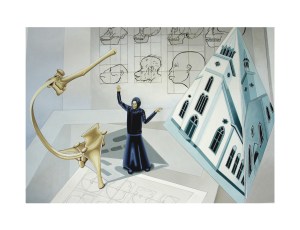
Dr. Freud determined the libido controls man’s nature.  He thought the male child was engaged in a constant struggle to overcome his father in order to claim his mother and demonstrate his power in the world.  He said he figured this out because of his own attraction to his mother and jealousy of his father and if it was the case for him it must be the case for everybody.

The female child, meanwhile, was in envy of male potency as symbolized by the male genitalia. I guess he was saying we are all controlled by our physical bodies and our minds simply respond to our animal natures.

Dr. Freud must have thought about sex quite a bit; he ended up having six children.

undergoing psychoanalysis3

Intelligent Design

LeonardD the artist doll just completed a series of artwork using only objects and materials he was able to find around the house.  He came by the other day to tell me about the work.  He said that he felt confident he could make art out of anything.  Well, I thought that was pretty interesting, so to challenge him I asked what art he could create if he were locked in a windowless room with nothing in it.  He said that he believed he could come up with something.

We talked about it awhile and decided that the artwork would need to be a tangible object that he could bring out with him when he left the room; we ruled out performance or conceptual art like John Cage’s 4’ 33” (a pianist sits at a piano in front of an audience for four minutes and thirty-three seconds without touching the keys) and the zen idea used by various artists in which blank white walls inspire a meditative immersion.

My friend said that to make something tangible from nothing sounded like something only God could do but decided to give it a try nonetheless.

I locked him in one of the empty rooms in my doll house.  He was in there quite some time.  When he emerged he held in his hand a small object of indescribable material that glowed as if lit from within.  The object clearly exhibited the creative intelligence I know my friend to have.

I was blown away.  LeonardD was uncharacteristically reticent about what occurred in the room, where the material came from and how he produced what he did.  After he left and I thought about it for a while there was only one conclusion I could draw: my friend is God.

intelligent design 3

Papal Infallibility

I think it’s unlikely anyone would attribute infallibility to another human being without believing that individual to be in close collaboration with some supernatural entity.  According to the Vatican papal decisions ‘are justly held irreformable, for they are pronounced with the assistance of the Holy Spirit’ (who, according to Martin Luther is no skeptic) and that ‘God protects the pope from error when he speaks about faith and morality.’

So, I guess when Pope Francis said that non-believers, if they were good, moral people, would be welcomed into heaven they (the non-believers) can fully expect to be there.  The only catch is, being non-believers, they probably don’t think there’s an after-life to be welcomed in to.

It seems to me one is better off remaining open minded about such things.  I’m inclined to take Pascal’s Wager: Bet on the existence of God; if he doesn’t exist you lose nothing, if he does and you bet against him you may be in big trouble.  But then, as I think about it maybe Thomas Jefferson had it right:  Question God’s existence; if there be one he must admire the homage of reason, if non-existent  the exercise thereof will have been worthwhile.

Goodness

In the novel Anna Karenina, Leo Tolstoy has the character Levin say: ‘If goodness has a cause it is no longer goodness; if it has consequences, or rewards it is not goodness either.’  Since Leo based the character Levin on himself he must have thought there was truth to such an idea.

If  I accept Levin’s statement as true then following the Golden Rule is not an example of practicing goodness because then I’m being good in the hopes other people will be good to me.

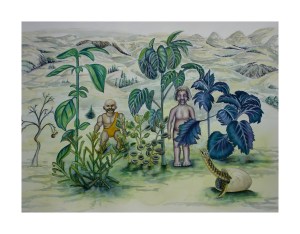
I guess Adam and Eve were inherently good, always obeying God until the serpent introduced them to the fruits of the Tree of Knowledge, the one thing forbidden by God who evidently wanted to keep Adam and Eve from knowing too much.

So, I suppose the moral of the story must be that the only way to be truly good is to be oblivious.

adam eve serpent3

Complacency

I find myself wallowing in contentment these days; consciously maintaining a positive outlook, simply putting the negatives out of my mind.

Breathe deeply:  inhale, exhale.

Avoiding confrontation means avoiding interaction to a large extent; companionship is reserved for one or two close friends.  I follow the news but refuse to dwell on tragedy.  Like Emil Cioran says: better not to act; action can only lead to regrets.

So, I stand here, day after day, feeling the soft summer breezes, inhaling the sweet scents of garden flowers, listening to the optimistic bird song.  What could be better?

I refuse to allow myself to be upset.  Why can’t little Annie sing on key?  What is LeonardD doing with that power saw?  What if those neighbor children want to play with me?  They’re so rough.

Never mind.

I’m afraid I’m becoming complacent.  Nothing excites me.  I think maybe there’s a difference between the calm of a centered discipline and my near lethargy.  Perhaps it would be good to step into an uncomfortable situation; force myself to face phenomena that will upset me; get my blood (such as it is) boiling.  Maybe Nietzsche’s right: ‘what doesn’t kill you makes you stronger.’

Well, I’ll think about it.  I’m a bit drowsy; the gentle patter of the water fountain is very relaxing.  I’m not sure that I really need a challenge anyway.

zarathustra 3

What emotions look like

I was thinking the other day how emotions sometimes creep up on a person, how they seem to come out of nowhere.  Suddenly one finds herself overwhelmingly attracted to someone, for instance, or some trivial incident leaves one extremely agitated for no apparent reason.

When one finds herself deeply in love it often comes as a revelation; one moment content in singularity and suddenly deeply connected to another.  Or, consider anxiety, how it can wheedle itself into your consciousness.  It lies in wait, bides it’s time until finding you at your most vulnerable, teases you with what in normal circumstances would be ridiculously mundane but now is horribly threatening.

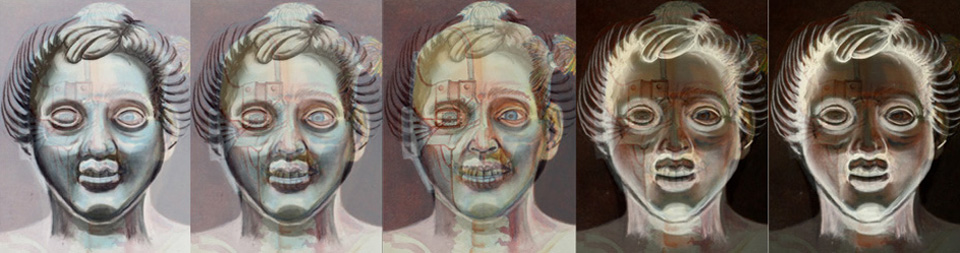
It makes me think the ancients weren’t just being poetic when they personified emotions and that makes me wonder what these personified emotions might look like. Emotions, of course, aren’t simple; take love: it isn’t only erotic but can be love of beauty and wisdom or altruistic care for others. Does that make Love a multiple personality?  Maybe there are a whole team of Loves that travel around together. I think Erotic Love might look like Eve in the Garden; the original innocent lover and first mother. Anxiety I can see as a clown. He hides his true nature, presenting himself as something he’s not; a malevolent entity harboring one’s deepest fears.

But then, as I think about it, perhaps it’s the other way around.  Eve is the temptress, the cause of man’s downfall, the conspire r with evil; the clown is the innocent, timid, lover, his unrealized passion revealed in his attempts to please.

I guess it’s up to the individual to paint the picture with the colors she finds most appropriate.  I’m inclined toward the evil clown but I must admit it may be because I can’t get Pennywise the dancing clown from Stephen King’s ‘It’ out of my head.

lossofinnocense3

A Life of Contemplation

Lately, I’ve been thinking what it’d be like to go off someplace where I could live more simply; someplace away from the distractions of the ever-depressing news of the day and the energy sapping ego conflicts of the workplace.

I could spend my days contemplating the inherent nature of existence; I could immerse myself in the eternal flow of life.  I would find my center and be at one with all things.  You know, like St. Anthony (the ascetic) did.

For nearly forty years Anthony lived a hermetic existence in the desert existing on the rare crust of bread offered him by passing pilgrims.  He rid himself of all desires of the flesh in the belief that through asceticism ultimate truth would be revealed to him.

There was one night, though, when hedonistic desires descended upon him like a torrential downpour.  He wanted, wanted, wanted: good food, good drink and women of any sort.  All night he suffered.  He fought back with every ounce of his energy.  When morning finally came Anthony was spent from the night’s exertions but was also strengthened in the knowledge he could overcome temptation.  His resignation was renewed, but with it, the fear of even greater tests to come.

I’m really not too worried about this happening to me.  Food and drink aren’t important to a doll and I’m really not that into primal urges.The Temptation of St. Anthony 3

Beauty or Beast?

Have you ever thought about how much physical appearance determines the person one becomes?  I mean, would the Barbies be so shallow and smiley all the time if they didn’t have such symmetrical, svelte features?  Would Woody Allen have developed a nervous, quick, humorous repartee or Christopher Reeves have been the strong silent type?

Even among children the larger toddler seems to command greater respect from her peers.  Given normal intelligence such a child is likely to fall right into the role of leader of the pack.

I guess my diminutive size and unexceptional appearance has led me to a life of solitary introspection and contemplation.  I’m not complaining.  It’s pretty clear to me one can be too exceptional; take King Kong.  All he wanted to do was spend some time with Fay Wray but because of his size everyone was afraid of him and wouldn’t leave him alone.

I’ll be content to just be who I am.

with horror movie extras3

Illusions of Well-being

According to the Romanian philosopher Emil Cioran a person would be better off not to have been born.  He determined suffering is the rule in life and there is absolutely nothing anyone can do about it.  All actions, he says, are or will be cause for regret.

The notion of well-being for Emil is an illusion that many people will harbor off and on during their lives but will in the end be unable to sustain.  Apparently Emil thinks it would be better to be, now, where he was before he was born-which is where he must be since he died some years ago.

Not having been born myself, rather, molded in plastic, I’m not sure how to think about Emil’s assertion.  I suppose he does have a point.  As far as I’m concerned my sense of well-being is dependent on the consideration of others, you know, to not step on me, keep me away from aggressive dogs (the ones that like to chew things up), and such.  And, how reliable can I expect that consideration to be; I guess there’s a faith aspect to any sense of well-being I might have.

As far as being better off being where I was before I was molded-in that vat of molten plastic-I suppose there is a sense of Oneness in that.

ouro boros3

Life imitates art?

A friend and I were discussing the relationship between art and life the other day.  He told me he thought much of life can be described in terms of the movie, Monty Python and the Holy Grail.  He explained the movie addresses how we create our own truths and manipulate events to suit our needs; how we harbor an inherent dislike of the other and make outrageous meaningless demands in order to demonstrate power over others, and how all this is part of our misplaced desire to achieve a heroic legacy.

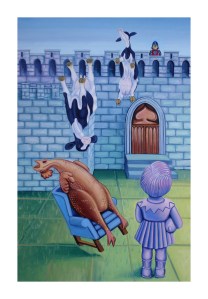
Then he described some of the scenes that he thought supported his idea.  I liked the one when the knights are taunted by the French who catapult farm animals at them.  I found the scene where Arthur and his men are stopped by these strange knights who won’t let them pass through their lands until Arthur brings them a shrubbery pretty funny too.

I guess it all kind of made sense the way my friend told it and probably there’s some truth in his analogy, but after seeing the movie I think a better observation is that although we may do silly things sometimes and take ourselves too seriously once in a while there’s nothing more important in this world than a playful creative imagination.

catapultedanimals3