A Pragmatist is someone who sees true reality and works with it, within the limitations of what is at hand. An Idealist sees the reality of what is, finds it lacking and seeks to change things for the better. In either case, these are all people of action, seeking positive outcomes, though the results they seek may differ, one being of a personal nature the other altruistic.
There are, however, those pragmatists who choose a life path of least resistance as they seek the easiest means of finding a comfortable existence, which might mean overstepping legal and moral imperatives, taking advantage of an open society. And there are those idealists, who, finding society resistant to change, are unable to reach their goals, give up, living out their lives amorally on the social fringes.
Human nature determines the path taken, but success and well-being will require a moral commitment.
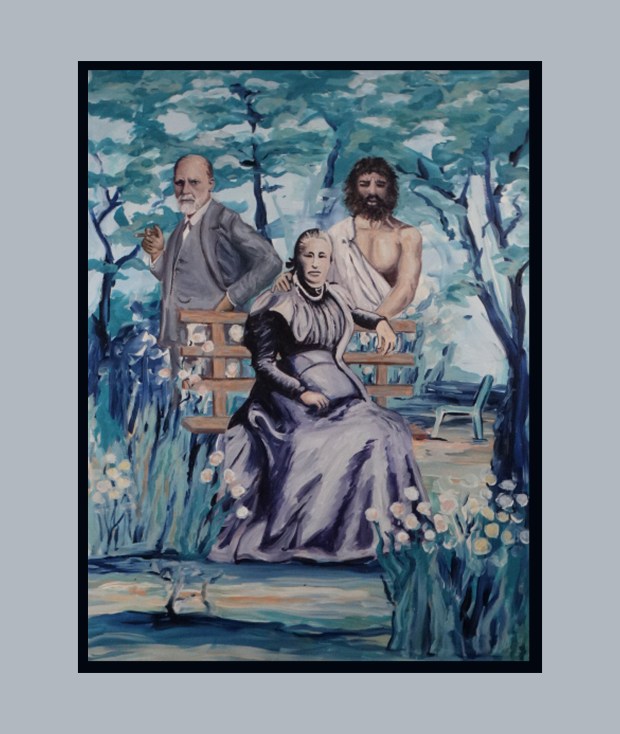
In the late 19th century, Sigmund Freud developed his theories on the nature of the human psyche. The primary motivation for most everyone’s behavior, he determined, was the sex drive. Beginning in early childhood, oral and anal fixations, then phallic and genital fascination defined the libido, the personality and life-force through the id, ego and superego: the realization of desire than tempered with age.
Problems of social adjustment were often caused, he surmised, by suppression of one’s natural sex drive, so, through psychoanalysis, he believed he could cure his troubled patients by making them aware of their latent sexuality.
Certain personality disorders Sigmund traced back to a childhood infatuation with his mother from whom the patient’s sexual inhibitions originated, an illness he labeled an Oedipal Complex after the tragic Greek figure Oedipus who fell in love with his mother and killed his father.
Anecdotally, it turns out Sigmund was his mother’s favorite and while he did produce progeny, it appears his sexual activity was short-lived.
The increasing use of chatbots these days has me wondering if my modest blog might be thought of as AI produced. Careful as I am-using spell-check and avoiding redundancies, not delving into contexts I know nothing about-it seems my short musings ought to be seen as human produce.
To underscore the obvious, the absence of intricate nuance must make it clear, dear reader, this writer is receiving no help from artificial sources. But, maybe, to be certain no doubt exists as to the origin of my modest posts, a convoluted sentence or two ought to verify these texts human touch.
VI’ve been reading about the concerns educators are having regarding technology in the classroom. While the distraction of smart phones can be reasonably curtailed, a more insidious issue is the use of AI to manage homework. Chat GPT, for instance, can produce assigned essays without the need for students to hardly think about the topic. In a test study, students who used the AI app were unable to answer questions about what exactly the produced document said.
Apparently, the problem isn’t restricted to the classroom. The business world, too, is in danger of AI relieving businessmen and women of having to think. Executives may use Chat GPT to produce reasoned argument/policies acceptable in the moment but potentially damaging to corporate goals.
So, it appears, using AI bypasses the need for contextual understanding opening the door to belief in conspiracy theory and the acceptance of disinformation for the multitude of users who find in it justification for their chosen narrative.
It would appear that artificial intelligence may be turning us into a stupidogenic society.
I’ve been thinking lately about some of the public individuals who have been fading from view, have virtually disappeared from the cultural narrative in recent months (or years). Some of these folks have found themselves in disfavor for a variety of reasons: perceived racial bias, sexual improprieties, sometimes simply political incorrectness or holding views found to be inappropriate by the more sensitive of our cultural judges.
I can think of a particularly clever and insightful comedian, a creative radio personality, a talented dramatic actor and several pols who suffer the sins of behaving badly in a moral or ethical sense. There appears to be a particularly virulent group of vigilantes sifting through the pasts of those deemed suspicious seeking condemning information. I suppose condemnation may be in order in some particularly egregious cases even though the perpetrator may have contributed to the public good most of his/her life.
It all makes me think back, wonder if there’s anything there, in my past, that might be brought up, maybe by a disgruntled neighbor or former friend, that I might find embarrassing were it to be revealed.
There’s something about the word ‘love’ that makes me cringe. Not the word so much as the idea, how it’s used and what it’s intended to mean. It seems, these days, to be overused and without thoughtfulness.
Well, there are different ways to think about it. Erotic love begins with mutual adoration, the two sensing the one of union. Things can turn; conceivably one lover might enter the thralls of so deep a passion, an emotional realm so overwhelming, rational thought will cease, cause unexplainable fluctuations of feeling that may even lead to deep hatred.
When applied to familial affection, extreme emotional fluctuation would appear to be the rule. Children and parents fighting, at each other tooth and nail one instance then enjoying a pleasant togetherness in front of the TV set the next.
Then, there’s the idea of agape; love of God and mankind. It seems to me likely anyone attempting such love will inevitably fall short which, I guess, will reinforce the sinfulness they know they can never escape, which on the positive side will eliminate the sin of pride.
Better, I think, to leave the term alone, not use it, and keep one’s emotions under control.
I’ve been reading, lately, about the primary concepts of stoicism. Among them is premeditatio malorum, which means, I guess, to ponder potential ills in order to keep in mind that bad things may occur at any time to prepare one for the eventual worst-case scenarios that life may impose. The idea seems to be that by living under a slightly dark cloud, one isn’t surprised and overwhelmed when bad things occur.
The concept seems counter-intuitive to the naïve paean to eternal optimism: “things could always be worse” which most of us intone pretty much all the time, even through the pain of the oppressive pandemic. The notion reminds me of Voltaire’s satirical ‘Candide’ where the eternal optimist Pangloss maintains we live in the “best of all possible worlds” even as one terrible event after another fall upon our hero.
But, there are other important stoic concepts to keep in mind, like starting each day with a morning meditation, ending each day in reflection, practicing moderation in all things, speaking less and thinking more among them. All of which suggests stoic practice has many benefits even if eternal optimism isn’t among them.
Sigmund Freud determined all human motivations contain a sexual component. The oral, then anal fixations of children and later phallic interests, beginning at a very early age, were focused on satisfying bodily needs. Many psychological problems, neuroses, occur because sexual impulses are repressed. Through psychoanalysis S.F. guided his repressed patients to realize the healthy need for normal active sexual behavior.
Freud, though, cautioned that excessive sexual activity interferes with the development of healthy social relationships, that strong friendships and sound decision making, adulthood essentially, depends on tempering sexual behaviors.
This could explain, I guess, while some of our politicians behave like adolescents.
In the winter of his eighteenth year this young man fell madly in love (well, it was a serious crush anyway). The object of his unrequited affection was a demure sweet young lady who turned the young man, usually easygoing and affable, into a tongue-tied moron (or so he thought and was in fact true).
The episode was simply reflective of the young man’s nature. He conjured imaginings of romantic scenarios; of heroic stances he might take. He lived in a world of fictional narratives reinforced by the heroic storylines he regularly indulged: good triumphs, tragedy is overcome.
It would seem in retrospect such an imaginative reality would soon be repressed but it was maintained far longer than it might have been by avoiding unpleasant confrontation, keeping a distance from uncertain challenges and living in an (overly) protective home environment. As a college student our young dreamer immersed himself in studies of an impersonal nature, solitary endeavors not requiring excessive personal connections. He had friends of course. College life teems with unassuming young people of an accepting nature, all thriving in an essentially responsibility free environment.
Eventually, over time, even an impractical dreamer will have to face harsh realities. The awakening for our young man came with the threat posed by the draft lottery and the likelihood of involuntary military service. Basic training was eye opening. The young man found himself verbally assaulted. Name calling the likes of which he had never previously encountered (but guessed often referred to perverse sexual acts) was common.
Military service didn’t cure the young man, didn’t redirect him toward a more functional pragmatism. Even now as he passes middle age the man finds himself entertaining flights of fancy. He has somehow been able to navigate through life being sufficiently useful as not to be a particular burden on society, you know, has basically paid his own way.
It’s good to know, I guess, that sometimes life provides a path for those who need to live in an alternative reality.
I’ve been thinking lately about the multitudes of good and sincere people in the world who have arrived at dramatically conflicting views as to the nature of reality.
Most all of us rely on what we consider to be unimpeachable support sources for our views and usually a contingent of like-minded others that reinforce our beliefs. The evangelical Christian, the Qanon conspiracy buff and the liberal mainstreamer will tend to approach daily occurrences with sets of premises and then conclusions that are quite different. Such conflicting perspectives are the stuff of the social divisiveness manifesting itself these days; the dilemma of free thought in a free society free from coercive oversight, I guess.
I have no answers other than responding with patient tolerance in the knowledge that most everyone deserves respectful acknowledgement of their usually carefully considered views. The hope is that we can all spot disinformation when it presents itself. Hopefully, we can think past the response of the recently interviewed lady asked why she embraces her position on a current controversial idea. ‘I know it’s not true’, she said, ‘but it’s consistent with my beliefs.’







 deideismusings