Religion as Art

I was reading a while ago about the Ban-Yatra, a Hindu pilgrimage which is performed in the Braj region of northern India.  Unlike many pilgrimages the ban-Yatra isn’t focused on reaching a sacred locale or the place of Holy Relics but rather is about uncovering the sacred in the profane as the pilgrimage progresses.

Braj is believed to be the birthplace and playground of Krishna.  Many of the stories of Hindu literature mention places and land forms here as sites where Krishna performed his miracles, cavorted with his cowherd friends and engaged in love-play with the Gopi’s and his beloved Radha. The pilgrimage involves circumambulating Braj, visiting shrines and temples and partaking in various rituals.

Unlike some eastern religious philosophies the worship of Krishna isn’t about renunciation of this world-denial of desire, but quite the opposite: realizing desire in the beauty of nature and celebrating the love of Krishna as being non-different from it. In order to do this the pilgrim cultivates bhava, an emotional and imaginative energy that allows him or her to see beyond the mere commonplace and experience the presence of Krishna in the natural surroundings.

One scholar suggests that in achieving bhava the pilgrim becomes like a poet creating meaning in the landscape as he or she passes through it.

Wow!  What a great observation. The artist certainly creates alternative worlds through imaginative emotive means; a significant parallel to the creative religious practice of the Ban-Yatra pilgrim. Maybe the difference between the two lies in just how literally one believes in the existence of this other world and its inhabitants. The artist, I suspect, is less likely than the pilgrim to embrace his/her imaginings as factually existent.

It seems to me religious practice in general could profit from a bit more creative play and a bit less dogmatic belief.

Krishna and the Walking Dead3

The Joys of Doubt

I had a visit from Pastor Ted recently.  We have quite a congenial relationship so long as we avoid speaking of religion or politics, which is why my ire was elevated a bit when he mentioned he read in one of my posts, that I referred to myself as a skeptical seeker.  That must mean, he surmised, that I was open and susceptible to salvation; a viable candidate for recruitment to his army of the saved.

I truly hate to be drawn into a discussion of this sort since it’s become clear that neither of us has any idea what the other understands to be true in the realm of the spiritual.  I tried to explain once again that for me doubt is the most uplifting of intellectual positions I can imagine; that doubt is the only philosophical option that allows complete freedom of investigation; that doubt is a most joyous state.

Alas, I fear Pastor Ted is so convinced his beliefs are the absolute truth and that anyone who is willing can commit to his beliefs, that he is unable to accept any alternative.

Pastor Ted is an honestly good person and a good friend but I guess, as Dorothy Parker so aptly put it, you can’t teach an old dogma new tricks.

covering the bases 3

Sacred Images

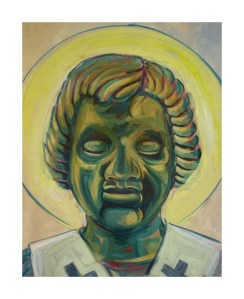
While reading about Byzantine Icons the other day I was amazed to learn that the painter, before he is able to paint one of these Holy Images, has to transcend earthly existence and enter the heavenly realm.  Apparently such a trip will instill the painter with the knowledge necessary to render a truly sacred image.

The resulting object is, only then, understood to be a Holy Relic and a living icon.  The holy personage thus rendered is seen as emanating the light of truth.  As I viewed some of these objects many did seem to have an inner glow.

Well, I had a friend do a painting of me in the style of the icon painters.  I don’t think his work was preceded by any voyage to the Great Beyond so I suppose the resulting icon is disqualified from the realm of ‘living relic.’

As I look at the finished product I can’t quite tell if my image expresses benevolence or self-importance-maybe a bit of each.  I suppose that might very well be consistent with the attitudes of the early church patriarchs who achieved sainthood. The painting does seem to emanate a sort of inner glow.  That may be because my plastic body is a bit translucent.

I showed the painting to the Barbies and they agreed unanimously it did nothing for me whatsoever.

byzantine icon3

Goodness

In the novel Anna Karenina, Leo Tolstoy has the character Levin say: ‘If goodness has a cause it is no longer goodness; if it has consequences, or rewards it is not goodness either.’  Since Leo based the character Levin on himself he must have thought there was truth to such an idea.

If  I accept Levin’s statement as true then following the Golden Rule is not an example of practicing goodness because then I’m being good in the hopes other people will be good to me.

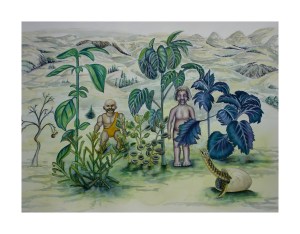
I guess Adam and Eve were inherently good, always obeying God until the serpent introduced them to the fruits of the Tree of Knowledge, the one thing forbidden by God who evidently wanted to keep Adam and Eve from knowing too much.

So, I suppose the moral of the story must be that the only way to be truly good is to be oblivious.

adam eve serpent3

Complacency

I find myself wallowing in contentment these days; consciously maintaining a positive outlook, simply putting the negatives out of my mind.

Breathe deeply:  inhale, exhale.

Avoiding confrontation means avoiding interaction to a large extent; companionship is reserved for one or two close friends.  I follow the news but refuse to dwell on tragedy.  Like Emil Cioran says: better not to act; action can only lead to regrets.

So, I stand here, day after day, feeling the soft summer breezes, inhaling the sweet scents of garden flowers, listening to the optimistic bird song.  What could be better?

I refuse to allow myself to be upset.  Why can’t little Annie sing on key?  What is LeonardD doing with that power saw?  What if those neighbor children want to play with me?  They’re so rough.

Never mind.

I’m afraid I’m becoming complacent.  Nothing excites me.  I think maybe there’s a difference between the calm of a centered discipline and my near lethargy.  Perhaps it would be good to step into an uncomfortable situation; force myself to face phenomena that will upset me; get my blood (such as it is) boiling.  Maybe Nietzsche’s right: ‘what doesn’t kill you makes you stronger.’

Well, I’ll think about it.  I’m a bit drowsy; the gentle patter of the water fountain is very relaxing.  I’m not sure that I really need a challenge anyway.

zarathustra 3

What emotions look like

I was thinking the other day how emotions sometimes creep up on a person, how they seem to come out of nowhere.  Suddenly one finds herself overwhelmingly attracted to someone, for instance, or some trivial incident leaves one extremely agitated for no apparent reason.

When one finds herself deeply in love it often comes as a revelation; one moment content in singularity and suddenly deeply connected to another.  Or, consider anxiety, how it can wheedle itself into your consciousness.  It lies in wait, bides it’s time until finding you at your most vulnerable, teases you with what in normal circumstances would be ridiculously mundane but now is horribly threatening.

It makes me think the ancients weren’t just being poetic when they personified emotions and that makes me wonder what these personified emotions might look like. Emotions, of course, aren’t simple; take love: it isn’t only erotic but can be love of beauty and wisdom or altruistic care for others. Does that make Love a multiple personality?  Maybe there are a whole team of Loves that travel around together. I think Erotic Love might look like Eve in the Garden; the original innocent lover and first mother. Anxiety I can see as a clown. He hides his true nature, presenting himself as something he’s not; a malevolent entity harboring one’s deepest fears.

But then, as I think about it, perhaps it’s the other way around.  Eve is the temptress, the cause of man’s downfall, the conspire r with evil; the clown is the innocent, timid, lover, his unrealized passion revealed in his attempts to please.

I guess it’s up to the individual to paint the picture with the colors she finds most appropriate.  I’m inclined toward the evil clown but I must admit it may be because I can’t get Pennywise the dancing clown from Stephen King’s ‘It’ out of my head.

lossofinnocense3

Illusions of Well-being

According to the Romanian philosopher Emil Cioran a person would be better off not to have been born.  He determined suffering is the rule in life and there is absolutely nothing anyone can do about it.  All actions, he says, are or will be cause for regret.

The notion of well-being for Emil is an illusion that many people will harbor off and on during their lives but will in the end be unable to sustain.  Apparently Emil thinks it would be better to be, now, where he was before he was born-which is where he must be since he died some years ago.

Not having been born myself, rather, molded in plastic, I’m not sure how to think about Emil’s assertion.  I suppose he does have a point.  As far as I’m concerned my sense of well-being is dependent on the consideration of others, you know, to not step on me, keep me away from aggressive dogs (the ones that like to chew things up), and such.  And, how reliable can I expect that consideration to be; I guess there’s a faith aspect to any sense of well-being I might have.

As far as being better off being where I was before I was molded-in that vat of molten plastic-I suppose there is a sense of Oneness in that.

ouro boros3

Life imitates art?

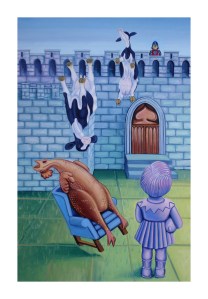
A friend and I were discussing the relationship between art and life the other day.  He told me he thought much of life can be described in terms of the movie, Monty Python and the Holy Grail.  He explained the movie addresses how we create our own truths and manipulate events to suit our needs; how we harbor an inherent dislike of the other and make outrageous meaningless demands in order to demonstrate power over others, and how all this is part of our misplaced desire to achieve a heroic legacy.

Then he described some of the scenes that he thought supported his idea.  I liked the one when the knights are taunted by the French who catapult farm animals at them.  I found the scene where Arthur and his men are stopped by these strange knights who won’t let them pass through their lands until Arthur brings them a shrubbery pretty funny too.

I guess it all kind of made sense the way my friend told it and probably there’s some truth in his analogy, but after seeing the movie I think a better observation is that although we may do silly things sometimes and take ourselves too seriously once in a while there’s nothing more important in this world than a playful creative imagination.

catapultedanimals3

Meaning of Life

Sometimes I wonder about the meaning of life; is there purpose in my existence.  Buddha says life is suffering; relinquish your desires to find the way to enlightenment.  The Dao says be frugal in thought and action and you will come early to the way which will allow you to immerse yourself in the flow and stay centered.

Maybe purpose has nothing to do with it.  Maybe I just need to live my life moment by moment, in the flow, on the path to enlightenment.  You know, wake up, smell the coffee.

I think there may be some self-discipline involved here.

Achieving Enlightenment 3

Born Again

For me, I don’t think there’s anything as energizing as the onset of spring.  As the temperature becomes mild, the birds began to sing and the crocuses began to appear I feel my spirits lift.  There’s a sense of rebirth in the air; life reappears after months of dormancy.  In some ways it’s like a religious experience.

My friend Pearl said this idea reminded her of an experience she had while attending a revival meeting a while ago.  She said the evangelist told the congregation that life was suffering because of the guilt of their sins and the only way to overcome the depths of despair, the fear and trembling of existence was to leap into faith and be born again.

Pearl thought about this awhile but being a bit of a skeptic and seeing rebirth wasn’t in her plans for the evening, she decided to pass on the leap and just deal with the despair and absurdity of human existence the best she could.

Well, all I can say is if our existence is essentially despairing and absurd then why do I have spring fever?

born-again-3.jpg