Playing Nice with Others

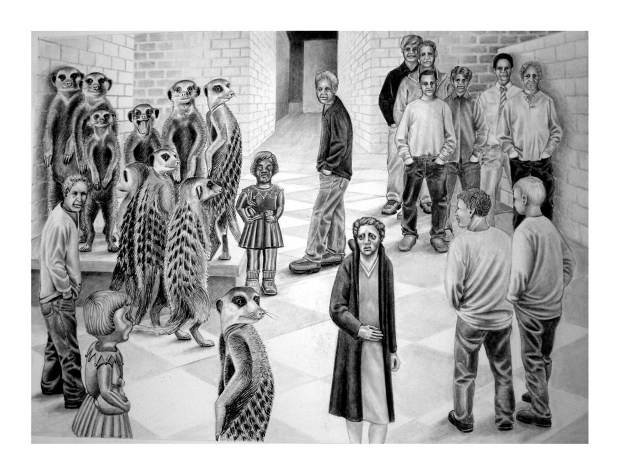
I’ve become aware, lately, that my verbal offerings, comments and responses, while visiting with others in small gatherings of family and friends, elicit responses I had no intention of eliciting; it appears that what I say is often interpreted in vastly different ways than intended. And this, even though I’m careful these days to withhold or at least moderate strong personal opinions.

When I was younger, I held small regard for countering someone’s opinion, relished, in fact, the opposition. But I don’t feel that way anymore. I hold back these days. But now It would appear that sometimes concessions are expected, admission of guilt, a desire for me to reveal my inadequacies, personal weaknesses: concessions I’m not willing to give. The whole idea of such a scenario I find extremely winceable, beyond my capacity to the point of exasperation.

If one is to maintain a sense of pride in achievement, a sense of worth, restraint must be exercised, emotions withheld; an acceptance of the potential volatility of personal relationships, a willingness to let go.
It all becomes exitential in the end, I guess.

With Lego People

The Theory of Everything

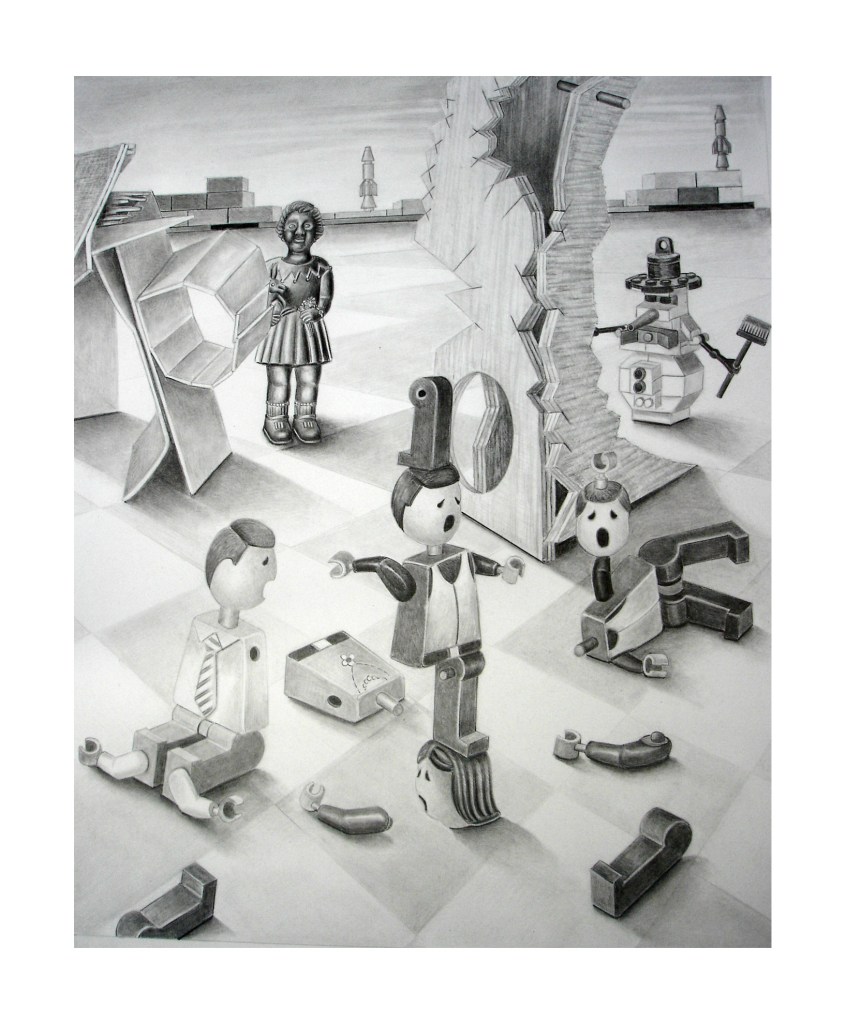
I guess no one really understands who or what we are. Researchers continue to find new infinitesimal entities, described as particles and/or waves that are the sub-atomic components of our material makeup. Well, ‘find’ is maybe the wrong word since these entities can’t be seen but only sensed by their movements. These entities existing within the primary forces of nature, electro-magnetism, weak/strong forces and gravity are the elusive quarks, bosons and leptons that complicate physical understanding. Physicists continue to seek mathematical structures that explain how everything fits together, to find a ‘grand unification theory’ but as new entities of enigmatic forms and behaviors are found the developing picture blurs.

Some prescient thinkers of the past warned of the travails of seeking a final answer, notably the philosopher E. Kant, in the 18th century no less, warned of pursuing that which is not adapted to our powers of cognition.

It would appear there are things we just can’t know.

Human Nature

I’ve been reading that in France in the mid-20th century various fringe groups instigated massive protests against the government, building barricades across streets in Paris and causing as much mayhem as they could muster, which was considerable, energy being particularly high when an injustice is believed to have been committed against the people.

Although the demands of the anarchists weren’t well articulated it appears the rub essentially was about class struggles; a class-less communism seeming to be the desired end; freedom to be equals through re-distribution of resources. The result of all the chaos turned out to be a ruthless police crack-down and excessive prison sentences where abominable conditions led many inmates to suicide, which led to more protests and civil unrest.

It all seems too familiar: the tendency to perpetrate violence. Even all-out anarchy appears hidden beneath mankind’s benign exterior. Human nature seeks opposition; someone or something to cast as enemy, the cause of their difficulties, emotions rise, factions unite, shouting occurs, and all Hell breaks loose: another revolution of sorts happens.

The human psyche being what it is I sometimes wonder how periods of peace happen at all.

Freeing the Mind

As my thoughts drift through the gray mists of partially realized ideas my mind is invaded by abstract anxieties, remorsefulness for past inadequacies, inferior efforts. But such thoughts dissipate, evaporate, then segue into an ethereal cloud mind wandering through multitudes of what might have been, should maybe be, may yet occur. Thoughts free without direction, small intention, wandering mind. Perhaps a good idea will occur.

Ugly Truths

I’ve been reading, lately, a treatise by a moral psychologist who claims pretty much everyone lies, cheats and steals. Apparently most all of us have such a deeply-held, innate self-interest that, given the opportunity, dishonesty is inevitable.

Excuses made to avoid an unwanted invitation are likely to be lies. We do this, I guess, because we all want to be well-thought of and it’s pretty clear unremitting truth will make anyone pretty unpopular. And when it comes to cheating, laws are set up such that everyone who drives a car will inevitably cheat in some way, at least in terms of speed limits. As far as theft goes, ‘borrowing’ items from one’s workplace, even if justified as improving one’s work efficiency is never the less stealing.

So, as I think about it I guess I have to admit I fit the profile. I can claim, I suppose, I do no grievous harm to any individual. I do have to admit, though, I’m a liar, cheat and thief. The worst of it is I still think I’m a pretty good person.

Surviving the Wilds

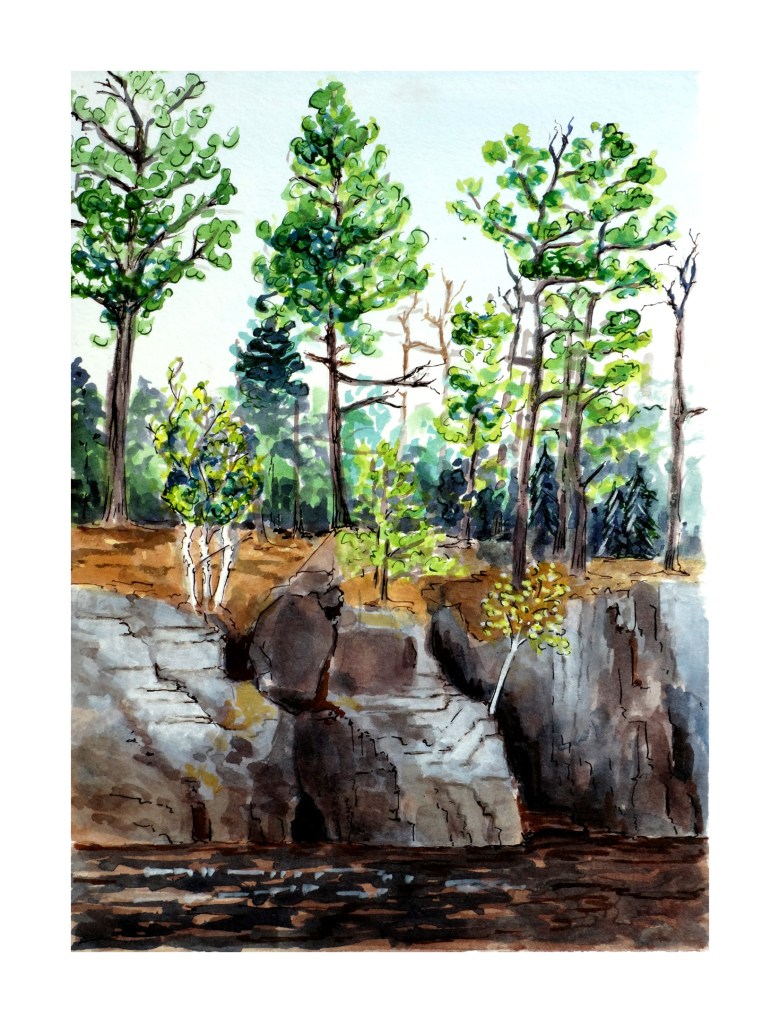
In the midst of a camping trip when conditions become somewhat adverse, one’s mettle is tested. What to do: pack up and go home or remember the pioneers and early explorers who underwent extreme hardships, hostile natives, an unbalanced diet; men (and women) who we remember for their heroism and important accomplishments opening, as they did, the continent for settlement.

I think these things as I sit in the comfort of my pop-up camper listening to the soft purr of the generator suppling power to my various electronic devices.

The mosquitos and rain are pretty daunting, though.

landscape 1

Conspiracy Theory

I’ve been reading lately about humankind’s inclination to embrace conspiracy theory. When on finds oneself facing what appears to be insurmountable problems it is not uncommon to imagine the existence of a conspiratorial force interfering with and blocking one from resolving problems.

Usually, such ideas of conspiracy are short lived, disappear when difficulties subside, but, in extreme cases, when living in incomprehensible uncertainty, the human imagination may take hold, enhance the powers of malevolent entities, and allow imagined evils to grow, create false realities and extend beyond individual problems to suppose secretive governmental power structures and even cast doubt on the understood nature of the physical universe.

Proponents of conspiracy theories exploit the psychological power of belief and reinforce power over disciples by cherry-picking misleading Biblical texts or in some cases creating ‘sacred texts’ of their own. The truly committed may establish schools to insure their children are believers as well.

I worry the beliefs the flat earthers, election deniers and government conspiracy nuts impose on their children will produce skewed realities, individuals unable to grasp and address the existential issues becoming more real every day.

Realizing the Ungraspable

I find myself visited lately by an idea, a figment of imagination that, during times of contemplation come and go, hint at an ellusive potential for understanding; thoughts of solutions and resolutions appear, slip and fade replaced by new enigmas always wavering on the edge of consciousness remembered clearly then lost, evaporating, caroming into then out of view; ideas within sight for an instant but ungraspable, mind fluctuating from one ill-defined thought to another, the intangeable true reality beyond reach. Something of value may be there twisting into then out of focus. How long must I wait for the idea to appear.

Existential Truth

I think it was the philosopher Arthur Schopenhauer who determined that a satisfied desire may be followed by a brief period of peace but that the momentary peace will soon be replaced by a new want; the moment of satisfaction will be lost. Suffering unrealized desire whether selfish or altruistic will be the state in which everyone lives. Which means, I guess, that anxieties will be constant companions throughout our lives.

Humankind, though, has imagination. In order to stay reasonably upbeat and optimistic we conjure favorable scenarios: a benevolent nature, a loving partner, supportive forever friends, lasting economic security. But, of course, things don’t always go as one might desire; scapegoats are needed to save us from our inadequacies.

Sanity requires maintaining faith in our beliefs.

Short Term Memory Loss

My short-term memory isn’t what it once was. I find myself, while visiting with a new acquaintance, forgetting her name before the conversation is over and twenty minutes after dinner is over, I’ve forgotten what I just ate and how many times while retrieving a needed item I’ve forgotten what I was retrieving. I guess I find these small memory slips more amusing than concerning but the realization the issue is a symptom of age and is degenerative is undeniable.

The upside, though, of short-term memory loss is I’m less inclined to hang onto negative occurrences. Experiencing the moment in terms of past memories leaves time for contemplation. It’s good, I think, to feel a sense of peace in aging.