Dr. Freud and the Superego

Dr. Freud said if you have a strong superego it will help you subdue those baser instincts and depraved inclinations (which he called the id) and keep you on the straight and narrow.

I guess my superego must be pretty good because I’ve pretty much avoided participating in any of the seven deadly sins very much.  As I think about it, I’m pretty modest, my desires are nearly non-existent, I don’t eat very much, am generally pretty good natured and I really try to keep my room clean.

So I guess maybe I might be thought of, in all modesty, as a good role model for the younger dolls, you know, someone to look up to.  They might even find me admirable even saintly, after I’m gone; someone they can place on a pedestal as the paradigm of virtue.  And then maybe they’ll build a temple for me where I can be forever held in the highest esteem-even worshiped.  Maybe the Church will canonize me and actually make me a saint.

Boy, what a thought!  I wonder what Dr. Freud would say.  I hope he wouldn’t think I’m suffering delusions of grandeur.

temple of babydeidei

Medieval Vision

Have you ever had a supernatural experience?

It could have been something you dreamed was going to occur that, later, seemed to really happen.  Or maybe you saw something that you were pretty sure couldn’t really exist in the world as we know it.  Or, as you sat contemplating things a message from beyond seemed to pop up out of nowhere, maybe from an incorporeal being.

Apparently this sort of thing happened to people living in medieval times pretty regularly; the difference for them was they had a more fluid idea of what constituted the real world then we do today.

I was reading the journal of three 12th century monks who set out to find the ‘terrestrial paradise.’  As they traveled to the east they encountered little people ‘no more than two feet high’ and went through a mountain region where there were basilisks, unicorns and dragons.  They passed through a region of constant darkness where ‘mournful shrieking came from sinners drowning in a sea of serpents’ and ‘a giant chained between two boulders’ was being tortured with fire…..  Well, the account goes on and on, one extraordinary event after another.

In my rationalistic way of thinking it all seems very imaginative.  They simply were encountering things they had never seen before and were interpreting them in terms of the magical world in which they lived.

I don’t know if I should be happy in my understanding of the natural world or sad in my inability to realize a truly magical kingdom.

medieval vision3

Discord in the Playroom

Not too long ago three new dolls joined our playroom family. Muscleman and Bobble-head St. Patrick were the first to settle in and it didn’t take long before Muscleman began imposing his will, bullying the other dolls.  He was constantly jostling Bobble-head St. Patrick and causing the rest of us grief.

But then Athena showed up.

Scale can be very disparate among dolls and Athena has a considerable size advantage over most all the rest of us.  That fact plus Athena Parthenos’ warrior mentality quickly changed the playroom dynamic.

Muscleman, as you can imagine, has a very large ego and he initially refused to recognize that his days of domination were over.  Athena had to whack him down a couple of times before he got the message.  Even then he continued to yell and boss dolls around but eventually things settled down and Athena no longer needed to wield her physical size and strength to maintain the peace.

The playroom has always been, up until Muscleman showed up, pretty egalitarian.  Most everyone tolerates others’ idiosyncrasies without too much complaint.  But, the turmoil did get me thinking about how tenuous group dynamics can be-how opinions can form and change and political pressures can develop-what can happen when a strong personality feels compelled to impose its will.

Bobble-head St. Patrick is really quite a pleasant doll but he does have the reputation of being quite strong willed.  What if he suddenly got the notion to evangelize and got some (maybe a lot) of the other dolls to embrace his religious beliefs?  Would we all then be expected to follow the tenets of their beliefs?

And then there’s Mini-Max, who’s quite materialistic.  He’s been accumulating toys of his own for some time.  He’s already been hinting that he could use more shelf space.  What if he began bribing dolls-offering them favorite treats in order to acquire more room for his possessions?  Would the rest of us end up having to live in the closet?

Well, hopefully my imaginings are nothing more than just that.  But, it does make me think a just and fair judicial system is nothing to sneeze at.

discord in the playroom3

Dreams

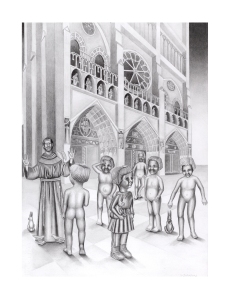
I had a dream the other night in which I became human; or rather I multiplied into five human children plus my normal plastic self.  We were all standing in front of Notre Dame Cathedral.  St. Francis was there.  The human DeiDeis seemed sort of mesmerized-focused intently on their surroundings as if they were anticipating an imminent occurrence or contemplating some sort of action.

When I awoke the next morning I couldn’t stop thinking about the incongruities in the dream.  I wondered what Dr. Freud would say but then I figured it would probably have something to do with sex and considering the presence of St. Francis and young naked girls I thought it best to just leave that alone.

Then I remembered reading about Carl Jung’s idea that deeply embedded within our psyches are primordial forms or archetypes common and meaningful to all self-conscious beings.  Certain situations like the Hero’s quest or the fall from grace, dichotomies like good vs. evil and light vs. darkness, and character types like the evil figure, the scapegoat and the outcast are just a few of these common archetypes Carl believed we all share; and he thought that sometimes these forms crop up during sleep when our unconscious is in charge.

I had to wonder if there could be archetypal meanings in my dream.

Being generally pretty upbeat about things my first thought was the dream must be about rebirth or renewal.  In this sense the saint might be the archetypal magician or Christ figure who transforms me: the many mes representing naked innocence seeking and discovering goodness and truth.

But then as I thought about it further the pragmatic me took hold; my ambivalence regarding structured religion suggested a darker aspect; maybe the dream was about evil overcoming good.  The saint becomes the archetypal devil casting a spell and creating six of me (six being the archetypal number of evil) to carry out the vile edicts of a corrupt church.

Well, the investigation was all very fascinating and I do think Carl’s got something with his notion of collective subliminal meanings, but  I’m going to be pretty careful who I talk to about my dreams and their meanings.

dreams of freedom3

On the Life and Death of Satan

I was reading recently about how the idea of Satan came about.

In the early middle ages St. Augustine determined that, as a result of Adam’s original sin and seeing as how we’re all descendants of Adam, evil exists in everyone.  This meant that when bad things happened everyone had only themselves to blame since they all had a bit of badness in them.  People bought into this pretty well because finding a scapegoat when badness happened wasn’t difficult.

Then, after a while, people began to take exception to St. Augustine’s concept thinking they really weren’t all that bad; actually they felt pretty good about themselves.  So they got to thinking it wasn’t them but something or someone outside themselves that made them be bad.  They anthropomorphized badness into a somewhat ambiguous horned satyr that they saw as perpetrating evil just because he wasn’t a very nice creature.  He was an idea most everyone could fear and dislike.

Later, in modern times, now that people don’t so much believe in supernatural entities anymore, Satan has begun to fade away.  So now, when bad things happen some people have gone back to finding a scapegoat, others have looked to St. Augustine and blame our inherent sinfulness and still others have dismissed the concept of evil altogether and rationalize badness as being relative to peoples and times.

When I think about how I stand on this I guess I lean towards relativism, but it takes some pretty hefty rationalization to accommodate some of the atrocities one hears about these days.

taking up cooking3

Life Stories

Friends and I were sitting around the other day chatting over afternoon tea. Sister Chloe got into talking about the providential nature of her life: How God had seen fit to bless her with strong, supportive parents who had taught her right from wrong, follow the Golden Rule, do no harm and help others when possible and to follow the path that God had laid out for her.  She acknowledged God’s ways were sometimes mysterious and were not always easy to understand, like when her brother was left on the driveway behind the family car and subsequently ended up looking like Flat Stanley.  She questioned how God could let that happen but said she believes he must have had his reasons as he does for everything.

Well, Lala then proceeded to offer that she saw her life in quite different terms.  Fortune, she said, had been kind to her.  Following a particularly potent incantation her father had won the favors of a Toys-R-Us manager and ended up being featured in a toy exhibit which enabled him to secure a fine home for the family.  Even though the family had had their share of bad occurrences, mother having been purchased by a quite rowdy child and very likely ended up moldering in a damp basement her stuffing infested with centipedes and spiders,  cosmic justice had, for the most part, shined upon her and she hoped the stars would continue to do so.  She showed us an amulet she was wearing that came from her ancient ancestors.  She felt sure this would continue to protect her through the travails of life.

Then it was my turn.  I told them that my father was fond of telling us when difficulties arose that there was no reason to fear unpleasantness or worry about things because what would be would be and we had the freedom to make choices in our lives that would lead us, in all probability, provided they were wise choices, to a content and happy life.  I told them this advice had worked out pretty well, that I’ve always done well in school, able to overlook the prejudices of my human classmates and even the potentially devastating event of my aunt being lost in a family move (I think the dog carried her off and buried her somewhere) was met by us all with stoic acceptance.  I said that I was content in my ability to choose and felt comfortable letting each day unfold as it will.

Sister Chloe asked me how I can go about without faith in the existence of a benevolent overseer.  Lala asked Chloe how she could possibly believe her ‘Superman in the sky’ could care about the events in her life.  I asked how either of them could attribute future occurrences to the Supernatural.

As I poured our second cup of tea we all agreed it was time to change the subject.  We decided to talk about the weather.

life stories3

Karma


Hindu believers see existence as never ending; people are born into being, live their lives and die only to be reborn, hopefully into a better situation than they left.  Although, if they aren’t lucky or haven’t accumulated enough good karma they might end up as a lesser animal or even inanimate like a rock (or a doll).

The skeptic in me thinks they might very well have gotten this idea by watching plant and animal life cycle through the seasons year after year but who am I to question an age-old belief embraced by so many people.

So, when I look at some of the Hindu gods I have to wonder what kind of karma they accrued in their previous lives.  Take Ganesha: human body, elephant head and lots of arms.  The story goes he was born of Shiva and Parvati both of whom had lots of arms so that attribute may have been hereditary, but it certainly doesn’t explain the elephant head.

If we assume Ganesha accumulated, in previous lives, sufficient good karma to become a god then maybe an elephant head is superior to a human head; maybe Ganesha is further along the karmic path than anyone else.

I’m not sure how to think about my own karmic destiny.  Considering the present quality of my construction my previous life must not have been all that wonderful.  Maybe if I’m exceptional this life I’ll come back as …………….a Barbie?

An Audience with lord Ganesha 3

What I know about Soren Kierkegaard

Kierkegaard’s dilemma was that despite his love for Regine he believed himself to be incapable of becoming a good husband, so to spare her he breaks off the engagement, telling her he was never truly serious about their relationship in the first place.

He wrote a lot about anxiety.  He says when we become anxious we are overtaken with fear and trembling as if we were on the edge of a precipice and were afraid of falling.  Then he says we should jump; take the leap into faith, embrace God for whom all things are possible.

He also tells us that either we shelter ourselves in the illusory belief that the individuals, doctrines and institutions we rely on for self-fulfillment are sufficient (bad) or we dismiss our worldly distractions, realize our declining physical bodies and face the existential horrors of life (good).

Whew!

I think he thought about things too much.  He should have just gone out and had a good time once in a while.

soren kierkegaard3


Religion as Art

I was reading a while ago about the Ban-Yatra, a Hindu pilgrimage which is performed in the Braj region of northern India.  Unlike many pilgrimages the ban-Yatra isn’t focused on reaching a sacred locale or the place of Holy Relics but rather is about uncovering the sacred in the profane as the pilgrimage progresses.

Braj is believed to be the birthplace and playground of Krishna.  Many of the stories of Hindu literature mention places and land forms here as sites where Krishna performed his miracles, cavorted with his cowherd friends and engaged in love-play with the Gopi’s and his beloved Radha. The pilgrimage involves circumambulating Braj, visiting shrines and temples and partaking in various rituals.

Unlike some eastern religious philosophies the worship of Krishna isn’t about renunciation of this world-denial of desire, but quite the opposite: realizing desire in the beauty of nature and celebrating the love of Krishna as being non-different from it. In order to do this the pilgrim cultivates bhava, an emotional and imaginative energy that allows him or her to see beyond the mere commonplace and experience the presence of Krishna in the natural surroundings.

One scholar suggests that in achieving bhava the pilgrim becomes like a poet creating meaning in the landscape as he or she passes through it.

Wow!  What a great observation. The artist certainly creates alternative worlds through imaginative emotive means; a significant parallel to the creative religious practice of the Ban-Yatra pilgrim. Maybe the difference between the two lies in just how literally one believes in the existence of this other world and its inhabitants. The artist, I suspect, is less likely than the pilgrim to embrace his/her imaginings as factually existent.

It seems to me religious practice in general could profit from a bit more creative play and a bit less dogmatic belief.

Krishna and the Walking Dead3

Intelligent Design

LeonardD the artist doll just completed a series of artwork using only objects and materials he was able to find around the house.  He came by the other day to tell me about the work.  He said that he felt confident he could make art out of anything.  Well, I thought that was pretty interesting, so to challenge him I asked what art he could create if he were locked in a windowless room with nothing in it.  He said that he believed he could come up with something.

We talked about it awhile and decided that the artwork would need to be a tangible object that he could bring out with him when he left the room; we ruled out performance or conceptual art like John Cage’s 4’ 33” (a pianist sits at a piano in front of an audience for four minutes and thirty-three seconds without touching the keys) and the zen idea used by various artists in which blank white walls inspire a meditative immersion.

My friend said that to make something tangible from nothing sounded like something only God could do but decided to give it a try nonetheless.

I locked him in one of the empty rooms in my doll house.  He was in there quite some time.  When he emerged he held in his hand a small object of indescribable material that glowed as if lit from within.  The object clearly exhibited the creative intelligence I know my friend to have.

I was blown away.  LeonardD was uncharacteristically reticent about what occurred in the room, where the material came from and how he produced what he did.  After he left and I thought about it for a while there was only one conclusion I could draw: my friend is God.

intelligent design 3