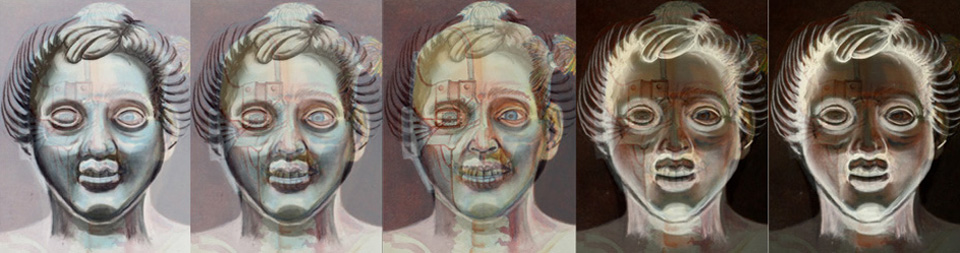
Faith and Reason (part 2)

Although the scientific method, empirical observation, was painstakingly pursued by the best minds of the 19th century, the theistic conceptions through which the empirical data was filtered produced some pretty bizarre conclusions.

Careful observation of fetal development revealed God’s hand in the progression of the fish-like embryo through resemblances of primitive animal life to ape-like higher animals including non-white species until reaching the perfection produced by a Euro-American mother.

The Genesis creation story of mankind originating from an original pair led to the notion of polygenism which determined separate creations occurred for the lesser animals and non-white races, a belief that accommodated a moral acceptance of slave ownership.

I suppose one of the difficulties with establishing any sort of factual truth is no matter where one starts the information gathering, pre-existing ideas must begin the process. Keeping those premises flexible is the key, I guess.


 

Faith and Reason

I’ve been reading that some of the best minds of the 19th century spent a good deal of time trying to reconcile religion and science. Science, based on sensory experience as it was and religion being of an extra-sensory nature created contradictory explanations of the nature of reality. And, I guess, the problem was exacerbated by new ideas of biological evolution conflicting as it did with widely held belief in the biblical account of creation.

There were those who determined no conflict existed, recognizing the existence of an Absolute, an indivisible unity, from which natural laws emerged that could be clearly observed in nature. What science uncovers is nothing more than the workings of the Intelligent Designer.

But, others were convinced of the dualistic nature of reality. They found no correlation between that which can be empirically observed and metaphysical abstractions. These thinkers saw no connection between the realm of the sacred and the chaotic, random natural world.

Of course it can, and has, been argued that scientific investigation requires a bit of faith in the forming of hypotheses and that religion involves a good bit of practical reason in the acceptance of dogmatic beliefs.

I guess neither faith nor reason can stand completely alone, one isolated from the other.


Sacred Assissi

Having spent some time recently visiting a Christian pilgrimage site of some considerable significance to believers (and history buffs as well), it became apparent to me the penitents amongst the crowds stood out. It was pretty clear there is a deep emotional engagement, a heart-felt belief in the Christian dogma, many of the pilgrims feel and adhere to.

It got me thinking about the sort of commitment other spiritual engagements require of their followers if their followers can be expected to remain followers. Other than Reformed Judaism which appears to be based pretty much on cultural tradition most other religious endeavors expect, if not an emotional commitment, an intellectual discipline whereby the metaphysical can be approached, the value of which for the honest participant is cultivation of a groundedness that is helpful in seeing through and beyond the petty and not so petty distractions life presents with considerable constancy.

Problems tend to arise when differences in doctrinal beliefs lead followers to deny the legitimacy of other traditions. It would be good, I think, if more adherents would focus on the common rather than the different and set aside the arrogance of an assumed superiority.

Mesmerized

I’ve been reading that there was a point in time, mid-nineteenth century, when the best minds, those of a scientific bent anyway, took great credence in the likely existence of an extra-sensory realm. Psychologists used hypnotism to probe peoples’ minds in search of the extra-personal consciousness through which all individuals were connected. A number of important thinkers were contemplating such ideas: Arthur Schopenhauer thought that if indeed an after-life existed it would be as an impersonal consciousness and Karl Jung, a bit later, wrote of a ‘collective unconscious’. I guess most everyone was pretty interested in these ideas because it suggested immortality might be available. An Austrian physician named Franz Mesmer had everyone’s attention engaged as he was in psychic healing and related spiritual phenomena.

Modern science, full of questions though it is, has come to discount the ideas of an extra –sensory realm, despite the fact sub-atomic entities, which are of great concern to contemporary physicists, are beyond anyone’s ability to see, taste, hear or smell. In fact, it can’t even be determined whether these quantum entities are particles, waves or both: the idea of one thing being two would seem to have some sort of super-natural aspects.

Anyway, whether quantum theory leads us back to the extra-sensory conceptions of the 19th century or not we must be, I guess, content to continue to live with uncertainties.