It occurs to me that as one contemplates, reaches toward the boundaries of understanding it becomes increasingly likely such an individual will find himself within the undesirable realm of the pseudo-intellectual.
As honest and unassuming as his intellectual pursuits might be, selflessly reaching toward understanding, negative responses to his ruminations has to cause him to wonder if perhaps he’s offering thoughts in a convoluted style, about ideas that are trivial or, even worse, common knowledge.
Still, one should not be deterred from his intellectual pursuit if motives are pure and not simply intended to boost self-esteem.
I understand that neuro-scientists are going to great efforts these days to make sense of what exactly constitutes consciousness. A lot of their efforts are about correlating conscious experiences, like the world view before us or our sense of time extension, with specific brain activity, what synapses fire when and where in the brain where it’s all happening.
No easy task, I guess, but one particular difficulty these researchers are having is how to deal with extreme subtleties of consciousness, those experiences that defy verbal representation, like the aesthetic response one might have when hearing a particular musical refrain or the ineffable responses to the smell of flowers on a spring day. To make matters even more difficult the same sounds or the same odor may not elicit the same conscious response experienced a second time.
It seems to me reducing conscious experience to specific brain activity isn’t necessarily a desirable enterprise anyway. Perhaps allowing the ineffable to remain ineffable is a breath of fresh air.
Robert and Judy have lived together in their small home in the country for a long time. Before they were married Robert lived alone in a small cabin. When Judy came to visit, she found that Robert harbored a weasel in the house. The animal was allowed free rein to come and go at will. According to Robert his unnamed companion kept the rodent population in check. After their marriage, Judy, finding the animal to be an unacceptable house guest saw to it a new house was built with a solid foundation.
Over the years, as will be the case for semi-isolated folks, idiosyncrasies have developed. Visitors are viewed a bit askance, long visits not encouraged and, as Judy might have expected, Robert has continued to harbor his excessive (in her opinion) attachment to the deer, wild turkeys, wood chucks and various other wild creatures that come around to be fed, which Robert continues to do with unerring regularity in order to keep them all nearby, while keeping them, in the interest of conjugal peace, out of the house.
As Robert’s health has begun to deteriorate, Judy, a registered nurse, diagnoses, treats and sees to it Robert gets needed medical attention while documenting his various skin maladies with color photos that she readily shares with whomever might be visiting. Clarence, reduced to physical specimen, shrugs off the attention, content to nap in his recliner until it’s time once again to feed his friends.
I’ve been traveling lately to find warmer climes, to escape the cold of March in the north. To do this I spend long hours driving over a number of days through predominantly bland ecru nothingness, dry and uninteresting small, distressed nearly abandoned towns I find hard to believe anyone would willingly occupy.
In another time, at a younger age my imagination would conjure another reality in these places and allow there may be an underlying beauty to be found if I looked hard enough, where a living could be made, life could thrive in a sort of parallel universe.
In 16th Century Europe, Luther’s Reformation provided a popular alternative for a population aggrieved by the excessive taxation imposed by the Roman church. The schism produced opposing factions that felt the need to impose doctrinal absolutes on their respective believers in order to reinforce professed Christian legitimacy. Heretics were found, declared and burned and in France the protestant Huguenots were slaughtered by ruling Catholics.
In response to the unchristian-like actions the French philosopher Michel de Montaigne offered some enlightening insights. He suggested if one took any one of his firmly held beliefs and then took time to consider the opposite view openly and thoroughly, he might very well change his opinion.
Unfortunately, his skepticism of rigid dogmatic belief did little to defer the unsettled populations, who ignored reason and continued to each passionately pursue their preferred narratives. Some things never change.
Does one’s mental acuity require an antagonist or are there just some of us who don’t function well without an oppositional push? Having a foil against which I can expend my energies allows for perceived successes, wins, against adversity and will produce a sense of euphoria (short-lived though it will be), that feeds the desire to continue to seek out opposition.
The commonly held desire for peaceful coexistence, the idea of a friction-free Utopia would send many of us into an undesirable state of ennui, although time to rest up between bouts will be welcome.
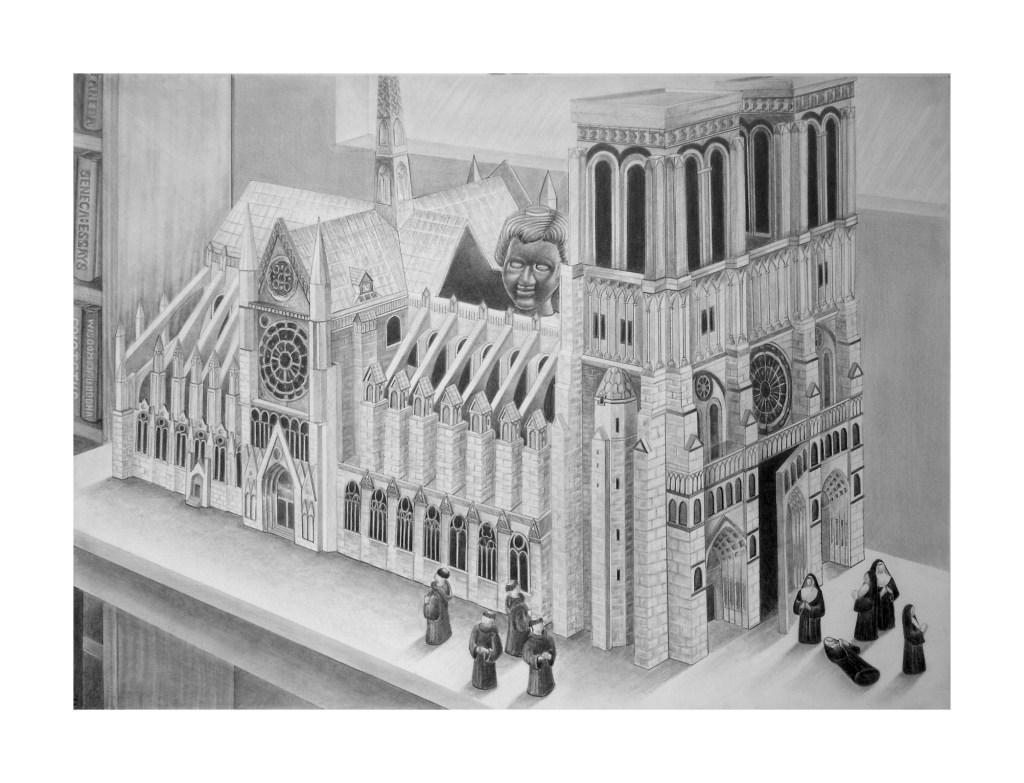
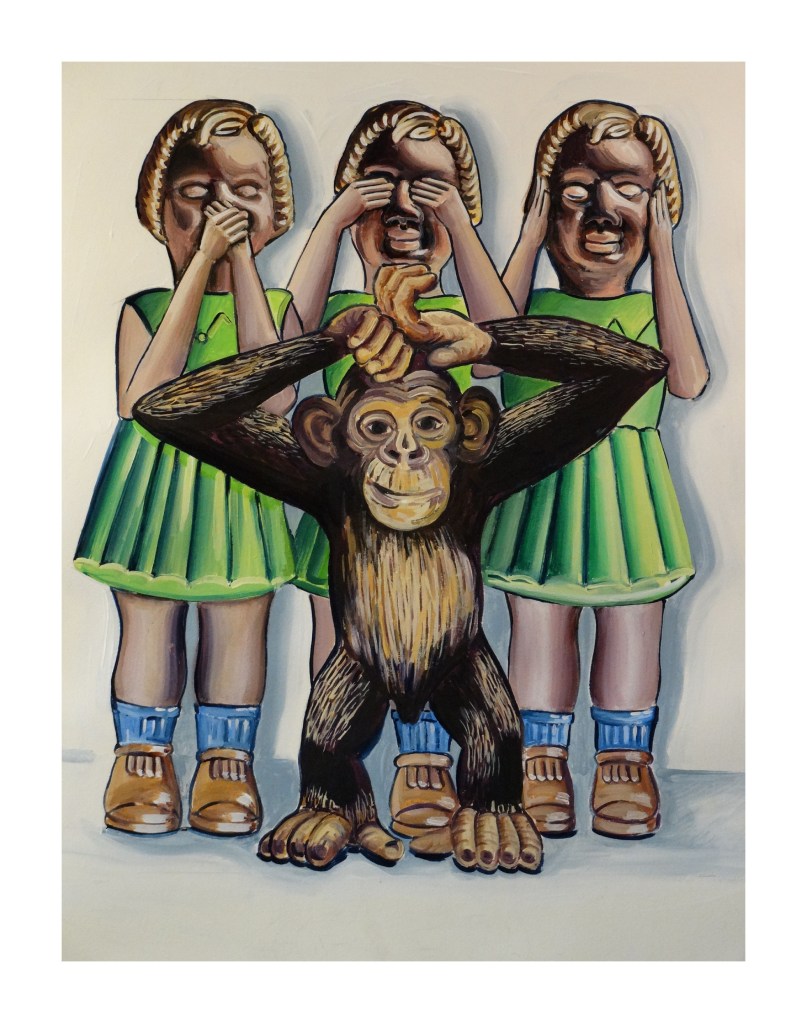
I’ve been thinking, lately, about pictorial narratives, wondering how personal experience might affect interpretations if the imagery contains a bit of ambiguity. Since we all have different life experiences, subliminal issues, it’s reasonable to assume pictorial interpretations will vary from one of us to the next.
And, if pictorial narratives are offered without explanation, one must assume a bit of mystery will present itself, which is, I think a good thing; it keeps the viewer pondering.
I’ve been reading about a time before electricity and central heating when Scandanavian people existed much closer to their natural environment, when enduring the harshness of cold, ice and snow could be mind-bending. I guess living in the northern climes during long winter months provided reason enough to explain the psychological darkness, existential angst that invaded the minds of inhabitants.
The indigenous Sami, nomadic reindeer herders, their sole economic existence dependent on the health of their herds, were required to constantly move through the harsh winters as lichen fields were depleted and new grazing areas found. It’s no wonders the culture of the area produced narratives with few happy endings, stories of protagonists arriving finally at the realization of existential aloneness.
I’ve been reading that, while the reformation of the Christian Church in 16th century Europe, the establishment of Protestantism in reaction to a corrupt Catholic Church, would, on the face of it, appear to be a time of enlightened reform, quite the opposite was true.
Luther’s translation of the Bible into German made it available to a laity that was then able to form churches based on their understanding of Biblical truth, which tended to vary, sometimes considerably, from one congregation to the next. This precipitated accusations of heresy and totalitarian mindsets closed to sectarian differences, leading to an intolerance greater even than that of the Catholic hierarchy.
These issues were all pretty important back then, people believing, as they did, that Hell was in store for most of the population.
I’ve been reading and thinking about the idea of a reasoned existence. Most all of us, more or less, reason our way through our problems weighing possible solutions and making determinations about which options have the greatest potential for success. We do this in a thoughtful way using our powers of reasoning; the decisions made on the basis of factual evidence.
At the same time most of us harbor beliefs for which there is no factual evidence. Our fertile imaginations allow our intuitions to take us into the realm of the imaginary. Which is not to imply the only knowable truths are dependent on hard facts. Richness of existence depends on our entertaining the ephemeral, ineffable. Caution, though, must be taken to carefully sift through the counter-factual in order we assure ourselves good choices are made.


 deideismusings