What to believe? It appears many of us (more than 50% of the U. S. population some sources estimate) get our news through social media, a source of information through which anyone can post thoughts of their own, ideas that may or may not be consistent with reality.
Expecting, as we do, our daily consumption of news to be based on fact, social media offers instead biases of opinion sometimes meant to deceive or to shock. Motivated by self-interest, unedited, the scroll of ideas repeated over and over will take hold, algorhythms feeding intuitions, reinforcing what the individual consumer believes to be true, bad enough in itself but made many times worse by exacerbating societal divisiveness.
We owe it to ourselves to dig deeper into the news of the day, to seek the facts beyond our intuitive inclinations, as uncomfortable as that may be. Moral truth is out there to be found.
I’ve been reading about the religious concept ’Via Negativa’, the idea that the only way to really know God is to obliterate any association one might imagine about a supreme being with tangible realities like personhood, embodiment, even singularity, that to truly grasp the enormity of the concept of an ineffable Other is to eliminate the limitations imposed by naming or envisioning being.
I guess the idea is to sense the presence of the un-nameable, non-entity in one’s surrounding environment and personal interactions every waking moment is to achieve true spiritual enlightenment.
I must say such an idea is intriguing and not totally unfamiliar sensing as I do, well, maybe not in every waking moment, but occasionally, something more in my surroundings and personal relationships than mere physical or psychic reality would suggest.
It’s good, I think, to have alternate ways to contemplate a personal spirituality beyond the limitations of conventional religion.
I’ve been reading, lately, about the primary concepts of stoicism. Among them is premeditatio malorum, which means, I guess, to ponder potential ills in order to keep in mind that bad things may occur at any time to prepare one for the eventual worst-case scenarios that life may impose. The idea seems to be that by living under a slightly dark cloud, one isn’t surprised and overwhelmed when bad things occur.
The concept seems counter-intuitive to the naïve paean to eternal optimism: “things could always be worse” which most of us intone pretty much all the time, even through the pain of the oppressive pandemic. The notion reminds me of Voltaire’s satirical ‘Candide’ where the eternal optimist Pangloss maintains we live in the “best of all possible worlds” even as one terrible event after another fall upon our hero.
But, there are other important stoic concepts to keep in mind, like starting each day with a morning meditation, ending each day in reflection, practicing moderation in all things, speaking less and thinking more among them. All of which suggests stoic practice has many benefits even if eternal optimism isn’t among them.
I suspect most everyone raised in the western cultural tradition imagines, when God is mentioned, a bearded white guy in robes, he maybe hippie-ish and long-haired as well, Jesus being in mind.
Seems so trivial though, doesn’t it? Having to imagine such an image of a supreme intelligence, an over-seeing presence responsible for our very existence, to whom our brief life on this earth is responsible. A benign existence that offered itself in human form in order to better relate to its created beings.
Even a finite human intelligence must wrestle with such a trivial image if it is to be taken seriously. The problem, I guess, is in the difficulty of thinking in the abstract, of conjuring a presence that’s beyond words, language being an inadequate conveyer.
Sigmund Freud determined all human motivations contain a sexual component. The oral, then anal fixations of children and later phallic interests, beginning at a very early age, were focused on satisfying bodily needs. Many psychological problems, neuroses, occur because sexual impulses are repressed. Through psychoanalysis S.F. guided his repressed patients to realize the healthy need for normal active sexual behavior.
Freud, though, cautioned that excessive sexual activity interferes with the development of healthy social relationships, that strong friendships and sound decision making, adulthood essentially, depends on tempering sexual behaviors.
This could explain, I guess, while some of our politicians behave like adolescents.
In the winter of his eighteenth year this young man fell madly in love (well, it was a serious crush anyway). The object of his unrequited affection was a demure sweet young lady who turned the young man, usually easygoing and affable, into a tongue-tied moron (or so he thought and was in fact true).
The episode was simply reflective of the young man’s nature. He conjured imaginings of romantic scenarios; of heroic stances he might take. He lived in a world of fictional narratives reinforced by the heroic storylines he regularly indulged: good triumphs, tragedy is overcome.
It would seem in retrospect such an imaginative reality would soon be repressed but it was maintained far longer than it might have been by avoiding unpleasant confrontation, keeping a distance from uncertain challenges and living in an (overly) protective home environment. As a college student our young dreamer immersed himself in studies of an impersonal nature, solitary endeavors not requiring excessive personal connections. He had friends of course. College life teems with unassuming young people of an accepting nature, all thriving in an essentially responsibility free environment.
Eventually, over time, even an impractical dreamer will have to face harsh realities. The awakening for our young man came with the threat posed by the draft lottery and the likelihood of involuntary military service. Basic training was eye opening. The young man found himself verbally assaulted. Name calling the likes of which he had never previously encountered (but guessed often referred to perverse sexual acts) was common.
Military service didn’t cure the young man, didn’t redirect him toward a more functional pragmatism. Even now as he passes middle age the man finds himself entertaining flights of fancy. He has somehow been able to navigate through life being sufficiently useful as not to be a particular burden on society, you know, has basically paid his own way.
It’s good to know, I guess, that sometimes life provides a path for those who need to live in an alternative reality.
I’ve been thinking lately about the multitudes of good and sincere people in the world who have arrived at dramatically conflicting views as to the nature of reality.
Most all of us rely on what we consider to be unimpeachable support sources for our views and usually a contingent of like-minded others that reinforce our beliefs. The evangelical Christian, the Qanon conspiracy buff and the liberal mainstreamer will tend to approach daily occurrences with sets of premises and then conclusions that are quite different. Such conflicting perspectives are the stuff of the social divisiveness manifesting itself these days; the dilemma of free thought in a free society free from coercive oversight, I guess.
I have no answers other than responding with patient tolerance in the knowledge that most everyone deserves respectful acknowledgement of their usually carefully considered views. The hope is that we can all spot disinformation when it presents itself. Hopefully, we can think past the response of the recently interviewed lady asked why she embraces her position on a current controversial idea. ‘I know it’s not true’, she said, ‘but it’s consistent with my beliefs.’
Thinking lately about dentistry: whether those who pursue such an occupation may harbor a sadistic inclination.
Having recently received a new set of dentures after undergoing the physical trauma such a procedure entails. The experience has me wondering whether ulterior motives a practitioner might have, beyond the lucrative salary, might be in play.
One hopes a medical professional would extend a benevolence toward her victims, but I don’t know if such is necessarily the case.
I’ve been thinking about the George Orwell novel 1984, how the totalitarian regime in the book implemented catch phrases to secure the minds of the populace. ‘War is Peace’ is used to establish a permanent enemy, a scapegoat, that can be blamed for any and all ills that befall the citizenry. ‘Freedom is Slavery’ discourages individualism tribalism in order to keep everyone bound to the collective. ‘Ignorance is Strength’ encourages the subservient populace to forego intellectual reflection, follow the dictates of those in power, not think about things to hard and they will realize contented peace. The message is, I guess, that given such ideas along with sufficient deterrents a totalitarian regime turns people into sheep without them realizing it.
Sounds familiar, doesn’t it; we owe it to ourselves to step up, encourage opposition, reaffirm our freedoms and checks on excessive power. The democratic media voices critical commentary daily; let’s make sure we support it.
It occurs to me the single thing common to all humanity is the desire to deflect, in some way, mundane reality; to find meaning beyond routine daily existence. Aldous Huxley calls such an accomplishment transcendence. Whether it be of a spiritual nature or other special interests, hobbies, travel or whatever the desire to transcend is primary motivator.
Is such pursuit transcendence or simply distraction? If the latter, what are we distracting ourselves from? Could it be the existential fear of having to find our true values: the fear of living an authentic life?
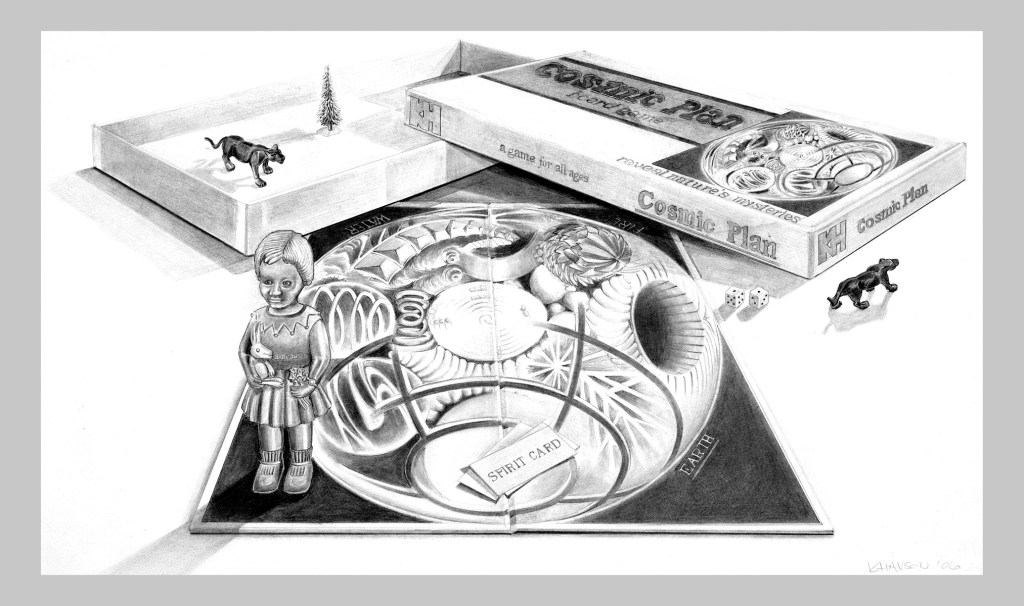
Or maybe we realize we don’t need to get all philosophical about doing what we enjoy, for whatever the reason may be. Maybe making up and playing a board game may be sufficient irony in response to such questions.





 deideismusings