Beyond the Grave

I see by the calendar Dia de Muertos, the Day of the Dead, is approaching.  Death isn’t something dolls, particularly plastic ones, think about very much but at this time of the year, with nature racing toward dormancy, the topic tends to come to mind.

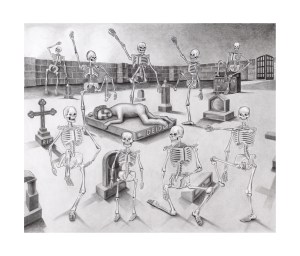
In medieval times death was on everyone’s mind daily.  The Black Plague invited Death to be a regular visitor if not a live-in house guest.  She became so well-known she starred in a regularly performed play called the Danse Macabre.  In the play the Black Angel would appear and along with her spirit helpers the psychopomps  invite victims to accompany them beyond the grave; the beyond being, I guess, a promised land of paradise.

Throughout history (and even earlier than that I bet) people have sensed an existence beyond the grave:  The ancient Egyptians conceived of a Ka or immaterial double that would live on after the demise of the physical body so the deceased would be able to keep doing the same fun things they had always done when alive.

The philosopher Arthur Schopenhauer was inclined to believe that, upon death, an individual’s will or essence of being would be reunited with it’s Cosmic origins: a sort of collective world soul (Plato called it the anima mundi) from which all life originates and subsequently returns; it’s a pretty cool idea of togetherness even though one wouldn’t really be aware of it because one’s memory and ego would cease to exist.

The Hindu people understand the universe to be eternal and that rebirth will continue to happen until enlightenment of the soul propels a leap into the infinite, which, I guess must be a bit like Arthur’s cosmic origins only they call it the Atman.

Contemporary Trans-humanists anticipate a situation in which one’s brain activity is downloaded to a computer and since the brain is where one’s being resides one can expect to live on forever provided someone is around to keep the batteries charged.

I’m sure I’m like everyone else in hoping the Black Angel stays away for a while but when it does come time for me to leave the realm of the physical, wherever  I end up, I hope I will have left behind a reasonably positive image for my friends to remember me by.

dayofthedead3

True Happiness

Pearl and Imacgirl got into a discussion the other day about whether one was better off and would be happier establishing firm beliefs or maintaining a healthy skepticism, you know, as a basic philosophy of life.

Imacgirl, the more pragmatic of the two, inclined as she is toward science, maintained greater understanding and happiness would be achieved by building on the core of established empirical truths methodically, the walls of which providing safety and security for the believer.

Pearl on the other hand, has a skeptical nature and is inclined toward unconventional explanations for what most would consider conventional wisdom.  She said doubting razes pre-established thought structures presenting unlimited opportunities.  Truth becomes an open question.  Walls disappear leaving one awestruck by the vastness of possibility and here, she said, is where true happiness lies.

My two friends were clearly at a stalemate so they asked me what I thought.  I guess it all came down to whether I would prefer the predictability of a life within the confines of common understanding or if I would throw caution to the wind, go where no doll has gone before and take my chances in the ethereal realm of the unknown.

Well, I told them that as much as I enjoyed abstract philosophical thinking what I really wanted to do was go for a walk in the woods, feel the breeze and listen to the birds. They decided to go along and eventually we all agreed that the experience we were having fit well with both philosophical positions.

eithoror3

Accomplishment

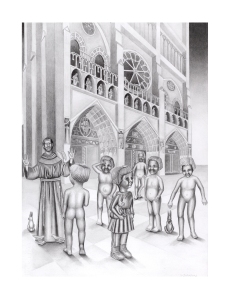
I spent a couple of hours cleaning my Notre Dame playhouse the other day.  It was quite a mess; hadn’t been organized for some time.  I straightened the pews, relighted the votive candles, moved the priest from the sacristy to the confessional, replenished the Holy Water and separated the Brothers and Sisters (for some reason they always seem to end up together).  I did all the things necessary to put a cathedral in good order.

When I finished I considered what I’d done and thought it was quite an accomplishment-maybe not on the scale of actually building Notre Dame-but still it was something.

Wasn’t it?

Okay, so what does it mean to accomplish something?  Does accomplishment occur if no one knows about it?  And, as soon as someone finds out does judgment occur?  And, then, if the accomplishment is deemed worthy do accolades follow?  I doubt the Buddha meant, when he said to his disciples: ‘accomplishment is transient; strive unremittingly’, that they should pursue an ego boost.

The Stoics were pretty sure finding yourself in favor (which is certainly what would happen if people thought you did something good) wasn’t a good thing; once favored the only direction to go is down.

Well no one will probably know about my cathedral dollhouse cleaning anyway; it’s stuck back in a corner of the den.  People rarely come by now that little Bobby entered the seminary.

So I guess I needn’t fear recognition for my accomplishment.  But, I suppose I could take a few photos just to remember how nice it looks once it gets messy again.  But, then, someone might see the photos and nominate me for the Good Playhouse Keeping Award.  Then I’d be expected to keep it clean all the time and if I didn’t people would think I was a messy doll.

Boy, those old guys sure knew what they were talking about.

notre dame playhouse3

Karma


Hindu believers see existence as never ending; people are born into being, live their lives and die only to be reborn, hopefully into a better situation than they left.  Although, if they aren’t lucky or haven’t accumulated enough good karma they might end up as a lesser animal or even inanimate like a rock (or a doll).

The skeptic in me thinks they might very well have gotten this idea by watching plant and animal life cycle through the seasons year after year but who am I to question an age-old belief embraced by so many people.

So, when I look at some of the Hindu gods I have to wonder what kind of karma they accrued in their previous lives.  Take Ganesha: human body, elephant head and lots of arms.  The story goes he was born of Shiva and Parvati both of whom had lots of arms so that attribute may have been hereditary, but it certainly doesn’t explain the elephant head.

If we assume Ganesha accumulated, in previous lives, sufficient good karma to become a god then maybe an elephant head is superior to a human head; maybe Ganesha is further along the karmic path than anyone else.

I’m not sure how to think about my own karmic destiny.  Considering the present quality of my construction my previous life must not have been all that wonderful.  Maybe if I’m exceptional this life I’ll come back as …………….a Barbie?

An Audience with lord Ganesha 3

What I know about Soren Kierkegaard

Kierkegaard’s dilemma was that despite his love for Regine he believed himself to be incapable of becoming a good husband, so to spare her he breaks off the engagement, telling her he was never truly serious about their relationship in the first place.

He wrote a lot about anxiety.  He says when we become anxious we are overtaken with fear and trembling as if we were on the edge of a precipice and were afraid of falling.  Then he says we should jump; take the leap into faith, embrace God for whom all things are possible.

He also tells us that either we shelter ourselves in the illusory belief that the individuals, doctrines and institutions we rely on for self-fulfillment are sufficient (bad) or we dismiss our worldly distractions, realize our declining physical bodies and face the existential horrors of life (good).

Whew!

I think he thought about things too much.  He should have just gone out and had a good time once in a while.

soren kierkegaard3


Fishers of Men

I’ve been wondering lately about what happened to the indigenous tribal groups that used to be so prevalent in the desert southwest.  Apparently, in the 16th century Spanish explorers along with Christian missionaries sailed westward to claim lands in the new world.  When they came across native populations the missionaries immediately set about trying to convert them believing they had the true path to salvation even though the indigenous people didn’t particularly feel the need to be saved since their own religions , which they had been practicing for thousands of years, worked pretty well.

There was one tribal group in northern Mexico, the Tarahumara people, who listened to the missionaries’ stories, then thought about it and changed things around so that God was married to the Virgin Mary and the Devil was God’s brother.

Well, I guess this didn’t sit too well with the missionaries because then they told the Tarahamara’s that if they didn’t believe in the true God and help build a mission they would surely go to Hell.  So the people went along and built a chapel so the missionaries could hold religious events but they still secretly consulted the local Shaman when they had serious questions to put before the ancestral spirits.

The missionaries, however, were unrelenting.  Before long they had the people working 9 to 5 in the mission gardens and were re-educating the children in the mission schools.

As sad as this story is I guess there is a bright side.  The gaming industry has been a God send for many native peoples.  I suppose you could call it Montezuma’s revenge.

fishers of men 3

Hypocrisy

I was visiting with Granny Applehead the other day.  She was waxing nostalgic about her days in secondary school.  She remembers each day began with students rising from their seats, putting hands to hearts and pledging allegiance to the flag.  No one really questioned the validity of the activity back then but, she said, as she thinks about it in retrospect it was pretty clear there was strong intention to instill in young minds a religious sense of nationalistic propriety: America, land of the free and brave has God on her side.

She surmised it was easier back then when everyone was pretty well on the same page regarding God and country.  There were a lot fewer people asking the big questions.

I guess explanation can be found in the post-WWII politics of the times and dealing with godless Communism.  You know, prep these young minds for Holy Wars to come.

Social critique has tempered the blatant flag waving.  The mind manipulation of the young is subtler now but it’s pretty clear we still think of ourselves as being in God’s favor; ready and willing to impose our beliefs and life-style on the rest of the world.

Granny just shakes her head at what she sees as the hypocrisy of our self-perceived sense of fairness and equality for all: as long as everyone conforms to our values and beliefs.

On my way home I was thinking about what the world would be like if everyone was like me: skeptical seekers, always questioning, investigating the new, comparing the old, reaching toward the limits of one’s capabilities to find what may lay beyond.  As egotistical as it may sound, I can’t see that as being a bad thing in the least.

fear of the other 3

The Joys of Doubt

I had a visit from Pastor Ted recently.  We have quite a congenial relationship so long as we avoid speaking of religion or politics, which is why my ire was elevated a bit when he mentioned he read in one of my posts, that I referred to myself as a skeptical seeker.  That must mean, he surmised, that I was open and susceptible to salvation; a viable candidate for recruitment to his army of the saved.

I truly hate to be drawn into a discussion of this sort since it’s become clear that neither of us has any idea what the other understands to be true in the realm of the spiritual.  I tried to explain once again that for me doubt is the most uplifting of intellectual positions I can imagine; that doubt is the only philosophical option that allows complete freedom of investigation; that doubt is a most joyous state.

Alas, I fear Pastor Ted is so convinced his beliefs are the absolute truth and that anyone who is willing can commit to his beliefs, that he is unable to accept any alternative.

Pastor Ted is an honestly good person and a good friend but I guess, as Dorothy Parker so aptly put it, you can’t teach an old dogma new tricks.

covering the bases 3

Psychoanalyzing Sigmund

Dr. Freud determined the libido controls man’s nature.  He thought the male child was engaged in a constant struggle to overcome his father in order to claim his mother and demonstrate his power in the world.  He said he figured this out because of his own attraction to his mother and jealousy of his father and if it was the case for him it must be the case for everybody.

The female child, meanwhile, was in envy of male potency as symbolized by the male genitalia. I guess he was saying we are all controlled by our physical bodies and our minds simply respond to our animal natures.

Dr. Freud must have thought about sex quite a bit; he ended up having six children.

undergoing psychoanalysis3

Papal Infallibility

I think it’s unlikely anyone would attribute infallibility to another human being without believing that individual to be in close collaboration with some supernatural entity.  According to the Vatican papal decisions ‘are justly held irreformable, for they are pronounced with the assistance of the Holy Spirit’ (who, according to Martin Luther is no skeptic) and that ‘God protects the pope from error when he speaks about faith and morality.’

So, I guess when Pope Francis said that non-believers, if they were good, moral people, would be welcomed into heaven they (the non-believers) can fully expect to be there.  The only catch is, being non-believers, they probably don’t think there’s an after-life to be welcomed in to.

It seems to me one is better off remaining open minded about such things.  I’m inclined to take Pascal’s Wager: Bet on the existence of God; if he doesn’t exist you lose nothing, if he does and you bet against him you may be in big trouble.  But then, as I think about it maybe Thomas Jefferson had it right:  Question God’s existence; if there be one he must admire the homage of reason, if non-existent  the exercise thereof will have been worthwhile.