A Shadow Self

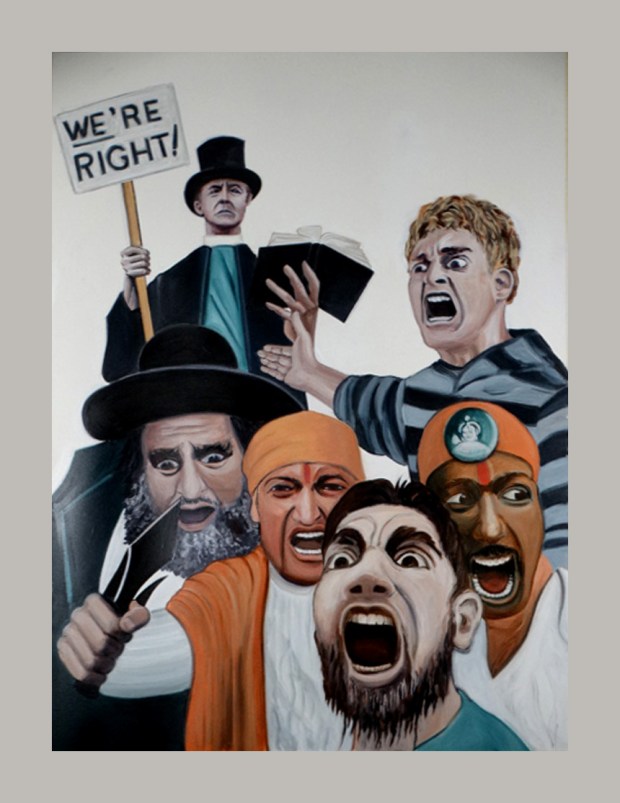
I guess it’s pretty clear that we are all innately susceptible to wicked behaviors. That, while we maintain a respectable public persona within us burns a shadow-self, a dormant entity that when motivated surfaces to exhibit behaviors that can only be described as evil.

There are various reasons why an evil shadow-self might reveal itself: fear of the Other among them. An obsessive jealousy might ignite one’s Darkside as well as vain responses to threatened identity. Instigators might arouse the shadow-selves in whole populations by demonizing a scapegoat as happened with the witch burnings during the Middle Ages and antisemitism in the 1930’s and 40’s.

When the eruption of the shadow-self occurs, our moral imperatives will likely be overwhelmed allowing our innate wicked behaviors to flood in.

The Problem with the Theory of Intelligent Design

After thinking about for some time, it occurs to me that the problem with the theory of Intelligent Design is that it requires combining and organizing disparate parts into a whole; particularly complex structures may involve evolved parts which are themselves constructed from even more basic components making such a concept unimaginable.

But biological life begins as a whole (single cell amoeba) that evolves from a primordial chemical soup. It grows and evolves from infancy to adolescence to maturity. Only afterward does the evolved being manifest the intelligence to conceive the notion of organized parts.

How to Travel as One Ages

We’ve been thinking about taking a trip to Great Britain in a few months in order to experience a few things we’ve missed in past visits. The ease of organizing an itenerary: flights, ground travel, reservations on-line makes planning a breeze and eliminates much of the uncertainty long distance travel often presented in the past.

But I’m thinking that as we age perhaps the two of us might consider a companion or two to further insure good experiences. Should one of us take an unexpected fall a physical therapist might be useful and then if worse came to worst someone adept at mortuary science would be good to have along.

Of course both would have to be socially compatible as well.

An Unsettling Scenario

I’ve been reading how the infiltration of artificial intelligence entities, robots, into the public sphere has the potential, as AI becomes increasingly sophisticated, to undermine the free and open exchange of ideas necessary to a democratic society.
Algorithms, as anyone who consumes social media knows, feed the reader more of the same. The potential for these entities to harbor hidden agendas, to move the consumer into conspiratorial beliefs is a real concern. The complex nature of the information produced through the computer system, based as they are on a multitude of factors, makes deciphering the how and why of the digital results beyond the comprehension of most human agents leading many to simplistic beliefs in deep state conspiracies like Qanon.
Hopefully mechanisms will be put in place and sufficient political will will be exercised to regulate the increasingly sophisticated cyber beings.

Populism

Political populism appears to be in the ascendance these days.  The idea the ‘power’ is in the ‘people’, the ‘people’ being those rightfully in control, dismisses the opposing views of the minority.  Opposition is unacceptable, lost elections must be the result of fraud, theft; criticism the purview of ‘intellectual elites’.   

Populism simplifies, views differences in terms of power, who’s in charge, distrusts the complexities of democratic structures that require ongoing dialog to self-correct when necessary.  The ‘power of the people’ will be placed in the hands of a strongman who will suppress, unde4rmine institutions in order to impose the ‘will of the people’.   

The attraction of such a position must have something to do with a sense of social impotency, a lack of faith in a democratic society.  The danger is the establishment of totalitarian control. 

An Impractical Dreamer

I’ve been reading, lately, about the common man, the 99% of the population that make up the social milieu and wondering what exactly common men have in common. I’m guessing these folks (well, us folks) are mostly of middle-of-the-road social and economic status, probably have limited educational accomplishment, likely adhere to some sort of religious beliefs and most certainly rely on a social network of other individuals of more-or less like mind. We’re the everyday working stiffs who execute our often-uninteresting daily toils in the hope there lies ahead a future of personal economic progress which will provide and secure leisurely retirement.
The uncommon man on the other hand is the intellectual or man of action who drives the public narrative. Maintaining his superior status in a democratic society requires he keep a finger on the pulse of the populace. When the common man begins to lose his sense of hope in a favorable future the uncommon man, in order to maintain his status, must placate the masses by providing a positive vision that a favorable future lies in wait. To maintain societal stability, keep the masses striving for more and better, the uncommon man paints a picture of prosperity near at hand, the good life awaiting those who sustain the necessary drive to be successful.
The philosopher Eric Hoffer thought an uneasy, socially and economically threatened populace of common men who, perhaps, had lost the dream of upward mobility have the potential to produce mass movements that have in the past and will likely in the future dramatically affect the course of history.
Given the state of our world, these days, it seems to me, what we need to do is seek out an uncommon man of superior artistic ability.

Experiencing the Other

How can we be limited to what we grasp through our senses?

I have a desire to reach beyond simple reality. The laws of nature can’t be enough to explain the beauty and complexity of the sensual world. Yet, as I think this, I know my intellect demands rationality. What must I do to accept the existence of both the sensual and super-sensual?

Many thinkers much brighter than me have, as Kierkegaard put it ‘leapt into the absurd’, grasped religious faith. Did the weight of physical existence lead them to sense a supreme deity, the underlying truth of existence? Whatever drew them to a belief in the super-sensible mustn’t have been a simple matter, an out may have been demanded. Blaise Pascal’s rational:’ I believe in the existence of God; if I am right in this belief I will be rewarded in the end. If I’m wrong it will be of no consequence’, reveals the uncertainty all believers (and most sensible non-believers) will always face.

The richness of possibility suggests the best answer.

The Sacred and The Profane

Streaming through Soundbites

I’ve been thinking lately about my daily consumption of the news. Anticipating, as I do, the discomfiting nature of what I’m likely to hear I rely on the feeds I get through my phone each morning. I’m realizing my perspective on things is being tainted by the sensational nature of these media soundbites.

As troubling as I find this realization, I will continue my sound bite consumption because I know I will find a more intensive investigation of current events to be more painful than worthwhile.

Morbid Thoughts

Something about autumn, nature’s impending hibernation, that has me thinking about ‘the long sleep’, contemplating my ultimate demise. I heard recently about a man who, before his recent death, directed his family to have his cremated remains scattered about a favorite hiking location while a song of personal significance was piped into the woodlands.

It seems to me a nice idea. It has me thinking about what musical work I might choose for such an occasion. I do have in mind a perfect location for such an event.

All fun to think about but I’m not in the planning stages yet.

Harpies

Living and Dying in Anonymity

I’ve been thinking lately about legacy, how one might expect to be remembered by those who knew him. It would seem most of us would like to be remembered, preferably positively, as a contributing member of his community even as he may have recoiled from participation, leadership rolls, maybe, in civic and religious organizations, being content maintaining a small coterie of friends as social norms require.

Having lived, as I have, in near obscurity, social anonymity for a long time I might expect little remembrance when I pass on, I suppose. But there’s still time. I do have a class reunion coming up. I wonder if my mates will remember me. To paraphrase Woody Allen: all one needs to do to be remembered is to show up.