Scandanavian Angst

I’ve been reading about a time before electricity and central heating when Scandanavian people existed much closer to their natural environment, when enduring the harshness of cold, ice and snow could be mind-bending. I guess living in the northern climes during long winter months provided reason enough to explain the psychological darkness, existential angst that invaded the minds of inhabitants.

The indigenous Sami, nomadic reindeer herders, their sole economic existence dependent on the health of their herds, were required to constantly move through the harsh winters as lichen fields were depleted and new grazing areas found. It’s no wonders the culture of the area produced narratives with few happy endings, stories of protagonists arriving finally at the realization of existential aloneness.

Edvard Munch: The Dead Mother and the child
A Reasoning Mind

I’ve been reading and thinking about the idea of a reasoned existence. Most all of us, more or less, reason our way through our problems weighing possible solutions and making determinations about which options have the greatest potential for success. We do this in a thoughtful way using our powers of reasoning; the decisions made on the basis of factual evidence.

At the same time most of us harbor beliefs for which there is no factual evidence. Our fertile imaginations allow our intuitions to take us into the realm of the imaginary. Which is not to imply the only knowable truths are dependent on hard facts. Richness of existence depends on our entertaining the ephemeral, ineffable. Caution, though, must be taken to carefully sift through the counter-factual in order we assure ourselves good choices are made.

The Zen of Pickleball

Having taken up the sport of pickleball fairly recently I now find myself deeply engaged, contemplating daily the intricacies of the game: the interplay between its physical demands and cerebral requirements. I’m increasingly seeing the game as metaphor, mirroring the travails highs and lows of daily existence. The elation of a well-played point paralleling an enjoyable evening with friends or the sinking feeling of being beaten down the line the equivalent of an upcoming dental appointment.

In the interests of coming away from an outing on a high rather than a low I find myself thinking about, preparing, anticipating what to expect in order to execute proper fundamentals, increasing my chances of success. Even so, mental preparation doesn’t always produce desired results. Sometimes I lose focus, or my timing is off, or the matchups are unfavorable, and I leave the courts in low spirits.

I wonder if the real issue here is that I don’t have anything truly important to think about.

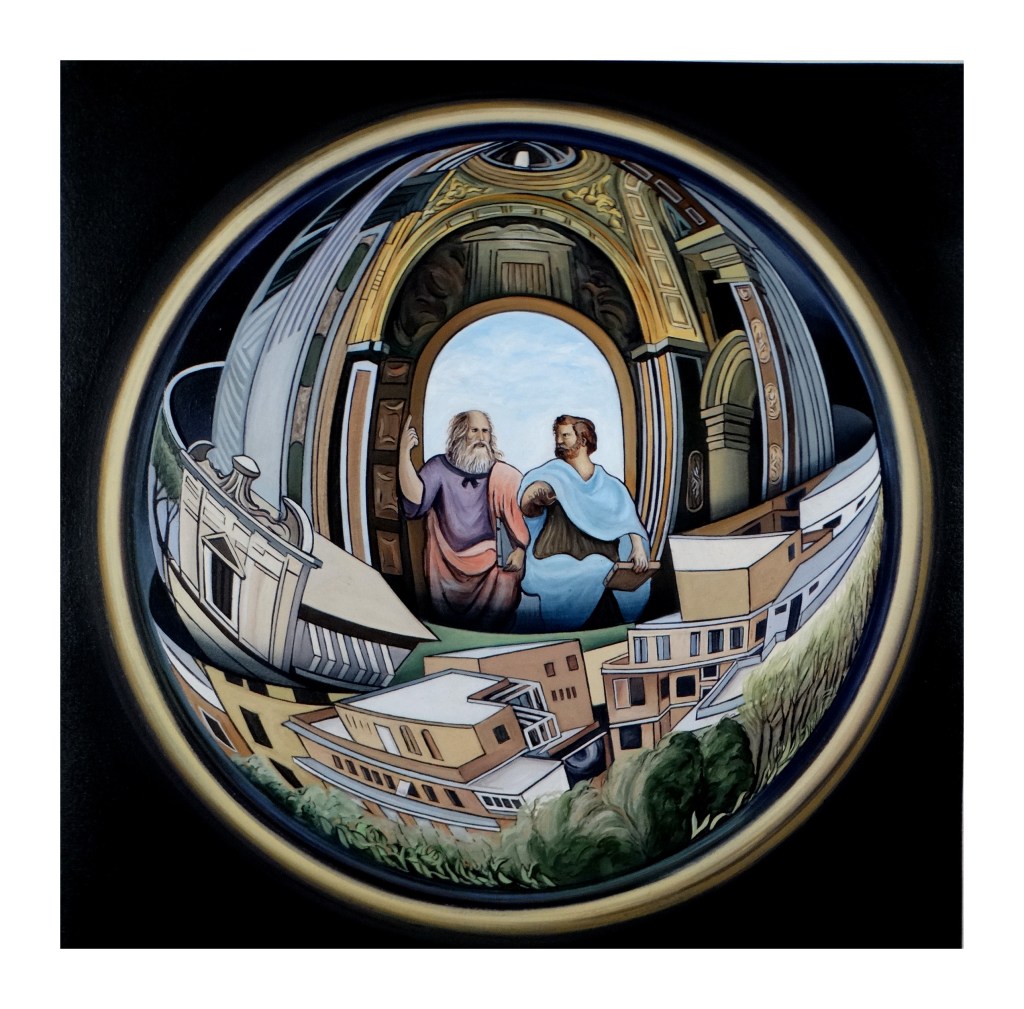
Plato, Aristotle and Medieval Christianity

I’ve been reading about the influence Plato and Aristotle had on the medieval Christian church. The thoughts of these two Greek philosophers were responsible for doctrinal controversy within the church hierarchy.

Plato, whose concept of ‘Ideal Forms’, on which the flawed material world was derivative provided some in the early church insight to see Plato as foretelling the existence of the Christian God, a God beyond rational understanding, a God unknowable before the Christ, to be accepted and revered through faithful observance. Thomas Aquinas, empiricist, thoughtful inquirer, found Aristotle’s sensate investigations proof of an ordered, natural world made that way by an omnipotent God. The contradictory thinking produced on the one hand the necessity of ‘blind faith’, the faithful encouraged to accept the mystery that is God, and, on the other an enquiring laity whose faith and rational understanding was based on knowledge.

The philosophical controversy still exists to this day but at the time paled in comparison to the power struggles and corruption within the medieval church.

An Uneasy Exchange

I visited with a childhood friend recently. We have known each other since elementary school and over the years have shared numerous interests, developed common sensibilities. Things change with time and experience, of course, and my friend and I have found ourselves philosophically polarized.

He has been, for quite some time now, a committed Evangelical harboring the benevolent belief Christian faith will bring serenity and peace not to mention a heavenly afterlife. I on the other hand, remain philosophically open-ended believing a pluralistic world view will produce the greatest likelihood mankind will be able to come together, to unite in a common empathy, reduce sectarian conflicts and direct us toward a peaceful future existence.

I though, unlike my friend, harbor the anxieties of real time, am unable to adapt to the closed system of religious faith, even though the vision of a sunny after-life is pretty attractive.

Saying the Unsayable

I’ve been reading about Robert Irwin the mid-20th century Abstract Expressionist painter who pushed the boundaries of what a painting could be. After struggling for years to solve the figure/ground problem (the ‘problem’ being how to make a painting of substance that contained no object or background) his concerns turned to the problem of eliminating the restrictions of the format, the limiting edges of the canvas.

Using reflected, carefully placed lighting and a small translucent disc he was able to extend a shadowy image upon the vertical wall surface. Viewers appreciating, I guess, the time and energy spent by an artist of recognized commitment and needing to put language to what they were seeing addressed the ‘beauty’ of this new work much to the consternation of the artist who had no thought whatsoever of aesthetics in what he was producing.

Maybe applying language to visual art should be tempered. Investigations such as Irwin’s should elicit unspoken personal response rather than public comment.

Confrontation

A recent heated confrontation has me thinking about my history of passionate exchanges. As I remember my teen years, confrontation was youthful exuberance fed by a black/white world view, nuances not yet present in my developing brain. Hot-blooded exchanges, aggressive verbal attacks were fed by moral outrage at perceived social injustices. To be honest such passions manifested in private, usually from the safety of my bedroom.

These days I try to avoid confrontation, am better able (thanks to blood-pressure meds) to temper animosities, remaining silent and suppressing my inclination to speak out in the heat of the moment. Even so, I am surprised sometimes when my temper flairs and I’m unable to withhold strong response. I guess certain behaviors are simply in one’s nature.

Fishing Trip Revisited

I’ve been thinking about the fishing trip I was on this past summer, how difficult, unpleasant I found it to be. The small boat on rough water and lack of the sonar devices most everyone else on the lake had made me thinking of the David Foster Wallace essay title: ‘A Supposedly Fun Thing I’ll Never Do Again’. I found myself humming Taj Mahal’s ‘Going Fishin’ to pass the time.

Now, as many things viewed in retrospect, I remember a not unpleasant experience resulting eventually in reasonable success. I think now of the small plaque in the fish camp’s cleaning building that offered the fisherman’s common plaint: ‘Tell Your Own Lies’. Multiple meanings in that, I guess.

Delayed Gratification

I’ve been thinking lately about how satisfying one’s desires ought to be thought about as one ages. The delayed gratification test given to young children involving one marshmallow now or two awhile later is meant, I guess, to determine a child’s sense of discipline, discernment and desires.

The idea of having it now or saving for later should, I think, be nuanced later in life as we age and our tastes and health are factored into what waiting means. At some point, when all possibilities are considered, it seems reasonable to consume and enjoy immediately.

Non-Representational Art

In the late 1940’s and early ’50’s artists painting in a non-representational manner had no language or means of conveying what they were doing. The intention was to create paintings of substance while eliminating pictorial space and figure/ground relationships. The problem being that not much could be said about what one was doing and what sort of meaning such work might have.

The result of these concerns was a move toward extreme minimalism, appreciation lying, I guess, in a Zen-like meditation on an essentially monochrome canvas. The artist Robert Irwin contemplated this orange painting for weeks moving one or the other horizontal lines up or down fractions of an inch.

Curious to consider how to interpret such a personal activity. No wonder, I suppose, why such concerns confound the viewing public and remain an esoteric interest at best.