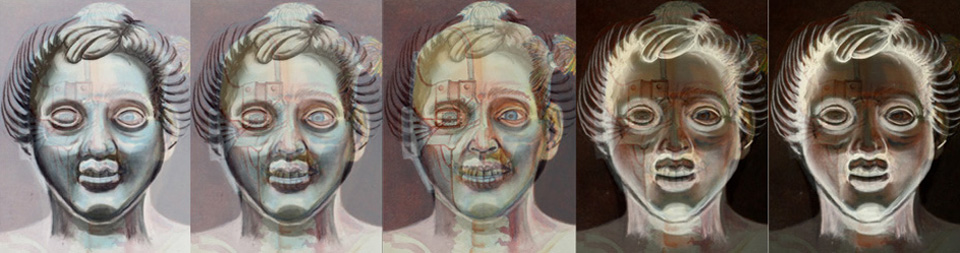
Descent into the Irrational

Boy, it sure seems, these days, judging by the public discourse, that we’re all sliding deeper and deeper into irrationality. Passions predominate on both sides of the philosophical divide; the peripheries of the political spectrum appear to absorb more folks daily as centrists disappear. Measured exchanges are being displaced by passionate condemnation; demonization of the Other renders moot any attempts at rational consideration of opposing views.

There appears to be little interest in seeking imaginative solutions to our ever increasing problems. I guess until an unavoidable disaster looms before us we will remain content within our tribes tossing stones, verbal and literal, at our chosen enemies.

It’s really unfortunate we’re all so easily manipulated by the public narrative. When it comes down to it I truly believe we have more in common than we may think.

Winners and Losers

I’ve been reading that the divisiveness so prevalent these days among folks of differing political persuasions is caused to a not inconsiderable extent by media narratives that posit the news in terms of winners and losers. Rather than defining contemporary problems as mutual and in need of consensus solutions, stories in the news all too often portray ideological differences as warfare pitting one side against the other in a battle which will ultimately determine winner and loser. And, since news outlets no longer see any necessity in offering a balanced story line with pros and cons for any particular stance, partisans can gravitate to the site of their preferred ideological narrative, reinforcing the corrosive divisiveness.

So, I’m wondering if there’s any way to get everyone in the same army in the same camp or on the same team: to get Republicans and Democrats, creationists and scientists, Russians and Islamists and perhaps the entire animal kingdom wearing the same uniform. I fear it will happen only under the threat of imminent cataclysmic disaster. Of course the potential Armageddon will be attributed variously to godless atheism, head-in-the-sand anti-intellectualism, capitalistic excesses, the Infidel, whatever.

I guess that takes us back to where we started. Will we all ultimately be losers?

The County Fair

I went to the county fair this past week as I have been doing for several years now. All rural county fairs, as far as I know, judge the quality of various activities and accomplishments through competitions that any county resident who wishes to can enter. One can compete in art and needle work and garden production as well as have the quality of their livestock judged. There are adult divisions and 4H competitions for children.

Judging by the quality of the 4H exhibits it appears most of these kids are slightly less than marginally involved in their projects. One young fellow put together a poster display about raising sheep in which he borrowed verbatim, short articles on line, printed them and pasted them to colored paper after which he arranged them on a poster board. For this he received a Grand Champion ribbon which makes one wonder about what sort of lessons are being taught and learned here.

In fact, apart from the animals that generally appeared healthy and well taken care of, the adult art and garden exhibitions left a lot to be desired; uninspired, I guess, would be a polite referral to many of the poorly executed offerings. To be honest the fair as a whole made me wonder if my neighbors make up a semi-functional citizenry lacking full grasp of meaningful social exchange.

Well, to be fair, everybody’s busy these days; maybe I should give credit for participation. Still the experience left me little desire to mingle with the masses let alone inspire any warmth toward humanity.


Political (pseudo) Science

As I understand it, science is a discipline whereby observations lead to evidence. The greater the number of observers along with the ever increasing number of observations lead to increasingly firmer, sounder more believable evidence. And, as time goes by and the multitudes of observations reinforce the evidence, truth appears; of course absolute truth can never be achieved because the possibility, as remote as that maybe, of new evidence entering the discussion can’t be discounted. But, practically speaking, from a pragmatic standpoint, science does sometimes reveal truths.  And, in it’s unadulterated purity science continues to seek truths which improve quality of life, understanding of the natural world and the origins of our existence.

Unfortunately, skepticism as to ulterior motive has led some to doubt scientific evidence, and, I guess, for good reason. On the one-hand vested interests claim justification in the name of science for activities that benefit a few and may potentially do harm. Then, also, those who find scientific findings contradicting their preferred world views tend to discount the evidence as atheistic. And so, science becomes politicized, in part because the complexity of the evidence is difficult for us non-scientists to understand; in fact, it sometimes sounds like nonsense to our untrained ears.

So, political science (not to be confused with the discipline that studies scientifically the way politics works) may very well become political pseudo- science when in the hands of the politically astute, casting doubt, for many, on all scientific findings. Which is, indeed, unfortunate. It kind of sounds  oxymoronic doesn’t it.


Ethical Worlds

I’ve been reading, lately, that we apparently don’t all live in the same ethical world, that our moral perspectives diverge sometimes pretty dramatically, and, that this fact may very well account for the conflicting religious and political stances which seem so prevalent these days.

On the one hand you have those who champion the individual, operate according to the ethic of the golden rule: do no harm, treat others the way you yourself wish to be treated and exercise compassion for all vulnerable living things. And then you have another sizable constituency whose ethics centers on a sense of sacredness, pledge loyalty to a higher authority and firmly believe one’s social benefits be tied to one’s contributions.

It certainly seems to me both of these ethical worlds exist upon pretty sound foundations and I suspect the residents of each respective world probably have more in common, ethically speaking, than the on-going, divisive, media narrative presents. Maybe it’s time to invite my neighbors (who I’m pretty sure are firmly ensconced within the opposing camp) over for tea. As long as I can come up with conversational topics that don’t involve politics or religion.

Like Minds

I’m being led to understand, these days, that there are certain innate values within the human genome that when melded with cultural norms pretty much define irrevocably who we are (not discounting the onward march of evolutionary change).

Tendencies toward care for others, loyalty to our own, recognition of higher authority and above all the deep-seeded need to seek out and find sanctity are so deeply innate that reasoned explanation, reliance on an exclusive rationality as ultimate explanation for how and what things are can be embraced only by those who fight off what we innately feel to be true. And, further, such vehement denial of one’s true self isolates from the sort of social cohesion necessary for anyone to reach beyond ego and be truly open and happy.

Being a fairly private individual myself and always having been kind of averse to group bonding of any sort I found these ideas required a bit of thought. Initially the saccharine notion of sitting around a campfire singing Kum ba yah came to mind. But then I realized there were groups of more or less like-minds that I more or less fit into. And that I found the interactions (usually sports related) with these groups rewarding and important parts of my life, really, which makes me think the conception of some sort of innate need for social bonding is probably accurate. I still wince at the thought of singing Kum ba yah though.


Realities, Truth and Fact

I read the other day that someone claims to have discovered a new shade of blue. I guess that may sound fairly reasonable in some ways but when one realizes that, when white light is separated through a prism the spectrum that results will contain all possible blues; there really can’t be a ‘new’ blue can there?

As I cogitate on this conundrum it has occurred to me that there probably are all sorts of discrepancies with regard to what ‘is’ and what is thought to be. Even if we set aside the obtuse political rhetoric we are fairly constantly bombarded by and contextualize the organization of ‘facts’ with which those in the sales professions wish to convince us……..and even if we eliminate those presentations that precede obvious ulterior motive there are still concepts and perceptions that fall through the cracks in otherwise impermeable rock-hard inescapable truth.

Which, I guess, makes me think that maybe sometimes I need to lighten up a little, maybe not try so hard to clasp onto the definitive answer. The world before my senses, delusional as it may be, is never-the-less pretty satisfying.

Rhythms of Nature

I’ve been thinking about the rejuvenating powers of spring; not exactly a profound realization, I know, but still. In addition to the obvious rebirth of the natural world, plant life rebounding, animals extra motivated to procreate, the psychological effects on humankind are undeniable. The energy of youth is renewed (well, remembered, anyway), people are out and about doing yard work planting gardens running 5 milers, setting off on long hikes, harboring romantic inclinations and optimism abounds.

Historically, vernal renewal has seen humankind shake off the imprisoning shackles of political tyranny: think Cinco de Mayo, Syttende Mai, Canada Day (probably not a lot of testosteronal energy needed here), the 1848 Revolutions in Europe, the Arab spring, the list goes on and on. So, it seems to me, something clearly does happen to the human psyche somewhere around mid-April into early June (after which time we can expect ennui to set in in preparation for the doldrums of fall and the small death of winter).

One would think the realization of our innate ties to the rhythms of nature should be sufficient motivation to maintain the health of the natural world. There are daily indications this may not be the case.

High Comedy

As abrasive, ugly and, I guess, pretty comical  public debate has become these days maybe it’s time to extol the virtues of the high energy levels our contentious philosophical exchanges generate. However distasteful, things are certainly better than the political structures in other parts of the world that are inclined to censor oppositional views of any sort (that couldn’t happen here, could it?).

Still, I have to question motivations sometimes. I’m afraid rather than championing fairness and what’s best for all, it appears, often, folks’ primary concerns center on me and mine, my own situation and how it measures up to what I see around me; seems like arrested development sometimes; a perpetual adolescence.

The 19th century philosopher John Stuart Mill reminds us that in any debate, both positions will contain a certain degree of truth; issues are never simply black and white. So, it’s up to us all, I guess, to try to make reasonable sense of the oppositional view rather than mindlessly rely on logical fallacies, strawman simplifications and ad hominem put-downs to bind us with our allies and reinforce what we wish to be the right and only view.

As I contemplate these ideas I’m fully aware of my own complicity, my own inclination to jump on my preferred band wagon, you know, thumb my nose at the opposition. But, at least it gets my blood pumping, raises the old energy level; better than wasting away in lethargy ville I suppose.

ship of fools


Primitive Science

I was reading, recently, that science, in the broadest sense is simply the systematic knowledge obtained through observation and experimentation, which means, I guess, that our earliest ancestors were practicing science as they observed and learned the habits of their prey and the locales where edible vegetation could be found. And then, later, our forebears developed a pretty sophisticated understanding of stellar and planetary movements affecting seasonal change and growing seasons: science without question.

There have been, of course, a few observational glitches along the developmental path. Grasping and accepting heliocentricity involved overcoming considerable cognitive dissonance (which might be attributed, to a considerable extent, to the Catholic Church). And, I guess, religion has thrown a monkey wrench into the workings of scientific progress on a somewhat regular basis through the ages. There are still quite a number of folks out there suspicious of ‘science’ when it questions long held beliefs or offers inconvenient truths.

But, it’s hard to argue that our very existence today isn’t due to a significant extent to our embrace of science. And, as we understand more and more about the workings of the natural world and even more questions arise we will trust science to address the questions with the knowledge that a definitive explanation of how it all works will probably never be seen. Progress will continue, nevertheless, new ideas will be presented and peer reviewed until established facts present themselves.

I can only hope education will prevail. Science, after all, is without ulterior motive; the betterment of humankind is its only goal.