Michel de Montaigne’s Enlightened Views

In 16th Century Europe, Luther’s Reformation provided a popular alternative for a population aggrieved by the excessive taxation imposed by the Roman church. The schism produced opposing factions that felt the need to impose doctrinal absolutes on their respective believers in order to reinforce professed Christian legitimacy. Heretics were found, declared and burned and in France the protestant Huguenots were slaughtered by ruling Catholics.

In response to the unchristian-like actions the French philosopher Michel de Montaigne offered some enlightening insights. He suggested if one took any one of his firmly held beliefs and then took time to consider the opposite view openly and thoroughly, he might very well change his opinion.

Unfortunately, his skepticism of rigid dogmatic belief did little to defer the unsettled populations, who ignored reason and continued to each passionately pursue their preferred narratives.
Some things never change.

The Value of Opposition (Imagined or Otherwise)

Does one’s mental acuity require an antagonist or are there just some of us who don’t function well without an oppositional push? Having a foil against which I can expend my energies allows for perceived successes, wins, against adversity and will produce a sense of euphoria (short-lived though it will be), that feeds the desire to continue to seek out opposition.

The commonly held desire for peaceful coexistence, the idea of a friction-free Utopia would send many of us into an undesirable state of ennui, although time to rest up between bouts will be welcome.

Narratives

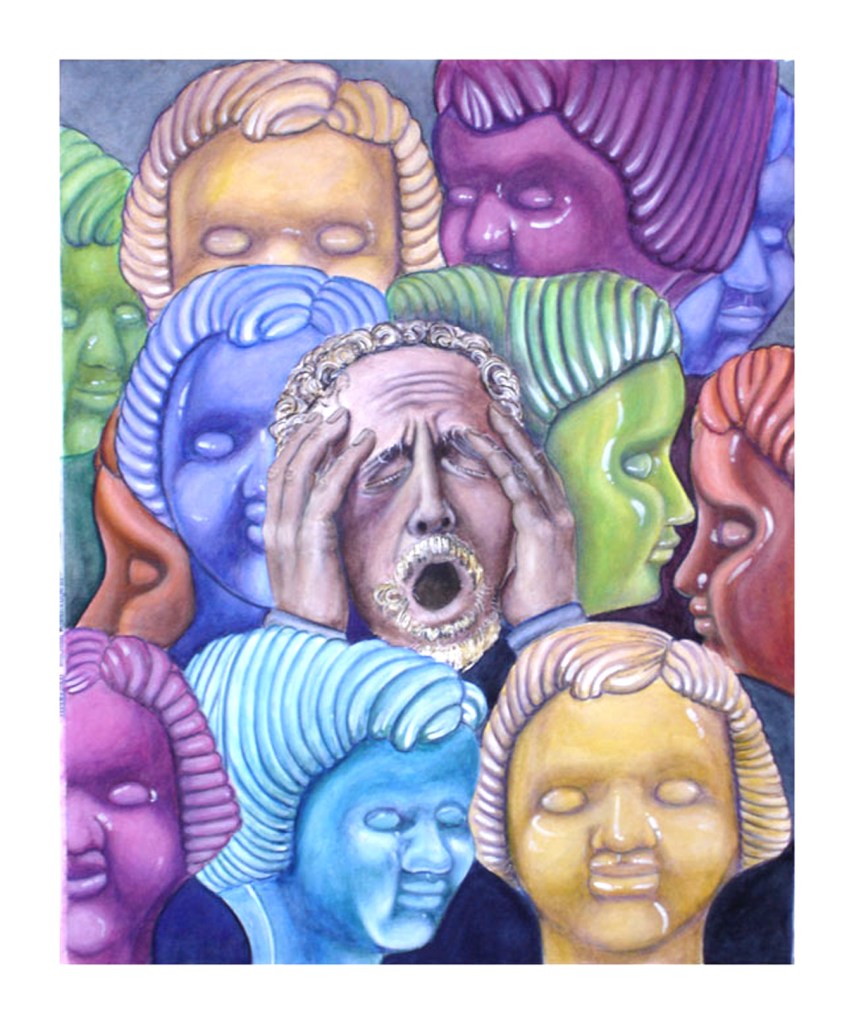
I’ve been thinking, lately, about pictorial narratives, wondering how personal experience might affect interpretations if the imagery contains a bit of ambiguity. Since we all have different life experiences, subliminal issues, it’s reasonable to assume pictorial interpretations will vary from one of us to the next.

And, if pictorial narratives are offered without explanation, one must assume a bit of mystery will present itself, which is, I think a good thing; it keeps the viewer pondering.

Scandanavian Angst

I’ve been reading about a time before electricity and central heating when Scandanavian people existed much closer to their natural environment, when enduring the harshness of cold, ice and snow could be mind-bending. I guess living in the northern climes during long winter months provided reason enough to explain the psychological darkness, existential angst that invaded the minds of inhabitants.

The indigenous Sami, nomadic reindeer herders, their sole economic existence dependent on the health of their herds, were required to constantly move through the harsh winters as lichen fields were depleted and new grazing areas found. It’s no wonders the culture of the area produced narratives with few happy endings, stories of protagonists arriving finally at the realization of existential aloneness.

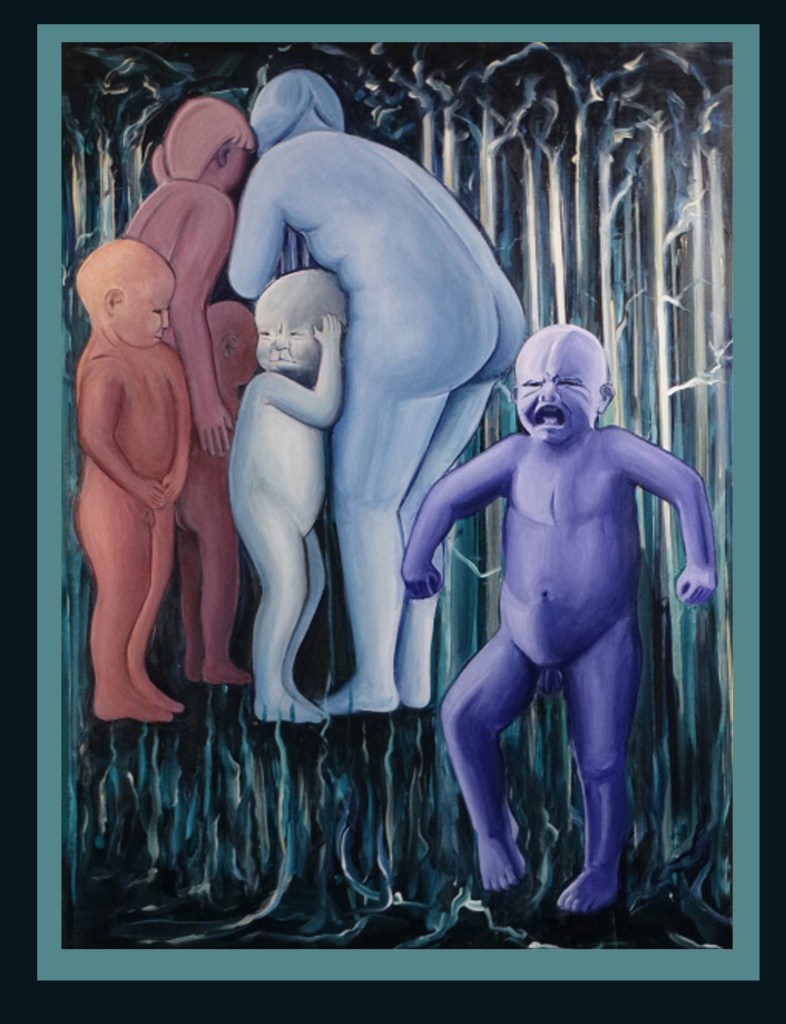
Edvard Munch: The Dead Mother and the child

The Downside of the Reformation

I’ve been reading that, while the reformation of the Christian Church in 16th century Europe, the establishment of Protestantism in reaction to a corrupt Catholic Church, would, on the face of it, appear to be a time of enlightened reform, quite the opposite was true.

Luther’s translation of the Bible into German made it available to a laity that was then able to form churches based on their understanding of Biblical truth, which tended to vary, sometimes considerably, from one congregation to the next. This precipitated accusations of heresy and totalitarian mindsets closed to sectarian differences, leading to an intolerance greater even than that of the Catholic hierarchy.

These issues were all pretty important back then, people believing, as they did, that Hell was in store for most of the population.

A Reasoning Mind

I’ve been reading and thinking about the idea of a reasoned existence. Most all of us, more or less, reason our way through our problems weighing possible solutions and making determinations about which options have the greatest potential for success. We do this in a thoughtful way using our powers of reasoning; the decisions made on the basis of factual evidence.

At the same time most of us harbor beliefs for which there is no factual evidence. Our fertile imaginations allow our intuitions to take us into the realm of the imaginary. Which is not to imply the only knowable truths are dependent on hard facts. Richness of existence depends on our entertaining the ephemeral, ineffable. Caution, though, must be taken to carefully sift through the counter-factual in order we assure ourselves good choices are made.

The Zen of Pickleball

Having taken up the sport of pickleball fairly recently I now find myself deeply engaged, contemplating daily the intricacies of the game: the interplay between its physical demands and cerebral requirements. I’m increasingly seeing the game as metaphor, mirroring the travails highs and lows of daily existence. The elation of a well-played point paralleling an enjoyable evening with friends or the sinking feeling of being beaten down the line the equivalent of an upcoming dental appointment.

In the interests of coming away from an outing on a high rather than a low I find myself thinking about, preparing, anticipating what to expect in order to execute proper fundamentals, increasing my chances of success. Even so, mental preparation doesn’t always produce desired results. Sometimes I lose focus, or my timing is off, or the matchups are unfavorable, and I leave the courts in low spirits.

I wonder if the real issue here is that I don’t have anything truly important to think about.

Fear of the Unknown

I’ve been viewing maps recently that were produced during the Middle Ages. It has become clear to me that the early cartographers needed to rely on a certain amount of imagination to create a geographic depiction of the world. The church at the time took pains to build a Biblically favorable geography that had little to do with reality.

I’m wondering how a medieval intellect, a contemplative sort, sitting on the beach looking westward out across the Atlantic Ocean might have imagined what lay beyond. Many sailors of the time feared sailing too far west lest they fall off the edge of the world. Nightmares of an awaiting Hell so nearby must have terrified the medieval mind.

These days the contemplative sort might be looking upwards, outwards, imagining the earth being sucked into a black hole or being overwhelmed by dark matter and being no less terrified than his medieval forbearer. Fear of the unknown is the constant I guess for all of humankind.

Plato, Aristotle and Medieval Christianity

I’ve been reading about the influence Plato and Aristotle had on the medieval Christian church. The thoughts of these two Greek philosophers were responsible for doctrinal controversy within the church hierarchy.

Plato, whose concept of ‘Ideal Forms’, on which the flawed material world was derivative provided some in the early church insight to see Plato as foretelling the existence of the Christian God, a God beyond rational understanding, a God unknowable before the Christ, to be accepted and revered through faithful observance. Thomas Aquinas, empiricist, thoughtful inquirer, found Aristotle’s sensate investigations proof of an ordered, natural world made that way by an omnipotent God. The contradictory thinking produced on the one hand the necessity of ‘blind faith’, the faithful encouraged to accept the mystery that is God, and, on the other an enquiring laity whose faith and rational understanding was based on knowledge.

The philosophical controversy still exists to this day but at the time paled in comparison to the power struggles and corruption within the medieval church.

A Dark Age

I’ve been reading about the intellectual world in Western Europe as it existed in the early centuries of the second millennium.

With the fall of Roman Civilization 600 years earlier, scholarship had declined, knowledge of the past had been reduced to monastic reproductions of Latin texts providing the church the opportunity to re-imagine the historical narrative to its own advantage, limiting it to a closed Christian perspective and its reliance on the ‘Word of God’ to explain the complexities of the natural world.

This constrictive culture led the few scholars of the time, whose concern for self-preservation amid accusations of heresy, to temper any announcements of research findings setting back intellectual development for centuries.

The eventual breaking free of such a restrictive situation can only be attributed to the indomitable human spirit, even though it did take a long time.