Karma


Hindu believers see existence as never ending; people are born into being, live their lives and die only to be reborn, hopefully into a better situation than they left.  Although, if they aren’t lucky or haven’t accumulated enough good karma they might end up as a lesser animal or even inanimate like a rock (or a doll).

The skeptic in me thinks they might very well have gotten this idea by watching plant and animal life cycle through the seasons year after year but who am I to question an age-old belief embraced by so many people.

So, when I look at some of the Hindu gods I have to wonder what kind of karma they accrued in their previous lives.  Take Ganesha: human body, elephant head and lots of arms.  The story goes he was born of Shiva and Parvati both of whom had lots of arms so that attribute may have been hereditary, but it certainly doesn’t explain the elephant head.

If we assume Ganesha accumulated, in previous lives, sufficient good karma to become a god then maybe an elephant head is superior to a human head; maybe Ganesha is further along the karmic path than anyone else.

I’m not sure how to think about my own karmic destiny.  Considering the present quality of my construction my previous life must not have been all that wonderful.  Maybe if I’m exceptional this life I’ll come back as …………….a Barbie?

An Audience with lord Ganesha 3

What I know about Soren Kierkegaard

Kierkegaard’s dilemma was that despite his love for Regine he believed himself to be incapable of becoming a good husband, so to spare her he breaks off the engagement, telling her he was never truly serious about their relationship in the first place.

He wrote a lot about anxiety.  He says when we become anxious we are overtaken with fear and trembling as if we were on the edge of a precipice and were afraid of falling.  Then he says we should jump; take the leap into faith, embrace God for whom all things are possible.

He also tells us that either we shelter ourselves in the illusory belief that the individuals, doctrines and institutions we rely on for self-fulfillment are sufficient (bad) or we dismiss our worldly distractions, realize our declining physical bodies and face the existential horrors of life (good).

Whew!

I think he thought about things too much.  He should have just gone out and had a good time once in a while.

soren kierkegaard3


Fishers of Men

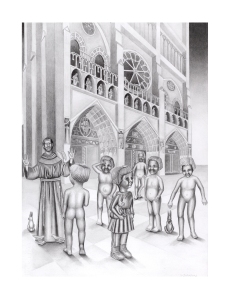
I’ve been wondering lately about what happened to the indigenous tribal groups that used to be so prevalent in the desert southwest.  Apparently, in the 16th century Spanish explorers along with Christian missionaries sailed westward to claim lands in the new world.  When they came across native populations the missionaries immediately set about trying to convert them believing they had the true path to salvation even though the indigenous people didn’t particularly feel the need to be saved since their own religions , which they had been practicing for thousands of years, worked pretty well.

There was one tribal group in northern Mexico, the Tarahumara people, who listened to the missionaries’ stories, then thought about it and changed things around so that God was married to the Virgin Mary and the Devil was God’s brother.

Well, I guess this didn’t sit too well with the missionaries because then they told the Tarahamara’s that if they didn’t believe in the true God and help build a mission they would surely go to Hell.  So the people went along and built a chapel so the missionaries could hold religious events but they still secretly consulted the local Shaman when they had serious questions to put before the ancestral spirits.

The missionaries, however, were unrelenting.  Before long they had the people working 9 to 5 in the mission gardens and were re-educating the children in the mission schools.

As sad as this story is I guess there is a bright side.  The gaming industry has been a God send for many native peoples.  I suppose you could call it Montezuma’s revenge.

fishers of men 3

Hypocrisy

I was visiting with Granny Applehead the other day.  She was waxing nostalgic about her days in secondary school.  She remembers each day began with students rising from their seats, putting hands to hearts and pledging allegiance to the flag.  No one really questioned the validity of the activity back then but, she said, as she thinks about it in retrospect it was pretty clear there was strong intention to instill in young minds a religious sense of nationalistic propriety: America, land of the free and brave has God on her side.

She surmised it was easier back then when everyone was pretty well on the same page regarding God and country.  There were a lot fewer people asking the big questions.

I guess explanation can be found in the post-WWII politics of the times and dealing with godless Communism.  You know, prep these young minds for Holy Wars to come.

Social critique has tempered the blatant flag waving.  The mind manipulation of the young is subtler now but it’s pretty clear we still think of ourselves as being in God’s favor; ready and willing to impose our beliefs and life-style on the rest of the world.

Granny just shakes her head at what she sees as the hypocrisy of our self-perceived sense of fairness and equality for all: as long as everyone conforms to our values and beliefs.

On my way home I was thinking about what the world would be like if everyone was like me: skeptical seekers, always questioning, investigating the new, comparing the old, reaching toward the limits of one’s capabilities to find what may lay beyond.  As egotistical as it may sound, I can’t see that as being a bad thing in the least.

fear of the other 3

The Joys of Doubt

I had a visit from Pastor Ted recently.  We have quite a congenial relationship so long as we avoid speaking of religion or politics, which is why my ire was elevated a bit when he mentioned he read in one of my posts, that I referred to myself as a skeptical seeker.  That must mean, he surmised, that I was open and susceptible to salvation; a viable candidate for recruitment to his army of the saved.

I truly hate to be drawn into a discussion of this sort since it’s become clear that neither of us has any idea what the other understands to be true in the realm of the spiritual.  I tried to explain once again that for me doubt is the most uplifting of intellectual positions I can imagine; that doubt is the only philosophical option that allows complete freedom of investigation; that doubt is a most joyous state.

Alas, I fear Pastor Ted is so convinced his beliefs are the absolute truth and that anyone who is willing can commit to his beliefs, that he is unable to accept any alternative.

Pastor Ted is an honestly good person and a good friend but I guess, as Dorothy Parker so aptly put it, you can’t teach an old dogma new tricks.

covering the bases 3

Psychoanalyzing Sigmund

Dr. Freud determined the libido controls man’s nature.  He thought the male child was engaged in a constant struggle to overcome his father in order to claim his mother and demonstrate his power in the world.  He said he figured this out because of his own attraction to his mother and jealousy of his father and if it was the case for him it must be the case for everybody.

The female child, meanwhile, was in envy of male potency as symbolized by the male genitalia. I guess he was saying we are all controlled by our physical bodies and our minds simply respond to our animal natures.

Dr. Freud must have thought about sex quite a bit; he ended up having six children.

undergoing psychoanalysis3

Papal Infallibility

I think it’s unlikely anyone would attribute infallibility to another human being without believing that individual to be in close collaboration with some supernatural entity.  According to the Vatican papal decisions ‘are justly held irreformable, for they are pronounced with the assistance of the Holy Spirit’ (who, according to Martin Luther is no skeptic) and that ‘God protects the pope from error when he speaks about faith and morality.’

So, I guess when Pope Francis said that non-believers, if they were good, moral people, would be welcomed into heaven they (the non-believers) can fully expect to be there.  The only catch is, being non-believers, they probably don’t think there’s an after-life to be welcomed in to.

It seems to me one is better off remaining open minded about such things.  I’m inclined to take Pascal’s Wager: Bet on the existence of God; if he doesn’t exist you lose nothing, if he does and you bet against him you may be in big trouble.  But then, as I think about it maybe Thomas Jefferson had it right:  Question God’s existence; if there be one he must admire the homage of reason, if non-existent  the exercise thereof will have been worthwhile.

Complacency

I find myself wallowing in contentment these days; consciously maintaining a positive outlook, simply putting the negatives out of my mind.

Breathe deeply:  inhale, exhale.

Avoiding confrontation means avoiding interaction to a large extent; companionship is reserved for one or two close friends.  I follow the news but refuse to dwell on tragedy.  Like Emil Cioran says: better not to act; action can only lead to regrets.

So, I stand here, day after day, feeling the soft summer breezes, inhaling the sweet scents of garden flowers, listening to the optimistic bird song.  What could be better?

I refuse to allow myself to be upset.  Why can’t little Annie sing on key?  What is LeonardD doing with that power saw?  What if those neighbor children want to play with me?  They’re so rough.

Never mind.

I’m afraid I’m becoming complacent.  Nothing excites me.  I think maybe there’s a difference between the calm of a centered discipline and my near lethargy.  Perhaps it would be good to step into an uncomfortable situation; force myself to face phenomena that will upset me; get my blood (such as it is) boiling.  Maybe Nietzsche’s right: ‘what doesn’t kill you makes you stronger.’

Well, I’ll think about it.  I’m a bit drowsy; the gentle patter of the water fountain is very relaxing.  I’m not sure that I really need a challenge anyway.

zarathustra 3

A Life of Contemplation

Lately, I’ve been thinking what it’d be like to go off someplace where I could live more simply; someplace away from the distractions of the ever-depressing news of the day and the energy sapping ego conflicts of the workplace.

I could spend my days contemplating the inherent nature of existence; I could immerse myself in the eternal flow of life.  I would find my center and be at one with all things.  You know, like St. Anthony (the ascetic) did.

For nearly forty years Anthony lived a hermetic existence in the desert existing on the rare crust of bread offered him by passing pilgrims.  He rid himself of all desires of the flesh in the belief that through asceticism ultimate truth would be revealed to him.

There was one night, though, when hedonistic desires descended upon him like a torrential downpour.  He wanted, wanted, wanted: good food, good drink and women of any sort.  All night he suffered.  He fought back with every ounce of his energy.  When morning finally came Anthony was spent from the night’s exertions but was also strengthened in the knowledge he could overcome temptation.  His resignation was renewed, but with it, the fear of even greater tests to come.

I’m really not too worried about this happening to me.  Food and drink aren’t important to a doll and I’m really not that into primal urges.The Temptation of St. Anthony 3

Illusions of Well-being

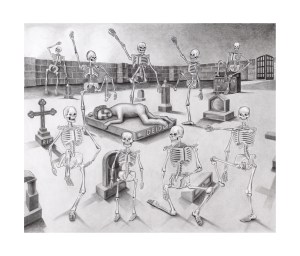
According to the Romanian philosopher Emil Cioran a person would be better off not to have been born.  He determined suffering is the rule in life and there is absolutely nothing anyone can do about it.  All actions, he says, are or will be cause for regret.

The notion of well-being for Emil is an illusion that many people will harbor off and on during their lives but will in the end be unable to sustain.  Apparently Emil thinks it would be better to be, now, where he was before he was born-which is where he must be since he died some years ago.

Not having been born myself, rather, molded in plastic, I’m not sure how to think about Emil’s assertion.  I suppose he does have a point.  As far as I’m concerned my sense of well-being is dependent on the consideration of others, you know, to not step on me, keep me away from aggressive dogs (the ones that like to chew things up), and such.  And, how reliable can I expect that consideration to be; I guess there’s a faith aspect to any sense of well-being I might have.

As far as being better off being where I was before I was molded-in that vat of molten plastic-I suppose there is a sense of Oneness in that.

ouro boros3