Robert and Judy

Robert and Judy have lived together in their small home in the country for a long time. Before they were married Robert lived alone in a small cabin. When Judy came to visit, she found that Robert harbored a weasel in the house. The animal was allowed free rein to come and go at will. According to Robert his unnamed companion kept the rodent population in check. After their marriage, Judy, finding the animal to be an unacceptable house guest saw to it a new house was built with a solid foundation.

Over the years, as will be the case for semi-isolated folks, idiosyncrasies have developed. Visitors are viewed a bit askance, long visits not encouraged and, as Judy might have expected, Robert has continued to harbor his excessive (in her opinion) attachment to the deer, wild turkeys, wood chucks and various other wild creatures that come around to be fed, which Robert continues to do with unerring regularity in order to keep them all nearby, while keeping them, in the interest of conjugal peace, out of the house.

As Robert’s health has begun to deteriorate, Judy, a registered nurse, diagnoses, treats and sees to it Robert gets needed medical attention while documenting his various skin maladies with color photos that she readily shares with whomever might be visiting. Clarence, reduced to physical specimen, shrugs off the attention, content to nap in his recliner until it’s time once again to feed his friends.

Michel de Montaigne’s Enlightened Views

In 16th Century Europe, Luther’s Reformation provided a popular alternative for a population aggrieved by the excessive taxation imposed by the Roman church. The schism produced opposing factions that felt the need to impose doctrinal absolutes on their respective believers in order to reinforce professed Christian legitimacy. Heretics were found, declared and burned and in France the protestant Huguenots were slaughtered by ruling Catholics.

In response to the unchristian-like actions the French philosopher Michel de Montaigne offered some enlightening insights. He suggested if one took any one of his firmly held beliefs and then took time to consider the opposite view openly and thoroughly, he might very well change his opinion.

Unfortunately, his skepticism of rigid dogmatic belief did little to defer the unsettled populations, who ignored reason and continued to each passionately pursue their preferred narratives.
Some things never change.

The Value of Opposition (Imagined or Otherwise)

Does one’s mental acuity require an antagonist or are there just some of us who don’t function well without an oppositional push? Having a foil against which I can expend my energies allows for perceived successes, wins, against adversity and will produce a sense of euphoria (short-lived though it will be), that feeds the desire to continue to seek out opposition.

The commonly held desire for peaceful coexistence, the idea of a friction-free Utopia would send many of us into an undesirable state of ennui, although time to rest up between bouts will be welcome.

Scandanavian Angst

I’ve been reading about a time before electricity and central heating when Scandanavian people existed much closer to their natural environment, when enduring the harshness of cold, ice and snow could be mind-bending. I guess living in the northern climes during long winter months provided reason enough to explain the psychological darkness, existential angst that invaded the minds of inhabitants.

The indigenous Sami, nomadic reindeer herders, their sole economic existence dependent on the health of their herds, were required to constantly move through the harsh winters as lichen fields were depleted and new grazing areas found. It’s no wonders the culture of the area produced narratives with few happy endings, stories of protagonists arriving finally at the realization of existential aloneness.

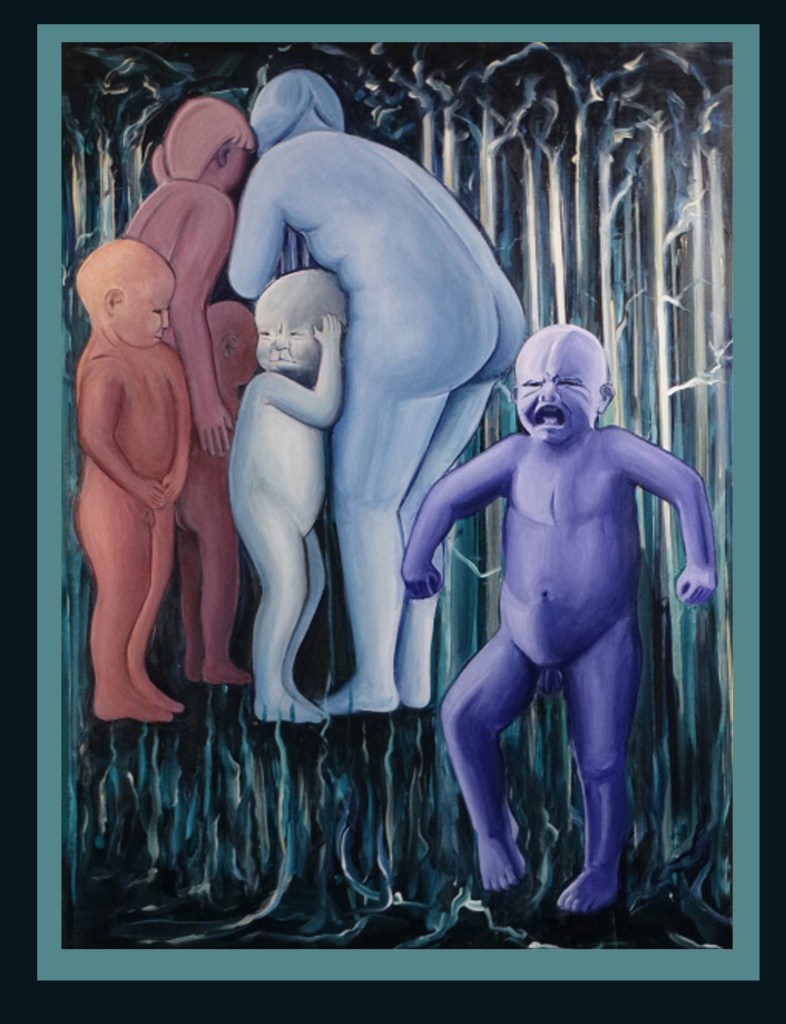
Edvard Munch: The Dead Mother and the child

Plato, Aristotle and Medieval Christianity

I’ve been reading about the influence Plato and Aristotle had on the medieval Christian church. The thoughts of these two Greek philosophers were responsible for doctrinal controversy within the church hierarchy.

Plato, whose concept of ‘Ideal Forms’, on which the flawed material world was derivative provided some in the early church insight to see Plato as foretelling the existence of the Christian God, a God beyond rational understanding, a God unknowable before the Christ, to be accepted and revered through faithful observance. Thomas Aquinas, empiricist, thoughtful inquirer, found Aristotle’s sensate investigations proof of an ordered, natural world made that way by an omnipotent God. The contradictory thinking produced on the one hand the necessity of ‘blind faith’, the faithful encouraged to accept the mystery that is God, and, on the other an enquiring laity whose faith and rational understanding was based on knowledge.

The philosophical controversy still exists to this day but at the time paled in comparison to the power struggles and corruption within the medieval church.

Keystone Species

I’ve been reading that biologists have determined that certain predators are key to preserving diversity in various eco systems: starfish, for example, serve the function by consuming mussels that would otherwise destroy the diversity in tide pools and fresh water largemouth bass are a keystone species in freshwater streams controlling the populations of minnows that would otherwise over-graze plant life. In the waters off western Alaska sea otters control the populations of sea urchins that can devastate kelp forests.

The lesson to be learned, I guess, is that keystone species are necessary to control populations of system threatening species in order to maintain healthy diverse eco-systems. I wonder whether a keystone species might exist somewhere that could control the species most responsible for threatening the health of the earth.

An Uneasy Exchange

I visited with a childhood friend recently. We have known each other since elementary school and over the years have shared numerous interests, developed common sensibilities. Things change with time and experience, of course, and my friend and I have found ourselves philosophically polarized.

He has been, for quite some time now, a committed Evangelical harboring the benevolent belief Christian faith will bring serenity and peace not to mention a heavenly afterlife. I on the other hand, remain philosophically open-ended believing a pluralistic world view will produce the greatest likelihood mankind will be able to come together, to unite in a common empathy, reduce sectarian conflicts and direct us toward a peaceful future existence.

I though, unlike my friend, harbor the anxieties of real time, am unable to adapt to the closed system of religious faith, even though the vision of a sunny after-life is pretty attractive.

Christian Apologetics

I’ve been reading, lately, Penzees, written by the 17th century philosopher Blaise Pascal. The work goes into great detail defending and advocating belief in Christianity. Rationale for such belief centers on the idea man is morally flawed and sinful making existence psychologically painful. Why else, the apologist argues, do we avoid the reality of the here and now through pre-occupation with the past or anticipation of the future, or by other constant diversions that keep us from facing the inevitable: the realization of a finite existence that will end in extinction.

The solution to this dilemma, we are directed, is in admitting our shortcomings, relinquishing our pride and our fear of the enormity of existence. If we do this, we can create a space, a place for God.

The philosopher offers strong argument. We all, if we think about it, live with our uncertainties and fears. Belief in a benevolent God will surely bring peace of mind to those able to embrace it. There are caveats, I suppose. One may find, upon commitment that remaining in ‘good faith’ may be somewhat more involved than a simple declaration of belief.

Confrontation

A recent heated confrontation has me thinking about my history of passionate exchanges. As I remember my teen years, confrontation was youthful exuberance fed by a black/white world view, nuances not yet present in my developing brain. Hot-blooded exchanges, aggressive verbal attacks were fed by moral outrage at perceived social injustices. To be honest such passions manifested in private, usually from the safety of my bedroom.

These days I try to avoid confrontation, am better able (thanks to blood-pressure meds) to temper animosities, remaining silent and suppressing my inclination to speak out in the heat of the moment. Even so, I am surprised sometimes when my temper flairs and I’m unable to withhold strong response. I guess certain behaviors are simply in one’s nature.

Fishing Trip Revisited

I’ve been thinking about the fishing trip I was on this past summer, how difficult, unpleasant I found it to be. The small boat on rough water and lack of the sonar devices most everyone else on the lake had made me thinking of the David Foster Wallace essay title: ‘A Supposedly Fun Thing I’ll Never Do Again’. I found myself humming Taj Mahal’s ‘Going Fishin’ to pass the time.

Now, as many things viewed in retrospect, I remember a not unpleasant experience resulting eventually in reasonable success. I think now of the small plaque in the fish camp’s cleaning building that offered the fisherman’s common plaint: ‘Tell Your Own Lies’. Multiple meanings in that, I guess.