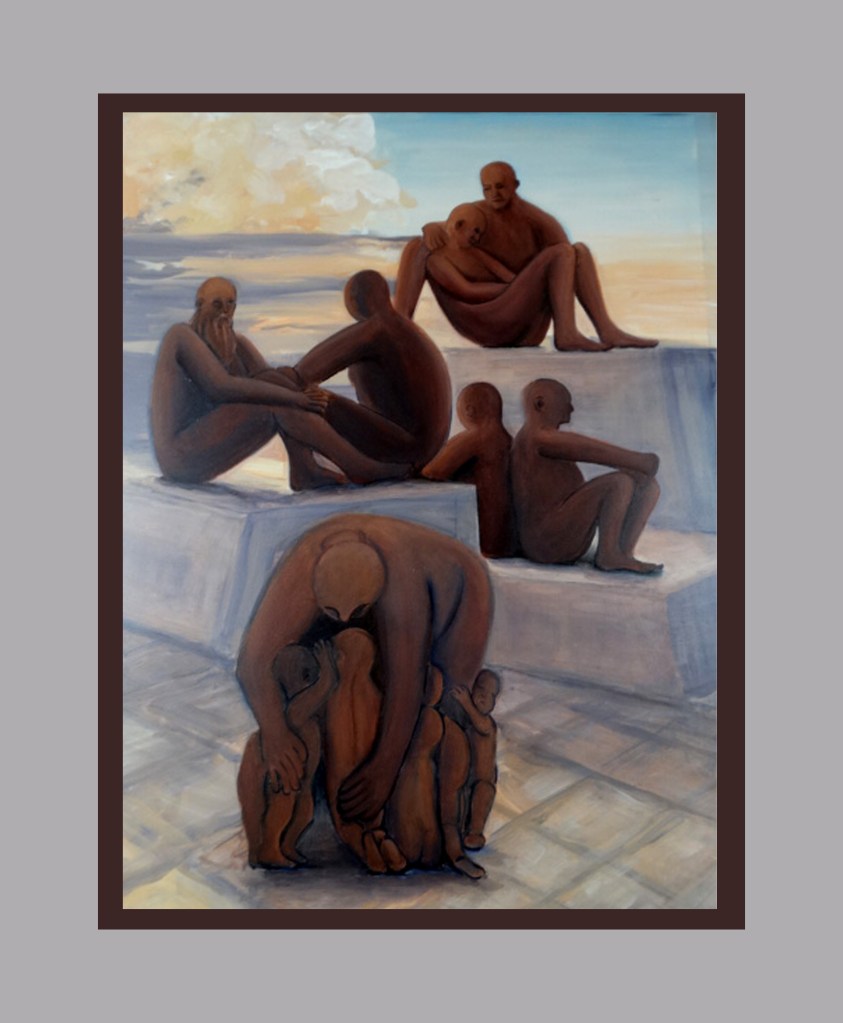
I’ve been thinking about the idea of a post-apocalyptic dark age: the economy has collapsed, goods of any sort are scarce, hostile elements, equally desperate, seek to exploit the Other, survival depends on courage and wits.
It’s the time of year, I guess, that seems to elicit premonitions of immanent disaster. What else can explain Halloween and the Day of the Dead? Add to these events the anxieties of the upcoming election and one can’t help but anticipate ominous times ahead.
Psychically numbing as the times maybe we rationalize it will end, equilibrium will reappear. The anxieties, though, will not go quietly.
The richness of recognized beauty defies simplistic explanation. No ‘eye of the beholder’ or theory of color and form is sufficient to address beauty’s underlying truth.
What other subjective truths are there? Are our intuitive beliefs a reaction to fear of the Other? What can harm us if we stay in touch with the Truth the natural world provides?
I’m wondering if species, creatures with life spans much shorter than ours, tiny beings with brains the size of pin heads, realize, given their brief existence, a rich and meaningful life.
Does a Wooly Bear caterpillar, struggling in moving water, feel angst, realize the probability of imminent demise while memories of hatching, eating and growing, the promise of evolution to flight slowly fades, the hope it’s brothers will survive to replenish the species and sensing these complexities while living a life that is only an instant of the life cycle we manage to waste away in insignificant concerns.
Such thoughts make me think I should pay more attention.
With the enhanced auditory abilities I’ve recently acquired (as a result of the acquisition of hearing aids) I notice what I can only describe as an otherworldly hum (not to be confused with tinnitus, which I also experience) which, if I might be metaphorical, I must interpret as the universe breathing, a wondrous sound Pythagoras might have been referring to (if he hadn’t been being metaphorical) as the music of the spheres.
I can imagine this auditory phenomenon as being primordial, originating with the Big Bang. How wonderful that modern technology has put me in touch, allowed me to realize, my connection to the universe.
I’ve been thinking lately about legacy, how one might expect to be remembered by those who knew him. It would seem most of us would like to be remembered, preferably positively, as a contributing member of his community even as he may have recoiled from participation, leadership rolls, maybe, in civic and religious organizations, being content maintaining a small coterie of friends as social norms require.
Having lived, as I have, in near obscurity, social anonymity for a long time I might expect little remembrance when I pass on, I suppose. But there’s still time. I do have a class reunion coming up. I wonder if my mates will remember me. To paraphrase Woody Allen: all one needs to do to be remembered is to show up.
I just attended my high school class reunion. I must say I was a bit uneasy about going thinking as I did about certain uncomfortable relationships that I experienced during those high school days.
But I was pleasantly surprised at how welcoming everyone was, genuinely happy to see each other, no sense of the teenage cliques I remembered. And, the bullies had mellowed, were really quite pleasant to visit with.
How many years of maturing should it take, I wondered, for a group of diverse individuals to reach common empathy? In this case it was sixty.
My maternal grandfather grew up in a large family of hardworking farmers who struggled to eke out a living from the rocky infertile soil of central Minnesota. Though never talked about, the tenuous life his family lived then was remembered later in life when sitting down to dinner often inspired the light-hearted but perhaps meaningful comment: ‘if you don’t like taters dinner’s over.’ The skills and knowledge required to sustain a farming existence led the brothers to develop an iron casting business that produced iron tools for cutting and polishing the granite quarried from the local mines. My grandfather served as foreman to the men who earned their pay as heavy laborers, casting the molten iron into earthen molds. These men required the intense no-nonsense leader that my grandfather became, moving as he did about the days’ activities, a cigar in his cheek providing a visual exclamation to his hard-working persona. In stark contrast at home G was quiet and subservient to his small soft-spoken wife whose deep evangelical belief drew grandfather into the Baptist church although I wonder about the depth of his faith. It’s hard for me not to appreciate the boot-strap-lifting, the will it took to succeed that produced the comfortable existence his family realized. Born to relative comfort myself I wonder if I would have had the will to succeed as my grandfather did.
Some twentieth century thinkers spent considerable time trying to understand what, exactly, one can know about the world. They thought that the fundamental basis upon which our knowledge of the world rests is suspect, based, as it is, on imagined truths originating from cultural orientations that define reality in terms of conceptual dualisms. Human inclination was to seek a secure ground of being in God or, perhaps, science that could provide reliable answers in dark times of stress and desperation. Such grounding led to unverifiable premises that produced false assumptions about the nature of the world. A number of these deep thinkers dismissed the reliance on the eternal and infinite as being outside the realm of finite human understanding. All that can be known for certain, they thought, are the facts that exist in this world. These guys thought a primordial ground of being as disclosed through conventional world views was not to be found. An honest search would instead reveal an abyss, a nothingness beneath the cultural veneer. To live an authentic life, they believed, one must man-up, face uncertainty, tempt fate and step away from the safety of familiarity. Other philosophers of the time thought a subjective ground of being could be found. Realizing the freedom to do what one chose depended upon a spiritual component to lift such a person beyond causal necessity. This ground of being will be personal and dependent on a belief in an existence beyond factual knowledge. I have to say I admire these great thinkers living as they did through difficult times, unstable finances and psychological angst, who spend so much time and energy pursing ideas that provide us all the opportunity to at least contemplate how we can live our lives authentically.
I’ve been reading, lately, about the common man, the 99% of the population that make up the social milieu and wondering what exactly common men have in common. I’m guessing these folks (well, us folks) are mostly of middle-of-the-road social and economic status, probably have limited educational accomplishment, likely adhere to some sort of religious beliefs and most certainly rely on a social network of other individuals of more-or less like mind. We’re the everyday working stiffs who execute our often-uninteresting daily toils in the hope there lies ahead a future of personal economic progress which will provide and secure leisurely retirement. The uncommon man on the other hand is the intellectual or man of action who drives the public narrative. Maintaining his superior status in a democratic society requires he keep a finger on the pulse of the populace. When the common man begins to lose his sense of hope in a favorable future the uncommon man, in order to maintain his status, must placate the masses by providing a positive vision that a favorable future lies in wait. To maintain societal stability, keep the masses striving for more and better, the uncommon man paints a picture of prosperity near at hand, the good life awaiting those who sustain the necessary drive to be successful. The philosopher Eric Hoffer thought an uneasy, socially and economically threatened populace of common men who, perhaps, had lost the dream of upward mobility have the potential to produce mass movements that have in the past and will likely in the future dramatically affect the course of history. Given the state of our world, these days, it seems to me, what we need to do is seek out an uncommon man of superior artistic ability.
Lately I’ve been viewing a series of programs about the lives of professional tennis players. The athletes that achieve elite status in the tennis world have usually been recognized as prodigies at an early age, as having unique hand to eye skills and an exceptionally strong drive to excel. In the interest of improving, competing with the best, the sport for these folks becomes of singular importance often taking them on an emotional roller coaster as their successes and failures on the court mount up.
Since in each tournament, sometimes involving nearly 100 players to begin, everyone other than the eventual winner will lose, the psychological impact of losing can be devastating for these hard-working athletes causing them to question whether they belong, hence the need for an entourage of supporters encouraging, reassuring them to continue that they have the potential to rebound from defeat. Most will experience the highs of winning but the emotional and physical intensity will eventually take its toll. Few players are able to maintain a career at the elite level for more than a few years.
As the spotlight dims, I guess the considerable monetary payback most of these players have realized will help them ease into a more conventional life, but I wonder how difficult it might be to find fulfillment after living such a high intensity reality.