Ladies of God

I’ve been reading about the many visionary women living during times of particular religious fervor who the Catholic church eventually endowed with sainthood. What made these women special was, that from an early age, they experienced altered states of consciousness, euphoric experiences during which they were able to channel God, were able to perform miracles, heal the sick and provide life affirming insights to those in need.

Catherine Emmerich was an 18th century mystic who received the stigmata, the wounds of Christ, which must have been a credibility producing event beyond doubt. Catherine of Siena, through rigorous fasting experienced a mystical marriage to Jesus at which time she received the ring of his foreskin (providing, I suspect, motivation to require circumcision of all males in the future). Bridget of Sweden, a practicing ascetic experienced over 600 visions in her life. Dorothea of Montau, a 14th century mystic, became an Anchoress, spending her life confined to a cell attached to the cathedral in Kwidzyn in what is now Poland.

What all these women seem to have in common is deep sense of religious mystery that led them to extreme commitment to God and the Church even at the expense of their own physical well-being. There’s small doubt there are commitments people ruin their bodies for these days that are far less significant.

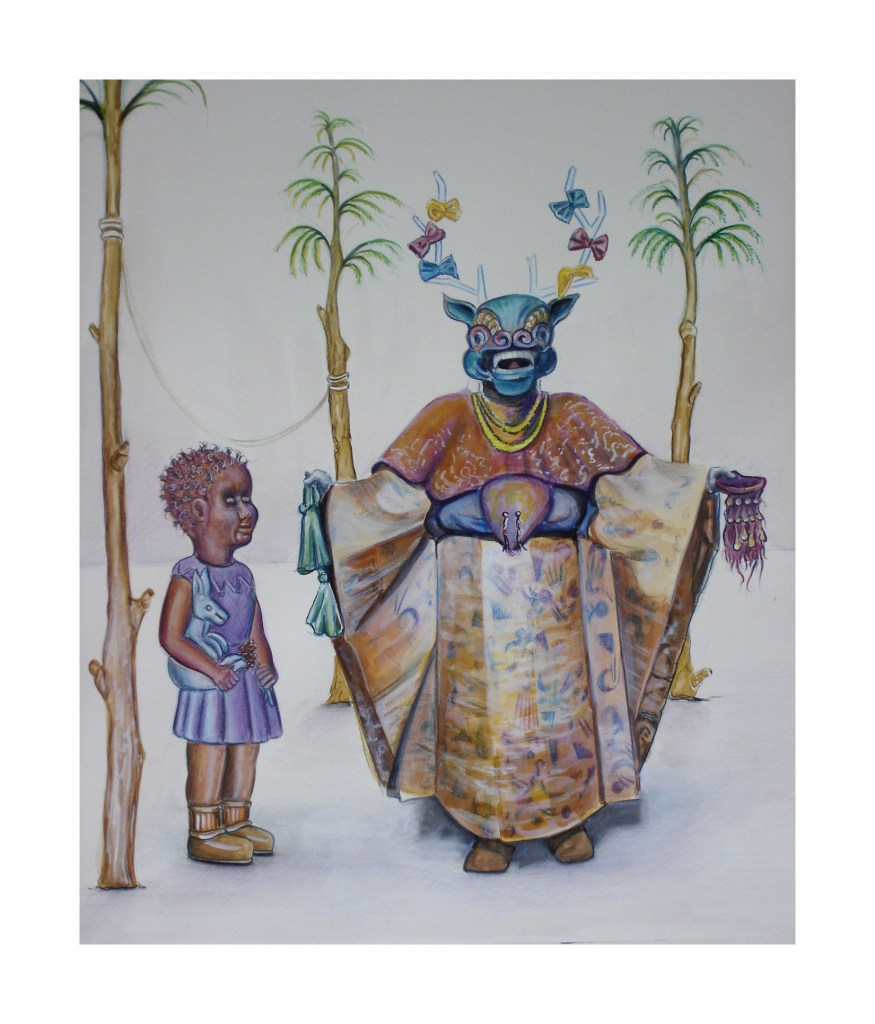
Mother and Child

The Talentless Hero

I’ve been reading aphorisms by the Romanian philosopher Emil Cioran. E. C. was an extreme misanthrope of such pessimistic belief it led his distraught mother, unable to understand his negativity to tell him she wished he’d never been born, that had she known what he’d become she’d have aborted him.

As I seek something enlightening (or at least redeemable) in his writings I find him relating that, while life is a misery, chronically painful, that suffering is universal and never ending and that most people are too pathetic to do anything about it, sustainable existence may lie in hope and the distractions engaging in arts activities might offer. But for the talentless, the disaster which is reality will be overwhelming. E. C. thinks better to give one’s life to heroic acts since there really is nothing to live for. The talentless hero can at least have a sort of remembrance.

As for me, I’m not sure how fair it is to reduce the heroism of, say, a combat troop who falls on a grenade to save his comrades to lack of talent. Still, it’s hard to imagine that an inner life of some sort wouldn’t keep one from diving for cover in such circumstances.

Easter Visions

I’ve been thinking about the influence Christianity had over the people of the Middle Ages. The fact that the peasants, poor as they were, would sacrifice to enrich the church and volunteer back-breaking labor to erect the cathedrals must have meant extreme piety. Their most important event of the year would have been Easter, celebration of the resurrection.

I’ve been reading, though, that perhaps religious experiences, the visions, messages from God so common to these medieval folks might have had something to do with chemistry; an inadequate diet brought on by Lenten fasting as well as the hallucinogenic effects of the ergot that formed in the grain bins as supplies ran low in the spring.

If such was the case for the medieval peasants, any means of tempering the harsh realities of their existence might certainly be thought of as a gift from God.

Trickster Gods

I’ve been thinking, lately, about the trickster gods polytheistic religions have conjured or otherwise discovered among their myriad deities. Tricksters like the Nordic Loki and Kokopelli, God of the indigenous tribes of the desert southwest, are known to be instigators of chaos, are blamed when life’s routines are interrupted or seen as tempters when one strays from the straight and narrow. Deceit, betrayal and treachery are the domains of the tricksters.

In contrast the monotheistic religions, who, of course, do have Satan to blame when things go awry, have the dilemma of reconciling their infallible, all-powerful Deity with the idea He would allow evil to occur, that He is unable to thwart the Satanic demons mortals struggle with.

On the one hand we have the pagans, who, keeping things simple, perform rites to solicit favor from gods they recognized as having faults as well as attributes, who may or may not perform as desired. On the other hand, the intellectual discrepancies monotheists are continually confronted with in order to sustain faith in an Infallible God must consistently be addressed.

When it comes down to it, though, I guess the real issue isn’t about specifics of belief but the mystery of belief in the unknown itself.

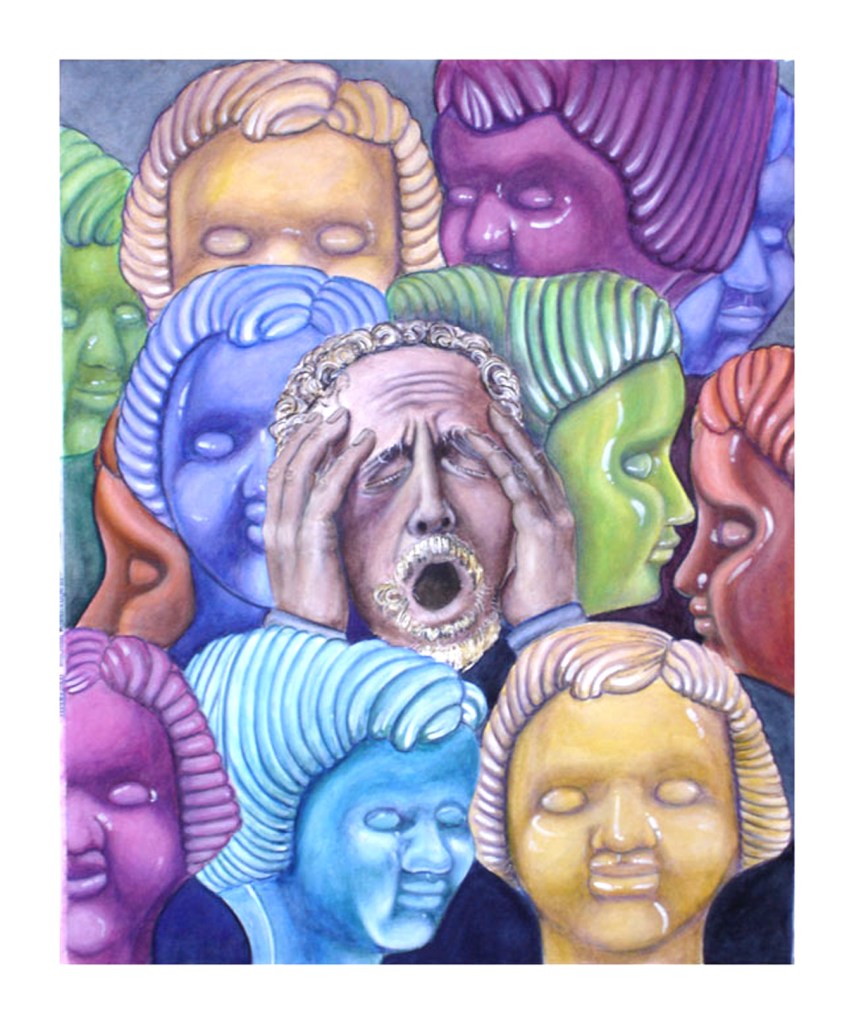
I Recently Discovered that My Brain is Shrinking

The science section of the Sunday paper often has an unsettling item or two, usually involving reports by researchers who have determined the dangers of various common behaviors that will likely shorten one’s life. The article that caught my attention most recently warned that alcohol consumption will shrink the brain. Researchers apparently measured brain sizes of some several hundred people and determined that as little as one drink a day will cause one’s brain not only to stop growing but to actually reduce in size.

As I think about this and being aware, as I am, of my forgetfulness as well as the consistency of my inability to come up with the word I want in a conversation, I’m led to believe the researchers may be on to something. The fact that I’ve been consuming alcohol for probably fifty years has me wondering whether dementia may be just around the corner. After all this time it probably wouldn’t make any difference if I quit my daily glass of wine or not; how much smaller could my brain get?

I guess I’ll just have to add alcohol consumption to my other life-shortening behaviors: too much coffee will give me cancer and I can expect diabetes from the sweetened sodas I drink. Such thoughts dim the brightness of the generally healthy lifestyle I see myself living. I guess the realization of life’s fragility will keep me reading such reports even though I won’t be thinking about them too long: shrinking brain, you know.

Expanding the Mind

I’ve been reading, recently, about the experiments with the drug mescalin Aldous Huxley performed in the 1950’s. He determined that the drug will ‘open the door’ of one’s perceptions, allow one to pass through the wall of harsh reality and for most everyone with proper introduction and guidance, will produce expanding insights, an increasing ability to see more deeply and observe the world ego-free. Being able to embrace the ‘isness’ of our visible world, the stuff of experience that has by survival instinct been reduced to labeled objects, would make everything we see more significant as the drug inhibits self-consciousness.

There are caveats. A sound, stable mind grounded and free of anxiety is essential. AH points out the drug may induce schizophrenic response, scare the user into interpreting his surroundings as cosmic malevolence, begin viewing experiences as conspiratorial, as a plot to destroy him.

Which has me thinking about the alternative realities so prevalent in the public sphere these days. How so many of us have caved to conspiratorial narratives, have fallen into the dark world of the ‘deep state’ even without experiencing the negative effects of a mind-altering drug.

Even so, it seems to me cracking open some of those ‘doors’, gain at least a glimpse beyond our limiting realities would gain us a worthwhile perspective. Maybe, if one really tried one could will the expansion without the drug.

Vision Serpent

The World Without Us

There’s a lot of discussion these days about whether or not humankind is putting excessive pressure on our earth’s finite resources. Population growth, new technologies for extracting fossil fuels, depletion of forest lands, loss of clean fresh water sources, garbage in the oceans, over fishing, the list goes on and on.

I was reading an interesting commentary on what would happen to our world if humankind was suddenly to disappear, how quickly it would rebound, become healthy again. Such a scenario, human extinction that is, is not all that unthinkable in view of international tensions these days.

Such thinking made the book, The World Without us, by Alan Weisman, compelling reading. Mr. Weisman suggests that, in his believable future world, infrastructures would begin to fail, the New York subway tunnels would flood almost immediately and within a few hundred years our most solidly built brick, mortar and concrete structures would crumble. Native vegetation would push up through asphalt roadways hastening nature’s reclamation of the earth. Coral reefs and sea life would rebound as the resilient oceans healed themselves.

Even 500 years later the earth, it seems to me, would be a much more attractive place to be; except, of course, I wouldn’t be here; unless I could somehow live in the future. But, I guess that’s a whole other issue.

An Alternative Civilization

I’ve been reading about an ancient culture of copper smelters that lived in what is now Southern Israel some 3000 years ago. Archaeologists excavating the site of an ancient copper mine have determined these people developed sophisticated smelting techniques, had domesticated animals and traded for food items that originated hundreds of miles away. But other than the information deciphered from the mine site the archaeologists know nothing of these people: no village sites or even single building structures have been found in the vicinity leading to the conclusion these people must have been nomadic.

Such information has me wondering how many other ancient cultures might have existed but are undiscovered; people who might have acquired knowledge, possibly had learned truths about planet Earth that hasn’t come down to us. Maybe these unknown people learned how to live in harmony with their environment, how to nurture and be nurtured. Maybe material acquisition wasn’t important to these ancient, enlightened people who worked together to forge healthy, satisfying autonomous existences, being of the land rather than seeing the earth as a resource to be exploited. This idea has me thinking the values and beliefs we associate with an ‘innate human nature’ may be other than the linear progression of civilization which is our heritage has led us to believe them to be.

It all makes me wonder if we might have become a kinder, gentler people had we followed a different evolutionary path.

The Attraction of Authoritarianism

I’ve been trying to understand the fluctuations in the world order these days with populist movements arising around the world ushering in strongman politicians, spinning narratives of restorative nostalgia, remembrance of times past when everything was better than it now is despite the relative affluence most of us realize.

There are always, I suppose, folks of ambition but mediocre talent who don’t achieve desired advancement, who might seek a less competitive structure than the socio-economic system that promotes the best and most able and insures the system functions as effectively as possible. And then there are those of modest ambition who may fear disenfranchisement and the disfavor of the strongman who climb on the bandwagon.

The problem is that the strongman, assuming free reign, may begin to make up his own rules, begin suppressing opposition, placing restrictions on access to information until there’s only one narrative. And, with only one narrative truth can be stretched, people demonized, scapegoats created to be blamed when things go awry.

Better I think to have a sometimes messy and chaotic pluralism where everyone has a say even if considerable energy may be required in public debate.

Liberty and Justice for All

After reading a definitive, in-depth account of the conflicting narratives between the various parties involved in the American Revolution it occurs to me how amazing it is that any sort of resolution was ever reached, deeply flawed as it was.

Liberty and justice for all was far from the truth of what occurred during and after the war. Moneyed interests controlled the economy to the detriment of the small landowners, Native American populations were pressured off tribal lands, Black Americans were returned to forced servitude. Widespread unrest prompted the founding fathers to push for a restrictive democracy, granting increasing power to the federal government. Congressional checks and balances negated sought after control by special interest groups.

200 years later I guess a certain equity has obtained. Many, assured as they are of equal treatment under the law have freedom to speak their views and can realize a reasonably stable existence even though ‘liberty and justice for all’ is far from a reality.