Seeking God-Master Carpenter

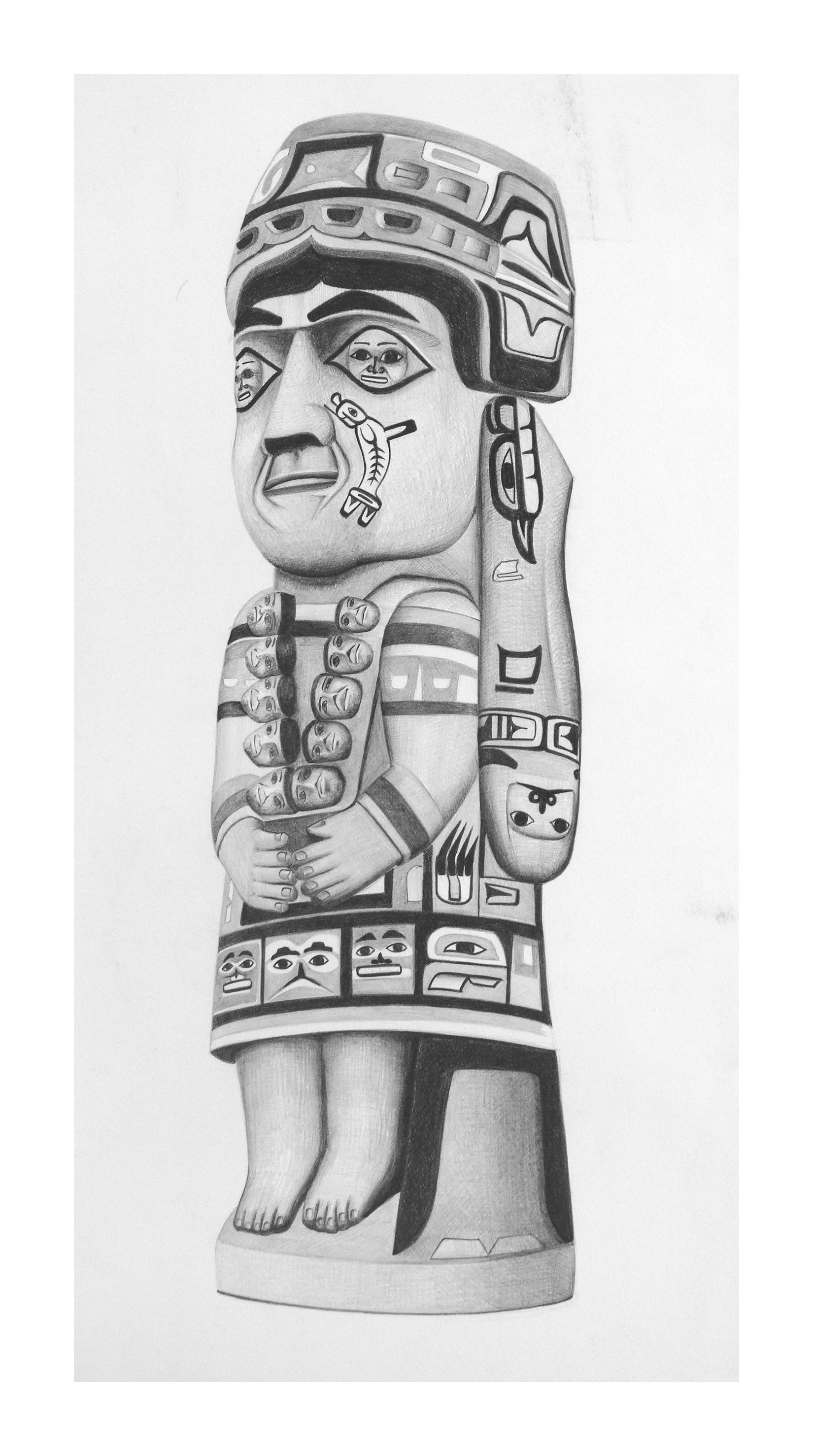
The rich mythology of the Northwest Pacific coast cultures identifies a number of characters that seem likely to have god-like potential. One of these, among the Haida, is Master Carpenter who taught the people how to carve and paint the meaningful imagery that appears on the clan houses.

The story goes that before the people knew very much about art Master Carpenter appeared in a halo of light. He told the Haida to go inside their houses and no matter what they might hear during the night, not to rise from their beds. Even though much pounding and scraping and other noises were heard the people did as they were told. In the morning they found their houses decorated with magnificent carved corner poles and the walls painted with beautiful clan totem designs. Then Master Carpenter told the people he would return each day to teach them the arts of carving and painting.

So, I’m wondering if the Haida people saw Master Carpenter as God. You’ve got the halo and the unreal amount of art produced in a very short time which is pretty potent if not omnipotent. It seems to pretty clearly place him into the realm of the supernatural at least.

I would think that, for the carvers and painters, he should carry a lot of weight-someone to appeal to for inspiration, thank for well-received work and blame for poor performance. I’m just not sure, after he did his initial teaching, how much he continues to hang around.

There’s no doubt he could be useful but I’m not sure he belongs on the short list.

mastercarpenter


Seeking God

I’m on a quest. I intend to find God. Well, I hope to anyway. Maybe it’ll only be a glimpse if anything. I know one of the problems with this seeking is how to recognize God once he’s, well maybe I should say it’s, in the vicinity. I’m pretty sure all this anthropomorphizing that has occurred vis a vis God’s appearance can’t be right; it’s just too far-fetched to expect God to have a physical form at all given his/her/it’s penchant for omni-presence, omni-power and all those other omnis. Although I guess if it wanted to assume a physical form it certainly could.

Anyway, I was reading about these Indian mystics who spend years in intense meditation, living in austerity, intent on achieving connection with the unnameable essence within all things and from which all things emanate. And, amazingly, some of them do find what they’re looking for. Their experiences differ but usually have in common a direct consciousness of the ground of being; a sense of becoming one with the absolute; an enlightened sense of a unified cosmos bound together by love.

Well, it’s pretty clear one doesn’t reach such a level of understanding overnight. This God-seeking is a serious endeavor not to be taken lightly if one expects results. I’m going for it; I’ll spend more time in contemplation; discipline myself to reach beyond; set aside timeout from daily routine.

I’ll let you know what happens.

ecstatic vision 3

Kinship

I was reading recently about the Tlingit people of the northwest Pacific coast. They have an incredibly rich mythology illustrated and enhanced by the beautifully crafted art they create.

Much of their mythology focuses on the close relationship of the people with their animal kin. At one time, it’s believed, all life was one until Raven released the sun. Then, in the light, the people scattered: some to the woods where they assumed four legs and heightened senses of smell and sight, some to the air where they became the birds and some to the sea becoming fish.

And still, the kinship remains a sacred connection with all sentient life, which is not to say these people are all vegetarians.

But, I don’t think they should be thought of as cannibals either. I think the animal in his self-sacrifice is offering himself for the good of the clan. And, I think the people recognize this.

Anyway, a lot of stories are told through the exquisitely carved poles these people continue to produce about the inter-relationships between clansmen and animals. In some cases, like the story of Kat and his bear wife unions are formed and progeny produced reinforcing the notion of kinship considerably.

I think the concept is a good one. Respect for all life forms and the knowledge of our mutual dependence upon one another bodes well for our extended existence.

clanhouse


The Inadequacy of Reason

I was thinking the other day about different kinds of reasonableness.

There is reasoning that follows the dictates of logic based on falsifiable premises and avoiding contradiction. And, then, sometimes the passions get a hold of a person and things can be believed or acted upon based on poor reasoning-things that don’t follow from the supposed justification of the reasoner.

The philosopher, Immanuel Kant, put forth the idea of practical reason. He thought that a belief in God and after-life was necessary (even though not based on falsifiable premises) in order that man behave moralistically and ethically toward his fellows, since such behavior is more difficult than acting exclusively out of self-interest.

Leo Tolstoy wrote A Confession toward the end of his life during a time of extreme disillusionment regarding the purpose of life and the meaninglessness and insignificance of the part he had played in it. His assumption had always been that reason was the ground of existence; that any and all insight and understanding that might be achievable would be so exclusively through reason. And now reason told him that it was all for naught; his existence made no difference in the grand scheme of things. Better to die, he thought.

When he looked around him he saw people engaged in hedonistic pursuits or religious endeavors, neither of which he felt validated a reasoned life. His awakening came upon considering the peasant who toiled and suffered throughout his life but was able to maintain his will to life positively. Maybe lacking formal education and not having too many big ideas to think about had something to do with it, but in their sense of spirit, irrational as it seemed to be, Tolstoy found the answer to his dilemma: reason must embrace the irrational and sustain a faith in the human spirit.

So, if it is fair to assume logical reasoning will not provide the final answers to life’s big questions is a leap into faith despite the irrationality and or absurdities of such the answer?

I guess I’ll stay open to all possibilities: enjoy the beauties of logical reasoning while embracing the spirit. How can I go wrong?

reasonability

Celebrating the Solstice

I love this time of year. As the solstice approaches and the days grow longer the weather is usually warm and nature is in her verdant fullest. Thanks to the strong presence of the sun.

The ancient Egyptians honored the sun, whom they thought of as Aman, on the summer solstice. Apparently in Egypt this time of year the Nile begins to rise and flood it’s banks replenishing the soil; an incredibly significant occurrence for a desert culture.  The Egyptian solstice celebration involved re-enactment of the battle between Horus, the son of Isis and Osiris and his uncle Set. Set, having recently killed his brother Osiris was cast as the bad guy. Horus ends up winning the battle and becoming king of the land but Set isn’t annihilated so continues to hang around being evil and causing havoc.

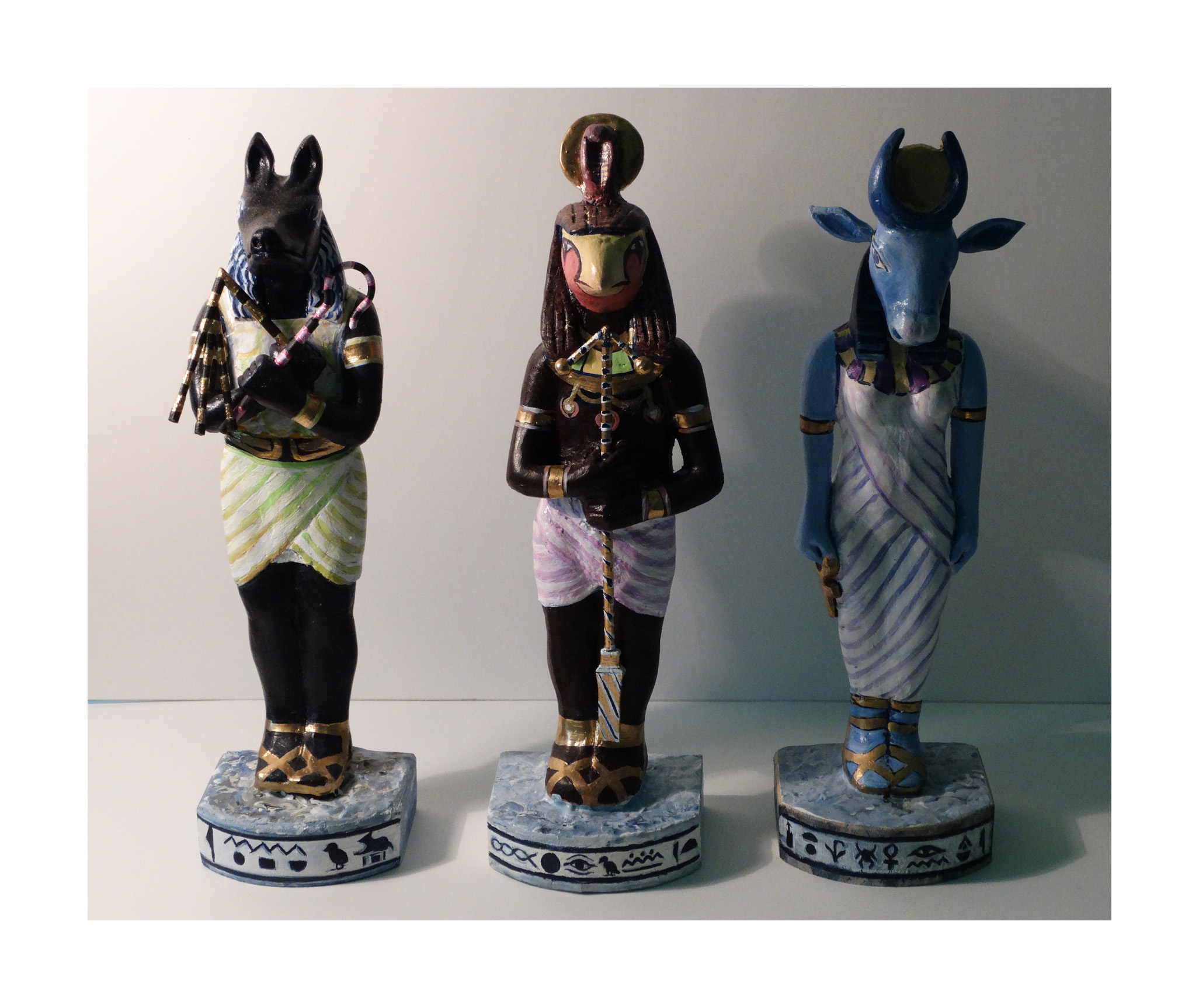
I find it interesting that so many of the Egyptian gods have animal attributes. For instance, Osiris is associated with the bull symbolizing virility and strength, Isis’ fertility is symbolized in association with the cow, Horus, the falcon symbolizes royalty and strength. And that’s just to name three. There was cat, baboon, Ibis, jackal and many other animals honored as well.  Sometimes the gods were thought to have reincarnated into their animal attributes leading the Egyptians to revere animals in a way we, being so thoroughly anthropomorphic, probably can never understand.

I also found it interesting that Osiris, after being reconstructed and brought back to life by Isis was thought to be annually resurrected with the rise of the Nile and it’s life-giving replenishing of the soil. I guess for an agronomist culture the idea of resurrection of life doesn’t take too much imagination.

It seems to me unfortunate that any religious tradition would claim exclusive rights to such a concept.

egyptgods2

The Benefits of Yoga

I’ve been practicing yoga lately and despite my limited mobility am finding the activity very energizing both physically and psychologically. The breathing exercises alone have great beneficial worth.

So, I was somewhat dismayed to read recently that an Indian Yogi named Maharaj, who had, according to his followers achieved the deep meditative state called Samadhi and had actually been existing in transcendental bliss for nearly five months, was declared clinically dead by a group of physicians that the family had called in to examine him.  Apparently his flesh began to turn green which the family saw as a pretty convincing give away.

As it turns out, the organization Maharaj operated from his Ashram  is a multi-national non-profit worth millions. What this suggests to skeptical me is ulterior motives vis a vis the yogi’s followers and his family.

Well, whatever happens regarding this distasteful affair, it won’t dissuade me from my semi-daily yogic exercises. I may never reach Samadhi (which, come to think of it, may be for the best) but I will continue to enjoy the benefits of a wonderful discipline.

buddha

The Rapture


Sister Chloe was enlightening me the other day about what to expect when the end times descend upon us.  At some point, she said, the quick and the dead, provided they are/were true believers, will be raptured heavenward to live for eternity in paradise.

I got to wondering what ‘paradise’ might consist of; is the weather always temperate, the days sunny?  Will the food be exceptional?  Is exercise part of the equation even though it can be a bit painful sometimes?

Anyway, I was reading this book, The Leftovers, about these folks who didn’t get raptured so were left to their daily grinds.  Well, the question that immediately arose after the rapture was why them and not us. It seemed that some of those folks raptured didn’t appear to have led all that great of a life in moral terms and some of those left had been fairly devout church goers.  It was a real conundrum which led to the development of an extremist cult aimed at dealing with the leftovers’ apparent rejection.

Sister Chloe seems to think if I follow my conscience and try to always do the right thing I’ll be just fine-will have nothing to worry about when the Rapture happens.  She’s so compassionate; naïve but compassionate.

The Rapture

Fertility Rites

Eastra, the doll of the season, was telling me the other day that in ancient times the beginning of spring at or about the time of the vernal equinox was celebrated with fertility rites which were meant to encourage a general fecundity among all living things animal and vegetable.

Many cultures had gods and goddesses honored in these rites; there was Artemis in Greece, Cebele in Phrygia, Diana in Ephesus and Attis the god of ever-reviving vegetation who was believed to have been born of a virgin and who died and was reborn annually.

I was trying to imagine what these rites might have been like. They probably involved a lot of fertilizing of various seeds and things and to get everyone into the mood, to get their energy up, to really get into the re-generation mind set there probably was a bit of strong drink, wild dancing and singing.

I found out Cebele the Phrygian Earth goddess was honored with a procession involving wild, high pitched flute music and drumming, scattered rose petals and clouds of incense followed by priests and priestesses scourging themselves with sharp knives.

But that was mild compared to the cult of Ishtar that may have involved child sacrifice, ritual copulation and virginal girls dancing around large male genitalia.

Whatever the rites involved the celebrants must have thought it worked. Besides the great fun had by all (excepting the sacrificial victim) animals reproduced, babies were born and crops grew. It does seem pretty magical and I guess it was hard for most people to take for granted the resurrection of the dormant (or dead) without providing some sort of penitential assistance even though we all know Mother Earth is a gigantic incubator and really doesn’t need that kind of help.

I think I’ll celebrate Mother’s magic with a nice contemplative walk in the woods.

rite of spring 3

Beyond Space and Time


Free-thinking Frank was telling me the other day about this group-a movement really-of skeptics dedicated to the task of debunking all things paranormal like ESP, UFO sightings, conversing with the deceased, telekinesis, and anything else they see as magical thinking.  They’re a conscientious bunch, Frank says, avoiding generalization and attending to the particular, which means they pretty much take all claims seriously.

Employing the scientific method these skeptics seek out verifiable data and eye-witnesses with consistent, non-contradictory accounts but for the most part are seeking normal and natural explanations for the anomalous phenomena thought of as paranormal.  Frank said these skeptics find religious claims dubious as well but aren’t inclined to consider them for analysis since they rely so heavily on non-falsifiable premises.

All in all, Frank said he thought the skeptics are on the right track attempting as they are to clear the air of the fog of magical thinking, you know, putting people on the path of verifiable truth.

As I thought about it, I wasn’t so sure; I found myself skeptical of the skeptics.  It seems to me science has relinquished its claim to the ground of truth these days.  The space-time continuum among other things has really messed with our intuitive sense of the cosmos.  Do our processes of thought even correspond to the structure of nature?

So, for me, it’s time to re-examine the paranormal.  The first thing I’m going to do is dig out my birth chart and see what the stars have in store for me.


evolvingworlds3

Thoughts on an After-Life

I’ve been reading lately about the various ways different cultures and people think about after-life. Many of the various after-life conceptions identify an inner spirit or soul within each individual that is in some way immortal and will live on in a place determined by their conduct in the life they’ve just left. Some contend the deceased will be reborn taking a living form, animal or human, consistent with their previous moral, ethical existence.

Some researchers have hypothesized what the after-life might be like. One suggests that after death the soul floats into the atmosphere where it lives off of the ultra-violet rays from the sun. Another believes after death the self will find itself in a dream word of memories and mental images. Still another thinks the mind will merge into a collective consciousness the downside being it will relinquish its personality.

But, the idea about what the after-life will be like that I like best is that each person will experience a world of her own, unique to herself and consistent with her earthly existence. If my next world follows my nature then it will be filled with wonder and uncertainty and I will continue to question, to look for the ever elusive answer and to revel in the ever-present Mystery. What could be better than that?

Being-in-the-world