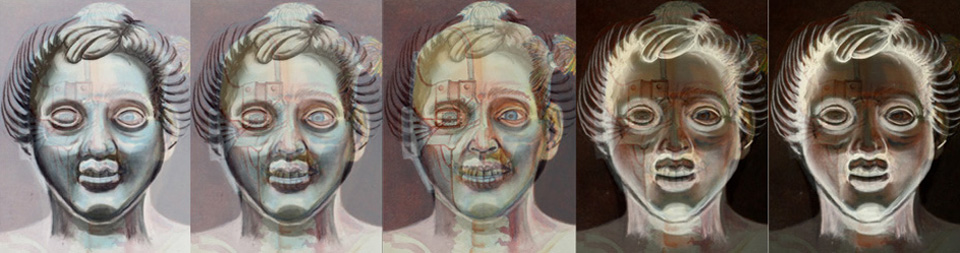
A Fresh Perspective

The new reality I’m experiencing as a result of my altered vision and hearing (due to a recently acquired ‘floater’ in my right eye and the installation of electronic hearing assistance) has, without requiring too much imagination on my part, delivered me into a fresh realm of existence. Not exactly the astral plane, I guess, since I remain physically present and still craving goo pizza, but there is experiential difference in a good way. Required, as I am, to look harder results in my seeing more and hearing more clearly adds to the richness of my general experiencing.

I think lately of the blind character Geordi in the Star Trek series whose ‘visor’ not only restored his vision but provided him with superhuman ability to see.

Nothing superhuman about my sensory alterations but I am enjoying my new perspectives.

Embracing the Absurd

I’ve been thinking about the downside of logical analysis. At what point does reasoning, making decisions based on irrefutable fact become inadequate for certain kinds of understanding?

Is the realm of the supernatural, for instance, discounted in its entirety because it defies logical analysis? If we allow that there exists certain knowledge that lies beyond the rational then credence must be given to the absurd. Derision must necessarily be tempered regarding the illogical and ridiculous.

Unsound reasoning must be allowed. The very argument I make here is, of course, of a reasoned and logical sort but following the public discourse these days makes clear that such rational thinking is unnecessary as the absurd will remain beyond criticism well embedded in popular thought.

I have just rationalized why irrationality must be legitimized. How absurd.

My Maternal Grandparents

My maternal grandfather grew up in a large family of hardworking farmers who struggled to eke out a living from the rocky infertile soil of central Minnesota. Though never talked about, the tenuous life his family lived then was remembered later in life when sitting down to dinner often inspired the light-hearted but perhaps meaningful comment: ‘if you don’t like taters dinner’s over.’
The skills and knowledge required to sustain a farming existence led the brothers to develop an iron casting business that produced iron tools for cutting and polishing the granite quarried from the local mines. My grandfather served as foreman to the men who earned their pay as heavy laborers, casting the molten iron into earthen molds. These men required the intense no-nonsense leader that my grandfather became, moving as he did about the days’ activities, a cigar in his cheek providing a visual exclamation to his hard-working persona.
In stark contrast at home G was quiet and subservient to his small soft-spoken wife whose deep evangelical belief drew grandfather into the Baptist church although I wonder about the depth of his faith.
It’s hard for me not to appreciate the boot-strap-lifting, the will it took to succeed that produced the comfortable existence his family realized. Born to relative comfort myself I wonder if I would have had the will to succeed as my grandfather did.

The Uncommon Man

I’ve been reading, lately, about the common man, the 99% of the population that make up the social milieu and wondering what exactly common men have in common. I’m guessing these folks (well, us folks) are mostly of middle-of-the-road social and economic status, probably have limited educational accomplishment, likely adhere to some sort of religious beliefs and most certainly rely on a social network of other individuals of more-or less like mind. We’re the everyday working stiffs who execute our often-uninteresting daily toils in the hope there lies ahead a future of personal economic progress which will provide and secure leisurely retirement.
The uncommon man on the other hand is the intellectual or man of action who drives the public narrative. Maintaining his superior status in a democratic society requires he keep a finger on the pulse of the populace. When the common man begins to lose his sense of hope in a favorable future the uncommon man, in order to maintain his status, must placate the masses by providing a positive vision that a favorable future lies in wait. To maintain societal stability, keep the masses striving for more and better, the uncommon man paints a picture of prosperity near at hand, the good life awaiting those who sustain the necessary drive to be successful.
The philosopher Eric Hoffer thought an uneasy, socially and economically threatened populace of common men who, perhaps, had lost the dream of upward mobility have the potential to produce mass movements that have in the past and will likely in the future dramatically affect the course of history.
Given the state of our world, these days, it seems to me, what we need to do is seek out an uncommon man of superior artistic ability.

Mythical Thinking

I’ve been trying to understand, lately, what exactly perpetuates the fairly widespread ideas of conspiracy theory surfacing these days in the political sphere. It occurs to me that perhaps many of us are being visited in our thinking by a deep-seeded primal intuition: that appearance and reality are intertwined.
The problem with such thinking is that appearances change; what appeared to be one thing one day takes on different meaning at another time in another context. For mythic believers, a rigidity develops. The idea that once an ‘appearance’ is defined and locked in and what is thought to be the case must be the case, any sort of subtle change in or redefinition of what appeared to be the case can only be thought of in terms of conspiracy. Someone or something must be manipulating Truth.
I suppose one who engages in mythical thinking does realize a richly imaginative existence, one that can be shared with other like-minded conspiracy theorists, of which, it appears, there are many. One would hope, in the interests of a healthier society, reality will make an appearance at some point.


An Impractical Dreamer

In the winter of his eighteenth year this young man fell madly in love (well, it was a serious crush anyway). The object of his unrequited affection was a demure sweet young lady who turned the young man, usually easygoing and affable, into a tongue-tied moron (or so he thought and was in fact true).

The episode was simply reflective of the young man’s nature. He conjured imaginings of romantic scenarios; of heroic stances he might take. He lived in a world of fictional narratives reinforced by the heroic storylines he regularly indulged: good triumphs, tragedy is overcome.

It would seem in retrospect such an imaginative reality would soon be repressed but it was maintained far longer than it might have been by avoiding unpleasant confrontation, keeping a distance from uncertain challenges and living in an (overly) protective home environment. As a college student our young dreamer immersed himself in studies of an impersonal nature, solitary endeavors not requiring excessive personal connections. He had friends of course. College life teems with unassuming young people of an accepting nature, all thriving in an essentially responsibility free environment.

Eventually, over time, even an impractical dreamer will have to face harsh realities. The awakening for our young man came with the threat posed by the draft lottery and the likelihood of involuntary military service. Basic training was eye opening. The young man found himself verbally assaulted. Name calling the likes of which he had never previously encountered (but guessed often referred to perverse sexual acts) was common.

Military service didn’t cure the young man, didn’t redirect him toward a more functional pragmatism. Even now as he passes middle age the man finds himself entertaining flights of fancy. He has somehow been able to navigate through life being sufficiently useful as not to be a particular burden on society, you know, has basically paid his own way.

It’s good to know, I guess, that sometimes life provides a path for those who need to live in an alternative reality.

Mosquito as Collective

A recent camping trip has me reconsidering the nature of Mosquito. It’s natural, I suppose, to see the insects as existing in swarms of creatures genetically engineered to pursue the blood needed to reproduce. But I have become inclined to now see the insect not as individuals but as a single organism working to attack and acquire the essence of their Being.

A Supreme Mosquito directs through a common mind, drones to the front lines to distract the blood source while the more capable move in from behind to withdraw the coveted substance.

It seems pretty clear to me that Mosquito thrives as a collective intelligence.

Is Professional Tennis a Healthy Endeavor?

Lately I’ve been viewing a series of programs about the lives of professional tennis players. The athletes that achieve elite status in the tennis world have usually been recognized as prodigies at an early age, as having unique hand to eye skills and an exceptionally strong drive to excel. In the interest of improving, competing with the best, the sport for these folks becomes of singular importance often taking them on an emotional roller coaster as their successes and failures on the court mount up.


Since in each tournament, sometimes involving nearly 100 players to begin, everyone other than the eventual winner will lose, the psychological impact of losing can be devastating for these hard-working athletes causing them to question whether they belong, hence the need for an entourage of supporters encouraging, reassuring them to continue that they have the potential to rebound from defeat. Most will experience the highs of winning but the emotional and physical intensity will eventually take its toll. Few players are able to maintain a career at the elite level for more than a few years.


As the spotlight dims, I guess the considerable monetary payback most of these players have realized will help them ease into a more conventional life, but I wonder how difficult it might be to find fulfillment after living such a high intensity reality.

Children

I’ve been thinking lately about what it means to produce children, why one would choose, in the first place, to assume the responsibility for creating one. I guess the animal instinct to procreate is a compelling motive (more so for some than others) and a need for the imagined stability of family must be a strong driver.

Once the child begins to grow, responsible parents will do what they can to instill moral and spiritual values as they understand them; will do their best to shelter their progeny from negative peer influences and impose rules they feel will lead to responsible behavior. The child, however, subject to myriad peer influences will respond as any fit animal would weighing options and quickly learning where maximal benefit lies. The parents will soon find themselves on the sidelines, no longer raising and directing, but watching and hoping for the best.

As the child develops into an independent entity, parents will see in it little resemblance to the being they imagined they birthed.

Mental Changes

Experiencing, as I am, the mental changes of aging, I’m finding certain positives occurring. Although being unable to remember what I had for dinner two hours after eating can be annoying, the advantages of ‘forgetting’ an unappealing event or appointment, accepted as excusable, has its advantages. On the downside, along with the short-term memory loss comes the inability to keep up with conversational topic switches, as when talk of a fishing trip abruptly segues to local politics.

All in all, I guess one must cheerfully accept the inevitable decline aging presents and stay upbeat. One’s longevity likely depends on it.