What’s That Smell?

I’ve been reading lately about the complexities involved in understanding one’s sense of smell. Exposures over time to different odors can affect how individuals experience scents in the present. Some smells are undetectable to some people while eliciting strong reactions from others.

Researchers theorize that the smells one grows up with may affect how odors are processed. A dairy farm childhood might elicit fond memories of the smell of cattle manure that differs considerably from that of someone who grew up in the city, whose exposure to the same smell recalls dog excrement stepped in on the sidewalk. Experiencing, assigning quality to odors depends not only on the health of the olfactory receptacles one’s nose contains but also on the variety of scents one has experienced in the past and the psychological baggage that goes with those memories.

I wonder what sort of mindset medieval city dwellers had dealing with the smells of chamber pot content poured from windows, horse excrement in the streets and the flow of human waste through town gutters.

I’ll bet a trip to the country was a breath of fresh air.

Kenosis

I’ve been reading about kenosis, the idea that, in order to fully embrace the natural world in all its beauty and complexity it is necessary to suppress the ego. Seems reasonable I guess: if one’s sense of self is excessive the inclination will be to subordinate, view the world as a vast department store where everything is available for the personal satisfaction of the consumer: forests, water, mineral resources, human labor is there to enrich the individual who covets it.

A strong ego may fail to recognize the presence of the Other: the aethereal essence permeating all things responsible for the beauty and complexity of the natural world. As the natural world comes increasingly under threat, in order to temper its decline an effort will be required that may exceed one’s comfortable complacence, demand actions and behaviors of uncommon strength and sacrifice. It’s not like these ideas are new: most all spiritual beliefs have embraced the sacredness of the natural world, honored the food animal sought benevolence from the Other to ensure food production.

Time to disavow our sense of anthropomorphic superiority, work to become one with the natural world.

Silver Creek (October)

Family Visit

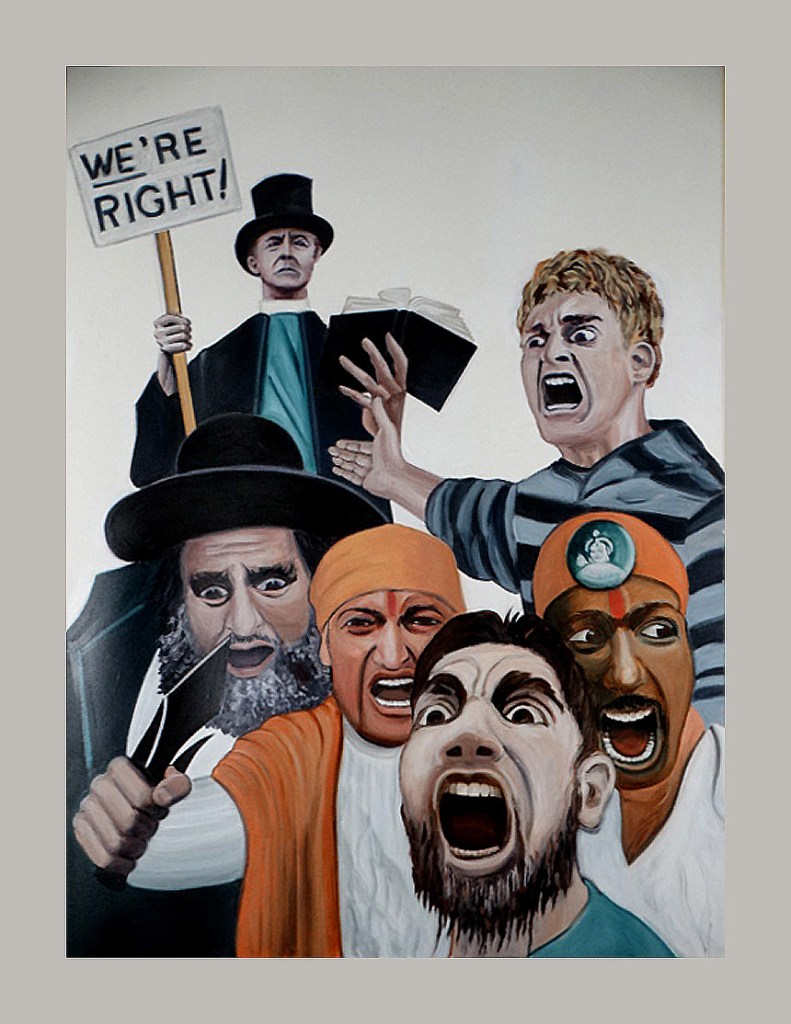
I spent some time with my siblings recently whom I haven’t seen for more than a year. Our relationships have always been congenial and remain so even though our political views and religious beliefs have diverged, become nearly polar oppositional. We each harbor, I’m sure, the certainty the other of us is mistaken, has somehow acquired beliefs so unacceptable that he/she is beyond redemption.

But sensitive topics didn’t come up this visit unlike earlier times when we were younger and aggressively confrontational. Instead, we consciously avoided political warfare in favor of fond remembrances of family no longer living and shared childhood adventures.

Still, I know we will all be best served, that our bonds will stay intact, by maintaining a healthy distance in time and miles between us.

One is Two

I’ve been reading a book on Buddhist thought, lately, and have been thinking about the counter-intuitive idea that one is two. On the surface, the idea is explainable (at least to my mind) in terms of a single defined object that takes on additional meaning when juxtaposed with other things within its visual field: that an object doesn’t exist in isolation, assumes aspects, is affected by, becomes part of a chaotic whole. And the more deeply an object is studied the greater its complexity is realized, melds into the complexities around it. The idea, I guess, is to realize, get a sense of the Whole, the profound inter-relatedness of all matter.

I assume this is what meditation is about. As I sit before my concrete Buddha (the buddha near the pond in my backyard) I allow daily concerns to pass beyond my conscious awareness and instead find and embrace the Whole. Seems simple enough I guess; requires attention though.

What It Means to be a Rando

Realizing myself to be far removed from the popular culture these days I nevertheless caught on to the term ‘rando’ I overheard being used recently in a conversation between two 20-somethings. The term refers, I guess, to someone of little importance, a slight for sure.

As a result, I’ve become aware of how out of touch I am with the ‘in’ use of language and I find it a bit disconcerting, being so unhip (and I’m sure such term itself would be considered pretty lame; as would the use of the word lame in such a context) that I feel a need to try and remedy the situation, try to fit in at least to a degree

In hopes of moderating my pop cultural inadequacies I’ve decided that the next time I find myself in an elevator next to a girl wearing ear buds, I’ll turn to her and ask: ‘So, how do you like your beats?’ That should gain me a degree of cool, shouldn’t it?

Maybe not.

The Bright Side of Life

I’ve been thinking about the satirical Monty Python tune ‘Always look on the Bright Side of Life’. The song comes to mind because I’m finding myself in quite the opposite situation lately: entertaining a dark humor. Being aware of the need to lighten up before I descend too far into the abyss, Eric Idle and the gang, always quick with dark humor of their own temper my daily diet of the news, the knowledge of world events that are consistently quite the opposite of enlightening.

Putting things into perspective, not wanting to totally abandon reality, the boys continue; ‘always look on the bright side of death’, informing us ‘we come from nothing, return to nothing, what’s lost’. And if humor doesn’t lighten one up whistling might help.

Impending Mortality

I had my last colonoscopy today: no polyps, colon nice and clean, good to go. I was beyond pleased at the announcement. Preparation for the procedure I find to be particularly unpleasant. Never having to ever again drink half a gallon of laxative in order to thoroughly cleanse my bowels and then suffering through a day of fasting is so relieving, particularly in view of the fact food is usually at the top of my daily thoughts.

So, I’ll never need the procedure again, my colon will stay healthy. Forever? The procedure being my last one ever along with an earlier assessment of my general health that led to the comment that, I would probably ‘have another twenty years’ before me sounds pretty good but the underlying implication is pretty hard to miss.

Anyway, right now I feel great and can easily live with the predicament of mortality.

Embedded Evil

I’ve been reading accounts, lately, some fictional, some non, of man’s inhumanity to man. Myriad examples abound on various media outlets; news of heinous acts perpetrated by religious zealots and alienated loners among others.

Usually when real bullets or knives are involved, we’re exposed to such malevolence in video offerings that carry a warning of disturbing content of particularly vile acts to prepare us sensitive viewers for what’s to come (which, I suspect, is a real attention grabber) and, when it comes to the fictional realm is choreographed with accompanying soundtrack resulting in glorification, romanticizing the obscenities.

The accounts of wicked behavior I find most disturbing, though, are in the form of written narrative where description can be presented unedited and without censorship, where behaviors so hateful and vile, described in vivid detail, have the potential to burn the obscene imagery into one’s mind.

So, I’m wondering, does consuming knowledge of wicked and vile acts anesthetize, numb one’s sensibilities making the horrors presented more tolerable? Can descriptions of vile acts so horrific that knowledge of them become embedded within the mind of the reader, alter his/her countenance?

I’m thinking we may need to temper our media consumption sometimes, pay attention to the good happening in the world, you know, seek the lighter side. I suspect some research may be involved.

A Symbol of Serenity

I purchased a Buddha the other day; a concrete yard sculpture, a fairly generic cast form, the sort of thing one finds at garden stores next to the gnomes and angels. Being concrete the buddha was pretty heavy to move, it required two workers to lift it into my van and a couple of hours sweat on my part to move it to the location near the pond in my backyard where I’d chosen to place it.

Now, as I stand back and view this sculpture situated as it is amid the verdancy of the surrounding ferns, hostas, Maple canopy and water surface it seems to emanate a significance greater than its generic origin would suggest; maybe it’s massive weight contributes psychologically to the concrete Buddha’s inflated worth, but, even so, it conveys a sense of the serene that I’m thinking will be helpful as I contemplate the big questions from the comfort of a lounge chair on my back deck.

Aristotle’s Legacy

I’ve been reading that, in the mid-20th century, natural philosophy was dominated by logical positivism: the idea that truths are established in terms of clearly perceivable facts, such as size, shape, age, quantity, etc. The logical structure of this theory might be thought of as analogous to billiard balls on a table caroming off one another in blind chain-reactions of cause and effect. Such theory rejects value or quality judgements which are subject to individual interpretation, being of opinion or belief rather than fact.

By 1945, as the atrocities of the Nazi death camps were revealed, some thinkers began to see some otherwise subjective value assignments, evil particularly, as having objective validity. Taking Aristotle as a starting point, the dissenters found a biological paradigm to define the natural world: alive and in constant change, developing, reproducing and transitioning. Rather than blind cause and effect everything in nature is in the process of self-directed development.

These ideas have me thinking of a recent experience I had while paddling my canoe along a shoreline. I startled a duck, most certainly a recent mother, who in the interest of her ducklings hidden somewhere in the rushes, put on the most amazing show of feigned injury, flopping along the water, drawing me away from her brood. Choices were there for her to make: stay hidden or risk her life to draw me off; no ‘blind effect’ to the cause there.
I’m with Aristotle on this one.