How to Live Authentically

Some twentieth century thinkers spent considerable time trying to understand what, exactly, one can know about the world. They thought that the fundamental basis upon which our knowledge of the world rests is suspect, based, as it is, on imagined truths originating from cultural orientations that define reality in terms of conceptual dualisms. Human inclination was to seek a secure ground of being in God or, perhaps, science that could provide reliable answers in dark times of stress and desperation. Such grounding led to unverifiable premises that produced false assumptions about the nature of the world.

A number of these deep thinkers dismissed the reliance on the eternal and infinite as being outside the realm of finite human understanding. All that can be known for certain, they thought, are the facts that exist in this world. These guys thought a primordial ground of being as disclosed through conventional world views was not to be found. An honest search would instead reveal an abyss, a nothingness beneath the cultural veneer. To live an authentic life, they believed, one must man-up, face uncertainty, tempt fate and step away from the safety of familiarity.

Other philosophers of the time thought a subjective ground of being could be found. Realizing the freedom to do what one chose depended upon a spiritual component to lift such a person beyond causal necessity. This ground of being will be personal and dependent on a belief in an existence beyond factual knowledge.

I have to say I admire these great thinkers living as they did through difficult times, unstable finances and psychological angst, who spend so much time and energy pursing ideas that provide us all the opportunity to at least contemplate how we can live our lives authentically.
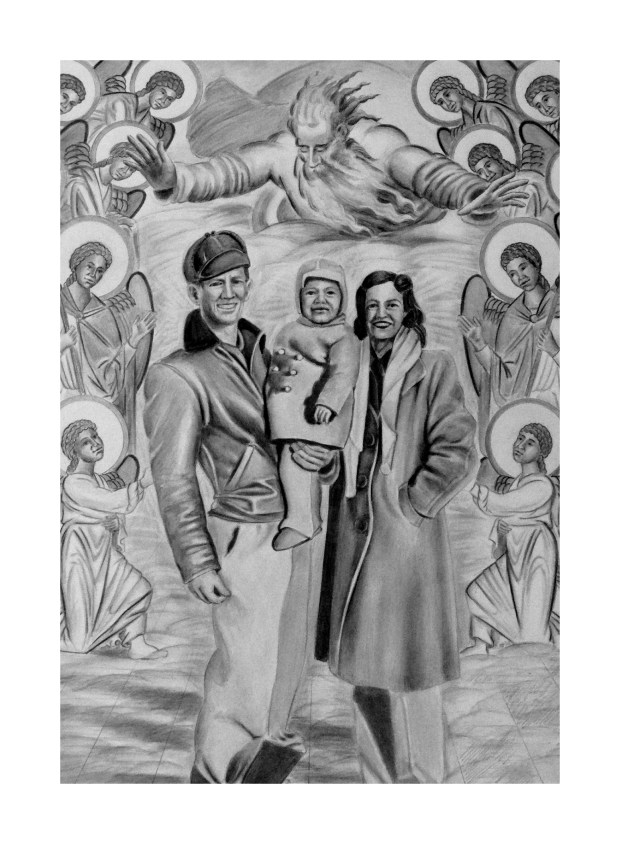
Upon Encountering God

He felt pretty good, confident in his aerobic fitness, you know, for his age: looking forward to the post-workout high that follows pushing oneself to near exhaustion. Nothing like cross-country skiing to achieve a full-body workout. A couple more strenuous climbs and he’d be home.

And then, a new experience: he found himself levitating above the ski trail. Below him a skier lay. He must have had trouble navigating the steep uphill. A voice above him offered context: “Well, it had to happen sometime. The old heart finally gave out; happens pretty regularly if you want to know the truth.”

The skier found himself thinking, reviewing events from his past, reflecting on relationships, choices made, evaluating his character: did he think of himself as a good person over-all? One has regrets, things he might have done that he didn’t and vice versa.

The voice again reading his thoughts: “Everyone who’s honest has regrets. Human failings are an obvious given, but all in all you’ve done less harm than good. You’re no genius but you keep seeking answers, simplistic as they may be. I know you think of me as a figment of your imagination which may in fact be so, but maybe internal conversations do have good answers to offer.”

“Anyway, shake it off, snap out of it, you only bumped your head.”

Leaps into Freedom

I’ve been reading about some of the deep thinkers of the early 20th century, how they struggled to come to grips with the tumultuous uncertainty of the time. Clearly, the 1920’s must have been difficult: the western world had just endured a devastating world war that put question to the very value of human life. The dissolution of long held beliefs brought about by Darwin’s theories of evolution 20 years earlier had serious religious implications for many and Einstein’s relativity theory upset the belief that time and space were fixed entities.

So, the philosophical search was on to find a grounded reality. Questions abounded: What lies within the bounds of knowable truth? How does language determine what can be thought? How do social norms repress spirit? In various ways a common thought occurred to these brilliant thinkers: In order for man to rise above the moral and spiritual ennui of the times he must muster the courage to intellectually move beyond, to take the leap into the freedom of personal choice without any assumption of reward, earthly or heavenly, expecting nothing and assuming total responsibility for one’s existence. Setting aside the false assumptions brought about by the mythical thinking embedded in language will lead one to realize a truly authentic life: to being one’s true self.

How exciting it must have been for those who dared take the leap beyond conventional foundations, accepting one’s existence fully in place and time, realizing the freedom of personal responsibility. The headiness of absolute personal freedom, I suspect, was eventually tempered by the need for close relationships and the giving they require.

Resisting the Inevitable

Doing my daily stretching regimen the other day and finding it occasionally painful has gotten me thinking about the inevitability of the physical downslope I’m descending. Ageing has a way of putting one’s physical prowess into perspective. Memories of the stamina and flexibility that once were mine have become distant.

So, as a counter measure to deal with this somewhat depressing realization I’ve obtained a wrist mounted device that measures my daily physical activity. I get encouragement sent to me online if I meet certain daily parameters. The device functions as a personal trainer to keep me on task, keep my physical activity reasonably high, keep the calories burning. This athletic enterprise has me, for the time being, feeling pretty good about my physical health, stamina and weight stability. My daily exercises, though, aren’t getting any easier. I remain aware of the reality of my situation, that the best I can hope for is to maintain an equilibrium for awhile.

I’m not giving up. Better, I think, to at least stay mobile. I’m determined to use it until I lose it.

The Uncommon Man

I’ve been reading, lately, about the common man, the 99% of the population that make up the social milieu and wondering what exactly common men have in common. I’m guessing these folks (well, us folks) are mostly of middle-of-the-road social and economic status, probably have limited educational accomplishment, likely adhere to some sort of religious beliefs and most certainly rely on a social network of other individuals of more-or less like mind. We’re the everyday working stiffs who execute our often-uninteresting daily toils in the hope there lies ahead a future of personal economic progress which will provide and secure leisurely retirement.

The uncommon man on the other hand is the intellectual or man of action who drives the public narrative. Maintaining his superior status in a democratic society requires he keep a finger on the pulse of the populace. When the common man begins to lose his sense of hope in a favorable future the uncommon man, in order to maintain his status, must placate the masses by providing a positive vision that a favorable future lies in wait. To maintain societal stability, keep the masses striving for more and better, the uncommon man paints a picture of prosperity near at hand, the good life awaiting those who sustain the necessary drive to be successful.

The philosopher Eric Hoffer thought an uneasy, socially and economically threatened populace of common men who, perhaps, had lost the dream of upward mobility have the potential to produce mass movements that have in the past and will likely in the future dramatically affect the course of history.

Given the state of our world, these days, it seems to me, what we need to do is seek out an uncommon man who can produce for us all a vision of hope and cooperation.

Unimpeachable Truths

I’ve been thinking lately about the multitudes of good and sincere people in the world who have arrived at dramatically conflicting views as to the nature of reality.

Most all of us rely on what we consider to be unimpeachable support sources for our views and usually a contingent of like-minded others that reinforce our beliefs. The evangelical Christian, the Qanon conspiracy buff and the liberal mainstreamer will tend to approach daily occurrences with sets of premises and then conclusions that are quite different. Such conflicting perspectives are the stuff of the social divisiveness manifesting itself these days; the dilemma of free thought in a free society free from coercive oversight, I guess.

I have no answers other than responding with patient tolerance in the knowledge that most everyone deserves respectful acknowledgement of their usually carefully considered views. The hope is that we can all spot disinformation when it presents itself. Hopefully, we can think past the response of the recently interviewed lady asked why she embraces her position on a current controversial idea. ‘I know it’s not true’, she said, ‘but it’s consistent with my beliefs.’

Upon Reflection

I’ve been reading about the history of the mirror: how the idea of ‘reflection’ took on new meaning over time.

Humankind has, of course, been aware of the reflected image since pre-historic man first gazed into a still pond. The dangers of such a discovery became apparent in Greek mythology when Narcissus, realizing his beauty, became obsessed with his reflection, fell into despair his love of self could never be requited, killed himself and was reborn as a flower (curious but fitting, I suppose).

By the Renaissance pretty much everyone had access to mirrors. It didn’t turn all Italians narcissistic but the focus on personal appearance brought about by the availability of the reflected image profoundly affected the way people everywhere thought about themselves. Gazing into a mirror makes the gazer aware of his (or her) unique oneness. Social relationships become more complex. The individual, aware of her (or his) physical attributes easily assumed an expectation of relative worth beyond the status assigned by other means such as social rank, wealth or useful contribution to society. Visual presentation: grooming habits, manner of dress hair styling became increasingly significant and for some cultures border(ed) on the ridiculous.

I must admit to remembering preening in my teen years. Now I purposely avoid mirrors whenever possible. But, as my physical appearance has become less photogenic I find my psychological well-being not as dependent on visual presentation. One of the advantages of ageing, I guess.

Routine

The idea of routine these days has taken on a sort of oppressive new meaning, limited as we are in our ability to socially interact and move about freely without concern of infection. Before the onset of the dreaded virus relieving a tedious daily cycle was as simple as a museum visit or dinner out with friends, experiences that give life meaning, expand imagination and help us realize possibility.

The conundrum has me thinking about cyclical time, how daily experiences reoccur with a good deal of regularity. Eastern Religions have long understood time to cycle on a cosmic scale which, I suppose, gave hope to those living less fortunate existences (who also looked forward to reincarnation). The philosopher Fredrich Nietzsche came up with a thought experiment he called Eternal Recurrence. The idea is to suppose one is destined to live this life over and over repeating the same experiences forever, an eternal cycle. The implication is, that if such were to be the case, one would want to be very careful that each moment of life was lived to the optimum: as best and as positive as one could make it happen.

What we need to do in covid world, I guess, is find ways to sustain ourselves positively, in uplifting ways. As important as it is to stay centered, alive and present in the moment, distraction may be in order. Many may find solace in readings with happy endings while others may seek the catharsis of apocalyptic disaster literature. Hobbies might be developed. Exercise is always good, solitary sport activities might be explored.

I really don’t have any particular advice for anyone, just trying to work it all out for myself.

Are We Living in a Simulation?

There are certain theoretical physicists contemplating, as I understand it, the idea that perhaps we are not living a base reality but are in a simulation, an artificial reality. We may be, they surmise, virtual beings created by a higher intelligence with infinite computational facility. These cyber-gods’ superior intellect along with our limited capacity to fully understand our world renders it impossible for us to grasp the closed system provided by our overseers.

The overseers, acting as game players, pit us against each other, create inventive situations for us to deal with and suffer through and then play favorites, much as the ancient Greek gods did. The idea is, I guess, our overseers are using us as pawns in the ultimate virtual Game of Life.

Well, if I am existing in a virtual closed system, I really can’t complain too much, reclining, as I am, in my lounger in front of a warming fireplace. I do, of course, face difficulties from time to time: existential psychological eruptions I must deal with, but all in all life is pretty good. If I am a virtual being in a created world it would seem my cyber-gods are fairly benevolent.

Belief in God

As things began spiraling out of control she wondered if belief in God was a viable option.

Well, maybe belief was the wrong word. It seemed to her unlikely one can suddenly ‘believe’ something, but there were remnants of belief she had taken to be credible at some earlier time in life. There were beliefs introduced to her as a child that had drifted along in her sub-conscious all these years until recent existential shock brought them (the beliefs) to the surface, beliefs which seemed, suddenly, to be just the thing these extraordinary times require.

So maybe it was more like expedient, practical to seek and find a supernatural entity to appeal to in these dire times when her resources were strained and uncertainties about her very survival constantly weighed upon her. She had settled, after all, as she had thought about it over the years, on an enlightened agnosticism, resisting the hard atheism embraced by some. God as a concept was elusive but not easily dismissed in totality and now seemed the time to, if not make re-acquaintance, at least allow the embedded idea to come a bit closer to the surface. There is something comforting about the idea of a benevolent overlord, protector, benefactor in these uncertain times.

But finding and maintaining belief, she realized, wasn’t that simple.