Superior Intelligence

I’ve been reading that there is evidence to suggest that the world is getting smarter, that world-wide, IQ scores have been steadily rising at a rate much faster than an evolving humanity can explain, which doesn’t necessarily mean, I guess, that a person of average intelligence one hundred years ago, transported by time machine to the present would be borderline retarded by our standards. But the presumption is our great grandparents would be sorely lacking in the intellectual flexibility we’ve become adapted to in recent generations to deal with the complexities of technological advancements not to mention the inter-connectedness communications with the world-at-large has impressed upon us. It appears our existence, the intellectual world we occupy, is larger and multi-faceted in ways unimaginable in the world of the 1920’s.

One wonders, though, if living in a smaller reality back then, restricted even to a limited geographical existence, you know, knowing less, didn’t have its advantages in terms of less anxiety, stress, working longer days and weeks making for less time to contemplate, anticipate all of the potential evils one might imagine. Living as they did through the devastation of WWI and the 1918 flu epidemic, did a naïve faith make it possible for them to realize a peace we will never again be able to grasp?

We’re healthier, wealthier and longer-lived than our great-grandparents could have ever hoped to be, but I have to wonder if our increased awareness makes us happier.


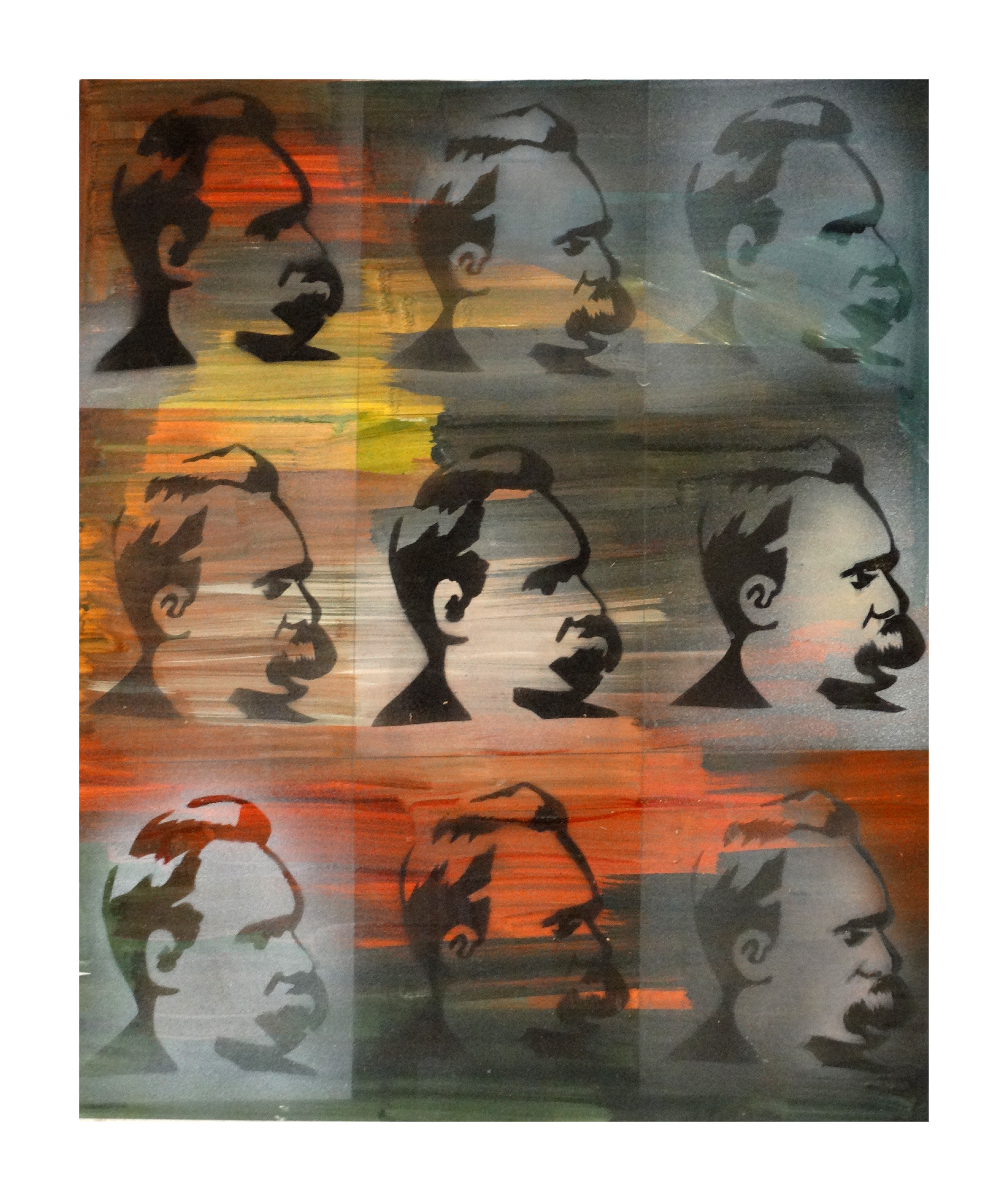
Maybe Nietzsche wasn’t so Pietzsche

I’ve been reading that, perhaps, Friedrich Nietzsche doesn’t deserve the unqualified admiration many, including me, have afforded him. His narrative flair, admonition to become; to rise above the masses and his denigration of the humble subservience, the ‘slave morality’ the church imposes, was, and still is I suppose, heady stuff for energetic youth who see before them boundless opportunity once they break free of the shackles of their controlling elders. I guess the problem becomes, how many friends and relatives end up under the bus as our young Nietzschean races toward becoming all she can be.

Our young pursuer of truth doesn’t realize, I guess, that Nietzsche’s ‘Overman’ is beyond her reach, the amoral purveyor of ‘Beyond Good and Evil’ will without second thought cast her into the abyss alongside her fellow inferiors. Our philosopher’s dismissal of moral proprieties, advocacy for the advancement of a dominant ‘higher man’ and elimination of the decaying races was philosophical fodder upon which the fascist evils of the 20thl century fed.

There’s no doubt Nietzsche was a great intellect (with an ego that matched). It’s unfortunate his social isolation or, perhaps, his austere Christian upbringing took him down such a pessimistic path. What would it have taken, I wonder, for him to have found true human compassion?

Optimism

I’ve been reading a very credible, in-depth commentary suggesting that never at any time in history has humankind enjoyed a better, more favorable existence than we do right now. Economic growth world-wide has increased longevity, relative health and safety; social strife, whether racial or religious has seen significant reductions as has conflict between nations. Relatively speaking, I’m led to believe, the potential for living a long happy and satisfying life has never been better anywhere.

As I read these optimistic observations and being, as I am, a regular consumer of the daily news and commentary, filled, as it is, with notions of potential doomsday scenarios, from terroristic infiltrations of our homeland to environmental devastation of our good earth not to mention even more dire possibilities like cyber attacks potentially destroying democracy as we know it and genocidal viruses being loosed upon us which could in all believability kill millions, I have to wonder how long, if I were to jump on the optimist’s bandwagon, such a deluded sense of well-being would be sustainable.

I don’t think it’s responsible to quit paying attention to the news altogether but maybe I might do a bit better sorting the sensational from the truly dire. Is it worthwhile to be conjuring images of ant-biotic resistant pathogens consuming one’s body from the inside-out or should I perhaps temper my news consumption a bit, maybe focusing on the truly useful issues like reducing my carbon footprint, being a more responsible consumer? I’ll try to take a more balanced approach to information consumption.

The Cave and the Light

I’ve been reading a quite in-depth account of how, throughout history, two particular strains of thought have been instrumental in quidding our understanding of the world around us.

Platonic thinking attributes essential truth to an eternal reality in relation to which our world is but a temporary, fleeting imperfection. The ultimate answers we seek, according to this philosophy, will be realized in contemplation of the eternal ideal forms of true reality.

On the other hand, Aristotelian thought is, that to know, to gain knowledge of the world in which we live requires sensory observation. Experiencing first hand, gathering information and applying inductive logic to what we see around us will unravel the mysteries of this life.

The thinking is, I guess, that pretty much all our philosophical tendencies will fall into one of these two modes. The Plutonic tending toward (or rationalizing) religious engagement with an heavenly realm, while the Aristotelian thinker gravitates toward science with its logical processes and empirical observations.

On a personal level it seems to me both perspectives can be embraced to some degree without contradiction. In fact remaining open to all possibilities would appear a smoother road to travel and with better scenery along the way.


The Romantic Sublime

The romantic inclination to solitary communion with nature in order to find truth in beauty is beyond doubt appealing and resonates with anyone who enjoys an invigorating walk in the woods.  The thoughtful Romantic realizes, of course, that nature has her darker side. The sun isn’t always shining, the birds sometimes are silent and Nature can on occasion lose her nurturing aspect, may in fact turn violent and even hostile, threatening the well-being of humankind. Nature’s beauty isn’t lost, though, in the violence of a hurricane or snow-storm but is re-characterized as sublime: an overwhelming and awesome power beyond human imagining.

It seems Nature’s sublimity is increasingly apparent these days, extreme weather events occurring with regularity. A thoughtful Romantic might wonder if perhaps there’s anger being leveled at a humanity exploiting her realm, encouraging us to take heed, to realize a necessary respect for the nurturing environment that sustains us.  Well, being the timid Romantic I am, I’m doing my best to reduce my carbon footprint in the hope Mother Nature will see fit to allow my continuing existence.


An Incurable Romantic

I suppose there must be an inclination for the thoughtful mind to balance opposites. During the 18th century the scientistic logic of the Enlightenment generated the philosophical counterpoint of Romanticism, a view of nature as transcendent ‘beauty as truth, truth beauty’. The thinking was, I guess, that Nature was the source of all knowledge, the way to deep understanding, so communing with nature, engaging in contemplation of the natural world was the way one might proceed to fully find the secrets our world holds.

I wonder if the adolescent ideas of ‘romance’ get in the way sometimes of an understanding of the significance of this early philosophy. Certainly the aspects of the romantic displayed in media dramatics: maudlin emotionalism, heroic fantasy and the like are a far cry from the philosophical significance of 18th century Romanticism.

I think that the attention to our nurturing natural world that the Romantics found so significant mustn’t be forgotten. The contemplative mind will embrace those ideas and work to philosophically assimilate them. Hopefully the true’ Romantic spirit’ won’t be lost amidst the superficiality of our popular culture.

Capitalism

I’ve been reading, how, in the 18th century the spirit of capitalism was instrumental in establishing wide spread personal freedoms and a kinder more cooperative society. The concept of free marketing meant everyone had opportunity to go into business for herself, solidifying her relationship with her fellow townsfolk and contributing to the betterment of all.

I guess it took a while before the realization there might be a downside to a materialistic prosperity to take hold. Class division, owners versus workers, made for disproportionate gains. Access to natural resources, mineral and timber rights and land ownership contentions, leading eventually to excessive exploitation of resources all spelled out a basic human fallibility: an over-blown, out-of-control self-interest. Obtaining more, often much more, didn’t necessarily translate to altruistic behaviors.

And, now, as the divide between the moneyed and the poor continues to grow, the more enlightened among us call for a moral capitalism, a conservation of the earth’s resources and a fairer distribution of wealth.

As I look about at what’s happening these days it appears we still have a way to go with that.

A Social Contract

I’ve been reading about the philosopher Jean Jacques Rousseau who developed quite an enthusiastic following in 18th century France. The gist of his thinking had to do with the idea of subordinating individuality to participation in the ‘social welfare’ of all in the community (which he identified pretty clearly as ‘us’ not ‘them’, a xenophobe, I guess). He advocated a purer, simpler life free of the oppressive class divisions that competitive commercialism produced. The primacy of our community should always supersede personal acquisition and behaviors, he offered, which sounded to pretty much everyone at the time a virtuous direction for society to take.

Anyway, around the same time the enlightened public (the well-to-do ones anyway) were enthusiastically embracing these ideas, the king, Louis XVI was bankrupting France, allowing a lot of folks to go homeless and starving in the streets. Oblivious to the plight of the masses his Queen, Marie Antoinette, suggested that if the people were starving they should just go ahead and eat cake.

The people understandably revolted, stormed the Bastille, released political prisoners and guillotined the royal couple. The leadership vacuum was filled by the likes of an egocentric Robespierre who took to extremes the philosophical perspectives of our Rousseau such that if one wasn’t overtly sacrificing for the ‘general will’ she might likely end of guillotined or hung. Apparently, Rousseau’s ideas got a bit out of hand, applied with a bit too much zeal.

Lessons to be learned, I guess: be skeptical of leaders that attempt to isolate and demonize a perceived evil ‘other’, that find conspiracies were they don’t exist. Do we need another Napoleon?

Wisdom

I’ve been wondering lately how exactly one achieves wisdom. After reading credible commentary on the actual lives of some of western civilization’s most notable philosophers it appears that, more often than not, the great minds of history have fallen well short of achieving the high ideals they advocate in their writings. When it came to basic living and social functioning many of our philosophical heroes struggled; were pretty inept to be perfectly honest. They often capitulated to oppositional forces out of fear of retribution from an intolerant church or tyrannical politics. They tended to fail in attempts to establish lasting relationships and they regularly came up short of the moral imperatives they so often championed.

It makes me wonder how seriously I should take Socrates admonishment that ‘the unexamined life is not worth living’ or the Delphic injunction to ‘know thyself’. Should I even wonder what I can know or what ultimately I ought to do? Can I hope for more than what I have reasonably before me?

The alternative, though, is daunting: proceeding without direction, acting exclusively from self-interest or pursuing survival as an end-in-itself. I guess great ideas and thoughts lift us above the mundane, offer possibility and hopefully help us maintain a healthy sense of altruistic support for our fellow man.

I guess I’ll keep reading.

Saving Planet A

I’ve discovered recently the thoughts of an innovative thinker, Kim Stanley Robinson, who has some quite amazing ideas about how we might potentially nurse our threatened world back to health or at least slow its deterioration.

Could it be possible to blast particulates into the earth’s atmosphere, simulating a volcanic explosion, to filter the heat of the sun with the very positive result of lowering temperatures? How about spraying sea water onto the polar ice caps on a massive scale to recapture the melting seas? Technologically and economically challenging ideas I suppose but at what point will such extreme measures be necessary to save the world?

Then there’s the concept of ‘quantitative easing’, a method of monetary manipulation that’s already been employed to stave off financial crises by ‘producing’ large amounts of capital. Perhaps with the proper monetary incentives farmers could be induced to engage in carbon trapping technologies and to replant acreage in bio-diverse forest lands. With additional capital solar and wind farms could become a primary factor in electricity production. Everyone, given the proper incentives could move toward clean energy transportation.

Being that there’s little doubt that impending environmental disaster is imminent, perhaps innovative thinkers like Kim Stanley Robinson should be taken seriously.