I’ve been reading a book on Buddhist thought, lately, and have been thinking about the counter-intuitive idea that one is two. On the surface, the idea is explainable (at least to my mind) in terms of a single defined object that takes on additional meaning when juxtaposed with other things within its visual field: that an object doesn’t exist in isolation, assumes aspects, is affected by, becomes part of a chaotic whole. And the more deeply an object is studied the greater its complexity is realized, melds into the complexities around it. The idea, I guess, is to realize, get a sense of the Whole, the profound inter-relatedness of all matter.
I assume this is what meditation is about. As I sit before my concrete Buddha (the buddha near the pond in my backyard) I allow daily concerns to pass beyond my conscious awareness and instead find and embrace the Whole. Seems simple enough I guess; requires attention though.
In these divisive times of disparate beliefs and alternate realities it seems reasonable to weigh with care one’s personal offerings on subjects of controversy. Strong opinions will arise inevitably in all of us paying attention to the political narrative these days, our chosen news feeds providing us with sound bites of ‘logical’ support for our irrefutable truths. Voicing opinion may best be tempered in the interests of momentary calm, but such a stance seems rarely practiced.
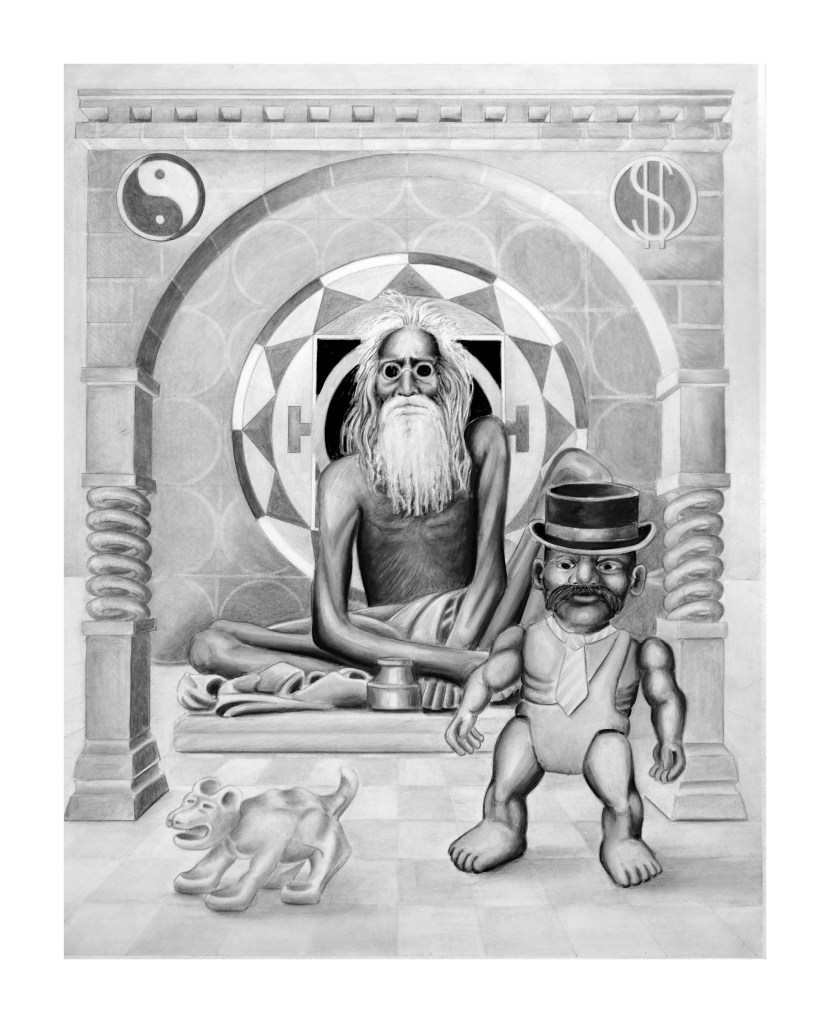
I’ve been reading about the concept of Mumbo Jumbo, an adaptable personage in the traditional cultures of Central Africa. When conflicts emerge, often within the polygamous harems, Mumbo Jumbo may appear with masked face, top hat and staff to gather the community and then single out the most egregious disruptor for punishment.
I’m wondering if a similar sort of magical thought may be creeping into our thinking these days.
I’ve been reading about the reality lived by people of late-medieval Europe who were inclined to interpret the phenomena of daily existence as a struggle between the forces of good and evil. Caught, as they were, between the beginnings of a science-based understanding of the physical world and the ancient beliefs they held about the potency of the supernatural, these folks tended to lean most heavily on the latter, which unfortunately led to ill-conceived practices detrimental to their existence: bloodletting and exorcism to name just two.
Not so easy, though, to dismiss the magical thinking of those earlier times: many of us still conjure images of evil entities responsible when bad things happen. As much as we might like to think ourselves intellectually superior to our medieval forebearers it would appear their ancient beliefs still inhabit our psyches.
I’ve been thinking lately that language is a limiting and essentially inadequate means of describing experience. (As I think about this it occurs to me I’ve probably thought this very thing before; in fact, I doubt I’ve had a truly original thought anytime recently).
Anyway, language may be the only way of describing experience, but the descriptions rendered no matter the mastery one may have of the written word will fall well short of sufficiently describing the color and complexities of sensual experience.
Roland Barthes, the late French literary theorist, said that man cannot know, understand prior to developing at least a rudimentary language. I’m inclined to disagree with such an idea. It seems to me my colorful and complex sensual experiences can occur to my conscious self without interpretation; that it is unnecessary for language to supervene upon my experiences for them to actually exist.
But, then, maybe my memory is going, I am aging after all; brain cells are being lost. Still, the visual imagery is there and doesn’t seem to require captions. I’m thinking language is over-rated. It simply is unable to account for the ineffable.
I’ve been reading that entertainment in late medieval France involved, for many of the unlettered inhabitants’ activities and performances we today might find a bit disturbing.
The Church was always on the lookout for those among the population whose behaviors might suggest possession by the devil (or devils, I guess). Exorcisms were a popular occurrence attended by the citizenry who looked with rapt attention as devils were extricated from the possessed by various means sometimes involving holy water enemas.
Women who were known to employ magic were considered in league with the devil and so declared witches subject to burning at the stake or drowning unless she floated in which case she would be burned. Such events were another well attended attraction no doubt.
These uneducated medieval folks saw most everything in terms of the supernatural. Fear of the Devil was a significant aspect of their reality. Satanic power begets respect leading many to participate in Black Sabbaths where the Evil One was worshipped, moral abandonment the rule, promiscuity encouraged, and great fun was had by all.
I guess for the average medieval townsfolk all was not pain and hardship, entertainments were there to be had if one could avoid becoming the focus of attention.
As things began spiraling out of control she wondered if belief in God was a viable option.
Well, maybe belief was the wrong word. It seemed to her unlikely one can suddenly ‘believe’ something not believed or at least had taken to be credible at some earlier time in life. Something, some idea, introduced to her, possibly in childhood that kind of drifted along in the sub-conscious for years until some sort of existential shock brought it (the belief) to the surface and seemed suddenly to be just the things the extraordinary times required.
So maybe it was more like expedient, practical to seek and find a supernatural entity to appeal to in these dire times when her resources were strained and uncertainties about her very survival constantly pressed. She had settled, after all, as she had thought about it over the years, on an enlightened agnosticism not a hard atheism. God as a concept was elusive but not easily dismissed in totality and now seemed the time to, if not make re-acquaintance, at least allow the embedded idea to come a bit closer to the surface. There is something comforting about the idea of a benevolent overlord, protector, benefactor in these uncertain times.
I’ve been thinking lately about escape. The psychological desire to retreat to unfamiliar environs even for a couple of days is truly compelling. Months long wait lists for camper purchases and campground reservations unavailable into late fall informs me I’m not alone. The uncertainty of contracting the dreaded virus variant even after being vaccinated has led the more responsible among us to seek outdoor activities away from urban crowds.
I long for such escape realizing at the same time that the whole notion is illusory: leaving home, traveling, is at best a distraction, a means of removing oneself from one’s daily realities, a short-term reprieve at best.
Knowing this truth changes nothing. If anyone hears of a lightweight camper for sale, please let me know.
The human genome has finally been deciphered and connected suggesting that in the future an individual’s genetic flaws may be found and possibly corrected leading to the potential for longer human lifespans. Imagination might lead one to the idea that sustaining life indefinitely is within the realm of possibility.
On the face of it the idea seems pretty uplifting, having all that time to…………… well, do exactly what. Another problem that comes to mind is that the very nature of human Being depends on uncertainty. Awareness of one’s mortality, as subliminal as it may be, is an enlivening prospect, an experiential richness, without which one would likely fall into a debilitating ennui, losing any sense of meaningful life.
It will be some generations, I suspect, before anyone must worry about such things. Meanwhile, realizing mortality will keep us in mind of the preciousness of daily existence.
I’ve been reading essays, lately by the 19th Century philosopher William James. W. J. believed the best path to a healthy happy existence passed through religious belief, which, he writes, involved embracing the best, ‘more eternal’ things in life. He poses his argument at a time when many were coming to grips with the revelations science had uncovered about the natural world. Mysteries previously attributed to the supernatural became understandable; an Enlightenment world view undermined religious belief for those who thought about such things. W. J. argues philosophical pursuit of ‘objective truth’ will only yield, in the end, a deadly dogmatism, an intellectual dead end unable to accommodate experiential re-discovery. Such a pursuit lacks grasp of the realization that scientific knowledge is but a drop in the sea of the unknown.
Our philosopher maintains all of us, everyone, has an ‘inner voice’, an intuitive sense beyond our rational, logical minds that we sometimes suppress, but, when acknowledged can contribute to a superior life experience. One must, he suggests, exercise intellectual bravery, seeking answers to Life’s Big Questions, to not fear being wrong, to conjure the faith to believe. Skepticism he writes delays man’s emotional, intellectual development, is no more than a delaying tactic for those afraid to be wrong. A foray into the metaphysical, the supernatural world is an enlightening prospect, a means of realizing possibilities of eternal entities which will convey a sense of optimism to those religiously embracing that which is beyond the confines of science.
On the face of it, to my 21st century mind, W. J. seems a bit too optimistic. Was the late 19th century a simpler more naïve time? Well, certainly not. It’s just that we’ve put the front and center LBQ’s on the back burner these days.
I’ve been reading, lately, about the primary concepts of Stoicism. Among them is premeditatio malorum, which means, I guess, to ponder potential ills in order to keep in mind that bad things may occur at any time to prepare one for the eventual worst-case scenarios that life may impose. The idea seems to be that by living under a slightly dark cloud, one isn’t surprised and overwhelmed when bad things occur.
The concept seems counter-intuitive to the naïve paean to eternal optimism: “things could always be worse” which most of us intone pretty much all the time, even through the pain of the oppressive pandemic. The notion reminds me of Voltaire’s satirical ‘Candide’ where the eternal optimist Pangloss maintains we live in the “best of all possible worlds” even as one terrible event after another fall upon our hero.
But, there are other important Stoic concepts to keep in mind like starting each day with a morning meditation, ending each day in reflection, practicing moderation in all things, speaking less and thinking more among them. All of which suggests Stoic practice has many benefits even if eternal optimism isn’t among them.




 deideismusings