Our Evil Selves

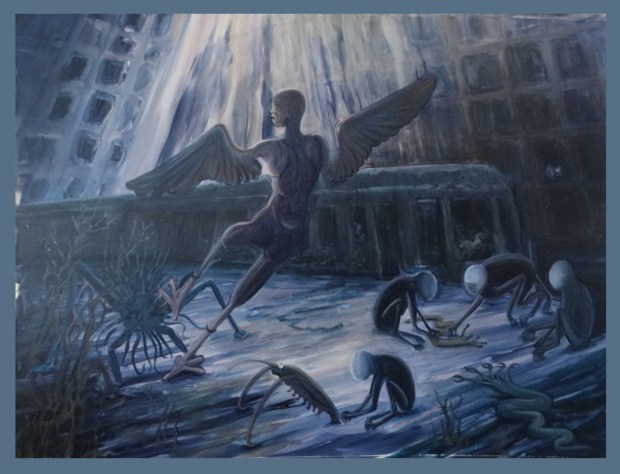
I’ve been reading that everyone has within them the potential to behave in ways that can only be described as wicked. The idea is that although most of us develop moral values that help us remain socially responsible neighbors, (you know, do unto others as we would have them………..), a shadow self that has the potential to cause us to engage in evil behaviors, lurks within us.

Sometimes obsessions driven by envy, pride, greed or lust can turn us away from the moral guidelines that have made it possible for us to live socially responsible existences. If these obsessions grow and fester, continue unchecked, they may disrupt our sense of identity to such an extent we may forget who we are. When this happens the potential for evil behaviors against our fellows becomes all too possible may even lead us to actions that go far beyond the disquiet that led us initially to the obsessiveness, which can result in a total annihilation of what was initially desired and spiral us downward into self-destruction.

An Impractical Dreamer

I’ve been reading, lately, about the common man, the 99% of the population that make up the social milieu and wondering what exactly common men have in common. I’m guessing these folks (well, us folks) are mostly of middle-of-the-road social and economic status, probably have limited educational accomplishment, likely adhere to some sort of religious beliefs and most certainly rely on a social network of other individuals of more-or less like mind. We’re the everyday working stiffs who execute our often-uninteresting daily toils in the hope there lies ahead a future of personal economic progress which will provide and secure leisurely retirement.
The uncommon man on the other hand is the intellectual or man of action who drives the public narrative. Maintaining his superior status in a democratic society requires he keep a finger on the pulse of the populace. When the common man begins to lose his sense of hope in a favorable future the uncommon man, in order to maintain his status, must placate the masses by providing a positive vision that a favorable future lies in wait. To maintain societal stability, keep the masses striving for more and better, the uncommon man paints a picture of prosperity near at hand, the good life awaiting those who sustain the necessary drive to be successful.
The philosopher Eric Hoffer thought an uneasy, socially and economically threatened populace of common men who, perhaps, had lost the dream of upward mobility have the potential to produce mass movements that have in the past and will likely in the future dramatically affect the course of history.
Given the state of our world, these days, it seems to me, what we need to do is seek out an uncommon man of superior artistic ability.

Finding God

Here in the wilds the breeze is moving through the trees rippling the water, providing a soft music, an accompaniment to the sensual feel of the wind.

We experience individually, our interpretation is our own, it is a personal failure to reduce what is before us to a simple explanation of natural law.

My Maternal Grandparents

My maternal grandfather grew up in a large family of hardworking farmers who struggled to eke out a living from the rocky infertile soil of central Minnesota. Though never talked about, the tenuous life his family lived then was remembered later in life when sitting down to dinner often inspired the light-hearted but perhaps meaningful comment: ‘if you don’t like taters dinner’s over.’
The skills and knowledge required to sustain a farming existence led the brothers to develop an iron casting business that produced iron tools for cutting and polishing the granite quarried from the local mines. My grandfather served as foreman to the men who earned their pay as heavy laborers, casting the molten iron into earthen molds. These men required the intense no-nonsense leader that my grandfather became, moving as he did about the days’ activities, a cigar in his cheek providing a visual exclamation to his hard-working persona.
In stark contrast at home G was quiet and subservient to his small soft-spoken wife whose deep evangelical belief drew grandfather into the Baptist church although I wonder about the depth of his faith.
It’s hard for me not to appreciate the boot-strap-lifting, the will it took to succeed that produced the comfortable existence his family realized. Born to relative comfort myself I wonder if I would have had the will to succeed as my grandfather did.

Mortality

Having recently experienced deaths of a number of people close to me, I can’t help thinking about mortality and what may come next. Humankind has, of course conceived existence of some sort after death for as long as self-consciousness has been realized, and although the physical presence of those deceased will no longer be with us, they do live on in our memories even as we realize an emptiness in their absence.

Whether wishful thinking or a transcendental awareness, after life existence will never disappear as a concept, as widespread religious practice, dependent on such belief, affirms. Even the non-religious must harbor the notion of some sort of post-biological consciousness.

In any case, a healthy perspective will depend on reveling in the wonder of a fleeting daily existence.


Christian Apologetics

I’ve been reading, lately, Penzees, written by the 17th century philosopher Blaise Pascal. The work goes into great detail defending and advocating belief in Christianity. Rationale for such belief centers on the idea man is morally flawed and sinful making existence psychologically painful. Why else, the apologist argues, do we avoid the reality of the here and now through pre-occupation with the past or anticipation of the future, or by other constant diversions that keep us from facing the inevitable: the realization of a finite existence that will end in extinction.

The solution to this dilemma, we are directed, is in admitting our shortcomings, relinquishing our pride and our fear of the enormity of existence. If we do this, we can create a space, a place for God.

The philosopher offers strong argument. We all, if we think about it, live with our uncertainties and fears. Belief in a benevolent God will surely bring peace of mind to those able to embrace it. There are caveats, I suppose. One may find, upon commitment that remaining in ‘good faith’ may be somewhat more involved than a simple declaration of belief.

The Sport Fishing Culture

I’m spending a week at a resort in northern Canada, a fishing camp catering to hard-core fishermen and women.

I watch as these singular-minded folks pull into the resort in their 3/4-ton four door Dodge Rams or the like pulling boats powered by 100 horsepower Suzuki outboards complete with swivel seats, windshields, depth gages, sonar fish-finders and mounted trolling motors. Big people mostly gathering around their cabins at days end, deep-frying their batter-coated fillets of Walleye on their propane deep-fryers, standing around in groups of six or so, beer in hand, watching their meal cook, talking of the days catch, I’m guessing.

I walk out the door of our cabin, they look at me, at my scratched up, dented 14-foot rental boat with the nine-horse Evenrude, ask how I did, “catch much?”; (better have a convincing answer to avoid the inevitable smirks, I’m thinking), “got a nice Walleye”, I lie.

I’m feeling pretty out of place here; I dream of spending time on one of the beautiful islands in one of these enormous lakes, enjoying a relaxing picnic away from the wave tossed boat and the competitive atmosphere of the camp.

Cape Breton (September)

Another School Reunion

I’ve been thinking lately about what draws people to get-togethers with their former high school classmates years after graduation. It makes sense of course to want to reconnect with those who were good friends, but I suspect those who wish to do so are in the minority, that there are a variety of other reasons compelling attendance.

High school was and is a contrived culture dictated by overseers in an artificial environment with time restrictions, attendance demands and pecking order. Those in charge, aware their charges harbor under-developed brains tolerate them on the basis of their cooperativeness, a fact not lost on the average intelligence who may opt to suck up to those in charge, rebel and play the renegade or simply accept the situation and persevere; we all know which behaviors can expect future social and economic success.

It’s mostly out of curiosity, then, that reunion attendance occurs. Everyone is wondering how so and so made it through life to this point given how tenuous his/her potential survival appeared back then.

The Look of Love

I read in the paper the other day that Burt Bacharach died. News items sprinkled with his biggest hits reminded me, and I’m sure many others who grew up in the ’60’s, of our post-high school days. Listening to Burt’s music has me remembering the naivete we shared, the romantic perspectives we embraced. Remembering some of the lyrics now, though, is a real eye-opener. Consider: ‘on the day that you were born the angels got together and decided to create a dream come true, so they sprinkled moon dust in your hair of gold and star light in your eyes of blue.’ Deeply romantic, I guess, but now it makes me wince.

Even considering Viet Nam and the Kennedy assassination we were of a simpler nature then, a bit less jaded, it seems to me. The tunes do bring back fond memories of convertible cruising on summer nights and minimal responsibilities, and I guess listening to Burt’s music may have had some positive effects on our developing psyches.

Animal Nature

Numerous paintings have been done over the centuries of peasant celebrations, often in wooded settings, where revelry is apparent, debauchery implied. The imagery captures times, sometimes after harvest when food has become abundant after the lean months before, other depictions suggesting spring when mankind recognized the rebirth of nature and the fecundity it implies.

The ancient Greeks depicted the animal nature released during these times of celebration as animal/human composites: satyrs, fauns, nymphs, suggesting, I guess, that the human inclination to give into one’s natural urges was less than civilized.

There are some of us, I suppose, who might benefit from such emotional release, civilization overlaying, as it does, a blanketing guilt upon those who might pursue such Bacchanolic revelry. Maybe we should rethink our moral priorities in the interest of mental health.