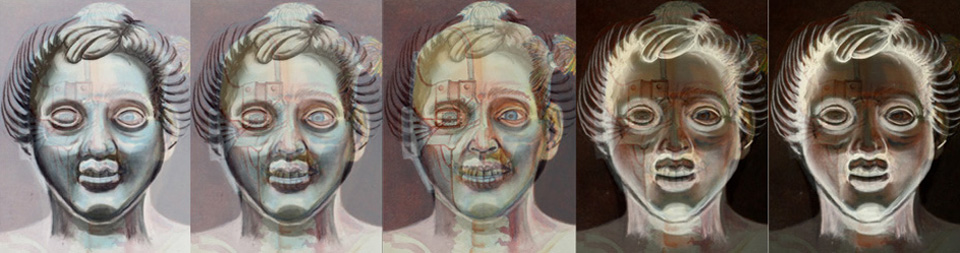
A Shadow Self

I guess it’s pretty clear that we are all innately susceptible to wicked behaviors. That, while we maintain a respectable public persona within us burns a shadow-self, a dormant entity that when motivated surfaces to exhibit behaviors that can only be described as evil.

There are various reasons why an evil shadow-self might reveal itself: fear of the Other among them. An obsessive jealousy might ignite one’s Darkside as well as vain responses to threatened identity. Instigators might arouse the shadow-selves in whole populations by demonizing a scapegoat as happened with the witch burnings during the Middle Ages and antisemitism in the 1930’s and 40’s.

When the eruption of the shadow-self occurs, our moral imperatives will likely be overwhelmed allowing our innate wicked behaviors to flood in.

A Fall From Grace

A stable upbringing will usually set most of us on a path to becoming someone worthy of self-respect. Through responsible participation in the mechanisms that contribute to a functional society we will find ourselves woven into the social fabric of our communities, thereby garnering the respect of our peers who share our moral values. Our sense of self-worth will grow into the assumption of political power, of being a man among men.

If, though, pride-in-self becomes excessive one may slide with ease into vanity, a character flaw demanding constant reinforcing kudos. As the need for recognition grows obsession develops, becomes dangerous, finally producing a loss of identity, a non-person results, immoral, prone to unjustified retribution against imagined nemeses. An inglorious fall from grace.

Our Evil Selves

I’ve been reading that everyone has within them the potential to behave in ways that can only be described as wicked. The idea is that although most of us develop moral values that help us remain socially responsible neighbors, (you know, do unto others as we would have them………..), a shadow self that has the potential to cause us to engage in evil behaviors, lurks within us.

Sometimes obsessions driven by envy, pride, greed or lust can turn us away from the moral guidelines that have made it possible for us to live socially responsible existences. If these obsessions grow and fester, continue unchecked, they may disrupt our sense of identity to such an extent we may forget who we are. When this happens the potential for evil behaviors against our fellows becomes all too possible may even lead us to actions that go far beyond the disquiet that led us initially to the obsessiveness, which can result in a total annihilation of what was initially desired and spiral us downward into self-destruction.

The Sacred and The Profane

Today’s newspaper carries news of a recently deceased 15-yearold Italian boy, Carlos Acutis, who has been designated by the Church for sainthood. Carlos developed an on-line exhibit of Eucharistic miracles that have occurred over the centuries, which caught the imaginations of the faithful making him prayer-appealable, accrediting to him miracles of healing through his on-line exhibit.

The Church in its infinite wisdom, had Carlos’ body exhumed, organs removed and cosmetically enhanced so pilgrims journeying to Assisi can receive whatever blessing the future saint might grant, the Church, meanwhile holding the increasingly valuable relics.

Faith is a tenuous thing. I suppose it’s necessary, in order to maintain belief, to find new saints and have their body parts available for purchase.

The Sacred and The Profane

Unimpeachable Truths

I’ve been thinking lately about the multitudes of good and sincere people in the world who have arrived at dramatically conflicting views as to the nature of reality.

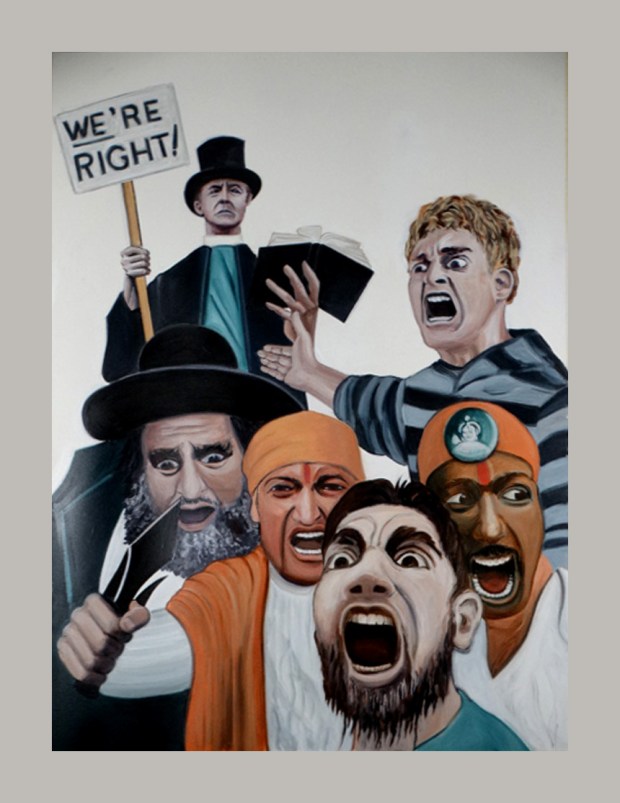
Most all of us rely on what we consider to be unimpeachable support sources for our views and usually a contingent of like-minded others that reinforce our beliefs. The evangelical Christian, the Qanon conspiracy buff and the liberal mainstreamer will tend to approach daily occurrences with sets of premises and then conclusions that are quite different. Such conflicting perspectives are the stuff of the social divisiveness manifesting itself these days; the dilemma of free thought in a free society free from coercive oversight, I guess.

I have no answers other than responding with patient tolerance in the knowledge that most everyone deserves respectful acknowledgement of their usually carefully considered views. The hope is that we can all spot disinformation when it presents itself. Hopefully, we can think past the response of the recently interviewed lady asked why she embraces her position on a current controversial idea. ‘I know it’s not true’, she said, ‘but it’s consistent with my beliefs.

The Problem with the Theory of Intelligent Design

After thinking about for some time, it occurs to me that the problem with the theory of Intelligent Design is that it requires combining and organizing disparate parts into a whole; particularly complex structures may involve evolved parts which are themselves constructed from even more basic components making such a concept unimaginable.

But biological life begins as a whole (single cell amoeba) that evolves from a primordial chemical soup. It grows and evolves from infancy to adolescence to maturity. Only afterward does the evolved being manifest the intelligence to conceive the notion of organized parts.

Eternal Recurrence

I’ve been reading about the fairly difficult existence that the philosopher Friedrich Nietzsche endured over his life time. Given his self-imposed isolation and the debilitating health issues that he endured: fairly constant migraines and nausea, it’s small wonder many of his thoughts were less than uplifting.
But, the physical and mental infirmities led him, I suppose, to one of his most notable ideas.

Eternal recurrence, stated simply, is to “live this life again in all its aspects, every pain and every joy, every thought and sigh and everything unspeakably small and great in the same succession and sequence over and over for ever and ever”, which must have been a pretty horrible idea for Nietzsche given his health and loneliness issues.

So, I’ve been thinking, maybe there’s something to be learned here, you know, make friends, go to the doctor, do good things; if life is indeed cyclical than maybe recurrence wouldn’t be so bad. There still would be periods of boredom to deal with though, I suppose.

The Effete Aesthete

I’ve been thinking about how visual art is consumed. I’m inclined to believe most people, viewing representational artwork relate favorably or unfavorably as the content reflects their interests: outdoor lovers and landscapes, hunters and wildlife, etc. Then, there are the aesthetes who revel in the beauty of color and composition or disdain the lack thereof. They seek rhythm, form and pictorial depth rather than meaningful subject matter.

The Effete Aesthete takes the visual art experience a step further. She seeks aesthetic nuance, contextual reference or artist intent as basis for value judgement, even though such meaning depends on secondhand interpretation provided by a critic or curator thereby eliminating the need for an honest interpretation of her own. Such action would seem to be a sterile and overrefined approach to visual art viewing.

Unimpeachable Truths

I’ve been thinking lately about the multitudes of good and sincere people in the world who have arrived at dramatically conflicting views as to the nature of reality.

Most all of us rely on what we consider to be unimpeachable support sources for our views and usually a contingent of like-minded others that reinforce our beliefs. The evangelical Christian, the Qanon conspiracy buff and the liberal mainstreamer will tend to approach daily occurrences with sets of premises and then conclusions that are quite different. Such conflicting perspectives are the stuff of the social divisiveness manifesting itself these days; the dilemma of free thought in a free society free from coercive oversight, I guess.

I have no answers other than responding with patient tolerance in the knowledge that most everyone deserves respectful acknowledgement of their usually carefully considered views. The hope is that we can all spot disinformation when it presents itself. Hopefully, we can think past the response of the recently interviewed lady asked why she embraces her position on a current controversial idea. ‘I know it’s not true’, she said, ‘but it’s consistent with my beliefs.’

Witch Hunts: The Problem of Inter-subjective Knowledge

The idea of the existence of witches is age-old but became particularly oppressive in 15th and 16th century Europe when imaginative tales of satanic behaviors became so ingrained in people’s minds it created a pseudo-reality that led neighbors to accuse neighbor of subversive behaviors, witchcraft, based on little more than petty jealousies. The accused were often tortured to confess and then burned or drowned on little more than hearsay evidence. Fear, fed by the church, was rampant, accusations plentiful, stories of satanic tortures and murders of children spread through the populous daily. Thousands were accused and put to death based on information that carried no factual evidence.

As the stories spread, igniting the imagination, they became seen as fact, even doubters were drawn in until the reality of the stories were known to be true beyond doubt.

I wonder how often the information we glean on-line inspires descent down the rabbit hole into equally absurd beliefs.