The Ancients

I’ve been wondering, lately, if anyone thinks about the ancients anymore. I’ve been reading about the polarizing political intrigues that engulfed Plato in the later years of his life. He found his integrity compromised despite his best intentions to teach the young ruler Dionysius philosophy, geometry and the path to a deeper understanding of the ultimate realities.

I guess the idea that absolute power, which is what these early Greek tyrants had, corrupts absolutely holds most of the time. Diogenes the Cynic certainly understood this. In protest to the perverse values of the time he cast off all social conventions (along with most of his clothes) and wandered the streets of Athens seeking an honest man while living hand to mouth, without material possessions of any sort, in a castoff wine barrel.

Some things never change I guess. It’s pretty evident today that the inclination to wield power trumps thoughtful contemplation, reasoned pursuit of the good and the just and true pretty much every time.

That Which Cannot Be Known

I’ve been reading how, early on, and I mean way early on, before humankind had developed the capacity for conscious thought, instincts advanced by evolutionary survivors determined our ancestors’ standard operating procedures. Instinct provided useful means for dealing with a relatively harsh environment, which in addition to food acquisition, shelter and clothing needs also included recognition of super-natural powers that led these early folks to establish ritual behaviors in recognition of whatever gods might have been imagined.

These intuitive actions (passed on, from generation to generation with slight variations, maybe, with the success or lack thereof of the procedure) manifested themselves in fantasies that assumed symbolic images: conquering hero, heavenly paradise, torturous underworld, and so on.

Now, the thing is, my very distinguished authority asserts, deep within our unconscious these primal connections are just waiting to spring to consciousness and mess with our delusional sense of self-control. Dissociation is close at hand, I guess. Reason and logic are but a Band-Aid.

Rather than fight it, I think it might make sense to embrace the super-natural realities buried deep within me, be creative, find a workable, useful manifestation of that which cannot be known and assimilate.

How to Solve the World’s Problems Part One

I’ve been reading a very interesting assessment of the religious conflicts that have been fomenting around the world these days (well, actually, religious conflicts may be the lone absolute all civilizations have realized ad infinitum).

The problem, that has developed into terroristic behaviors according to my very credible source, is disenfranchisement: a lack of opportunity to voice grievances by participating in a political dialogue. Giving marginalized peoples the opportunity to be part of the legitimate social/political structure has been shown to reduce extremist behaviors and even groups with fairly hostile inclinations, people who view non-believers as apostate or heretical, will, given the opportunity, most likely work within a legitimate structure.

So, perhaps, rather than preparing for a cosmic war, opening dialogue, developing mutual trust, bringing the outliers into the fold is a superior philosophical stance. Besides, who can really know which side God is on?


Spiritual Mysteries

I’ve been reading, lately, about the likelihood the human mind may be considerably more than a physical compilation of billions of neurons, that, in fact, human consciousness is the manifestation of god within, giving humankind the capacity, through mental focus, to alter the material world.

The idea suggests that if we as a species were suddenly to realize the power within us we could bring about great advancements to our civilization not to mention world peace.

I understand there are those among us feeding their enthusiasm for the spiritual mysteries and hidden meanings in traditional religious texts like the kabbalah, Zohar, Gnosticism and the teachings of Hermes Trismegistus.  These folks are organizing, believing there to be power in numbers and creating ‘focus groups’ they believe will cure the world’s ills by concentrating their collective consciousnesses toward what they may consider to be positive goods but which, in fact, if any credence may be attributed to the activity at all, may turn out to be not necessarily good for everyone.

But, of course, it’s pretty hard to prove that the human mind is anything more than an organic computer, sophisticated though it is, which allows us each to more or less function within our respective worldly milieus.  The idea of being god-within is certainly intriguing and imaginative. I though, as I’m sure you can tell, remain skeptical. On the positive side, I suppose any group activity probably has useful social value.

Pragmatism

I’ve been reading about certain 19th Century philosophers, William James and John Dewey among them, who developed a philosophic procedure, pragmatism, to deal with the disconnect between the growing validity of scientific discoveries and long held religious conceptions many folks embraced at the time.

Pragmatism was, and still is I guess, about practicality. Acting on an idea, empirical or religious, will produce either a result that proves to be personally useful, one of practical applicability, or will prove itself useless and disposable. The ‘truthfulness’ of the idea is thus established.

I guess it’s pretty clear that being practical, you know, for the most part, is important in decision making regarding social functioning and earning a living. It seems to me important, though, to hang on to idealisms sometimes no matter how trivial or fantastical they may be. Imaginings need to be limitless and be free to reach beyond any notion of functionality.

James and Dewey realized we live in a steadily evolving, transformational world. We need to spend time seeking the unknown in all its potential absurdness. Who knows, such investigations may lead to useful insights that will counter unwanted future evils.

Faith and Reason (part 2)

Although the scientific method, empirical observation, was painstakingly pursued by the best minds of the 19th century, the theistic conceptions through which the empirical data was filtered produced some pretty bizarre conclusions.

Careful observation of fetal development revealed God’s hand in the progression of the fish-like embryo through resemblances of primitive animal life to ape-like higher animals including non-white species until reaching the perfection produced by a Euro-American mother.

The Genesis creation story of mankind originating from an original pair led to the notion of polygenism which determined separate creations occurred for the lesser animals and non-white races, a belief that accommodated a moral acceptance of slave ownership.

I suppose one of the difficulties with establishing any sort of factual truth is no matter where one starts the information gathering, pre-existing ideas must begin the process. Keeping those premises flexible is the key, I guess.


Violence

I’ve been reading that, by nature of our very existence at this point in time, most everyone has been endowed with the genetic propensity to behave violently. Given the necessary provocation, or not, our ancestral drive for survival has instilled the will and desire toward physical aggression in the interests of protecting kith and kin on the positive side and for some of us who may be leaning toward the psychopathic, rape and kill for personal gain. Violence may be the prevailing characteristic of humankind given our histories of Wild West lawlessness, clannish feuds and nearly constant warring.

Passivity is, I guess, a logical reaction against having to deal with any sort of revenge perpetrated upon us by survivors of aggressive behavior on our part, who, then, would have to be back-watching for retributive response from us, which would likely create a stand-off and perhaps perpetual distrust, which would place everyone in a fairly constant state of tension.

So, I’m sticking with passivity; I’m anxious enough as it is.

Where’s the Nuance?

I’ve been reading about the most incredible difficulties those individuals of unorthodox thinking had around the turn of the 19th century (that is 1890’s to 1910’s or so). Public awareness of ideas questioning religious dogmas, racial inequities, subjugation of women and the like, often resulted in ostracization for any mindful individual who voiced such thoughts. Condemnation by a powerful fundamentalist clergy and demonizing by the mainstream press were powerful disincentives to speak out and those courageous enough to do so were often censored or ignored.

It must have been really hard to have a creative mind back then. New ideas were often seen as blasphemous or heretical by the majority; absolute truth ruled the day and made it easier, I suppose, for those who didn’t want to think too hard about the big questions.

These days it seems the majorities, consuming as they do their preferred sound bites, butt heads pretty much on a daily basis. Knowing their own truth leaves small room for considering the complexities, gray areas or subtleties of today’s issues, leaving free thinkers without much of a voice.

Some things never change, I guess, but resistance to free thought can be pretty disturbing sometimes.

What Hell is Like

I’ve been thinking lately about the implications spelled out in Dante’s Inferno and the pre-occupation of the middle-agers in one’s ultimate demise and the potential horrors of Hell.

In the book, Dante tells about being guided by the poet Virgil into the underworld, which is this huge pit containing the souls of all the people who have died and been found guilty of evil doings without having done anything, penitence-wise, that would have maybe gotten them to a more favorable eternal location. The first level of the underworld is for people who haven’t been baptized and, basically, all they have to do is wait around forever, but as Dante and Virgil go down deeper and deeper they discover each successive level holds souls who have been more evil than the last and are made to suffer worse conditions.

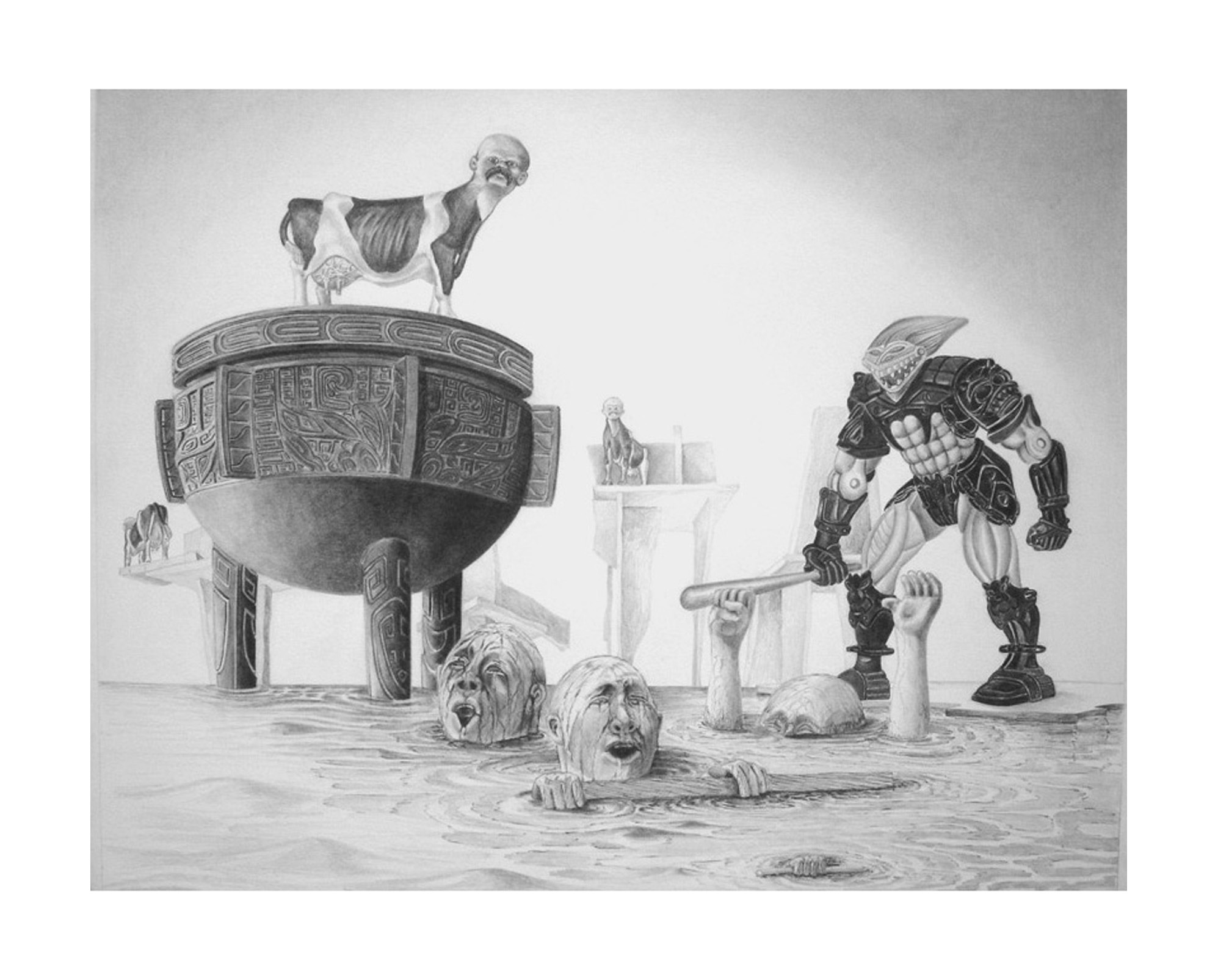
On level five heretics are encased in fiery graves and watched over by the Furies and Medusa. On level seven violent souls are submerged in a river of boiling blood and watched over by the Minotaur who, when they come up for air, shoves them back down.  When the poets get to the very bottom they find Satan encased in ice and unable to move, so they climb up his huge body and escape from Hell.

It’s pretty clear Dante must have thought about Hell a lot.  The amount of detail he goes in to is amazing. I wonder if he felt guilty about something or if he was just trying to warn people to walk the straight and narrow.

Anyway, I think people today think differently about what Hell will be like than they did in Dante’s day. It probably will have more to do with the loss of mobile communication devices and reality TV.

circle seven 3

Spiritual Common Ground

Having spent some time recently visiting a Christian pilgrimage site of some considerable significance to believers (and history buffs as well), it became apparent to me the penitents amongst the crowds stood out. It was pretty clear there is a deep emotional engagement, a heart-felt belief in the Christian dogma many of the pilgrims feel and adhere to.

It got me thinking about the sort of commitment other spiritual engagements require of their followers if their followers can be expected to remain followers. Other than Reformed Judaism which appears to be based pretty much on cultural tradition most other religious endeavors expect, if not an emotional commitment, an intellectual discipline whereby the metaphysical can be approached, the value of which for the honest participant is cultivation of a groundedness that is helpful in seeing through and beyond the petty and not so petty distractions life presents with considerable constancy.

Problems tend to arise when differences in doctrinal beliefs lead followers to deny the legitimacy of other traditions. It would be good, I think, if more adherents would focus on the common rather than the different and set aside the arrogance of an assumed superiority.