Moral Entitlement

I’ve been reading, lately, about the idea of moral entitlement: how some people assume privileges others are denied. Or, to put it another way: some individuals and groups feel themselves morally entitled to take advantage of those they consider lesser or inferior.

I have no doubt such situations have existed, probably, for as long as man has walked the earth. A sense of superiority on the part of some accompanied by the complementary assumption of inferiority by others is pretty well embedded in our psyches. This idea has perpetuated social class and sectarian divisions that continues to account for dissonance and conflict.

One can argue the moral illegitimacy of such stratification, I suppose, but what I find more curious and annoying is the ego driven individuals who assume unjustified advantage. I suspect such people and/or groups will realize the idealistic beliefs that have led to their divorce from mankind must be tempered in the interests of everyone’s basic social needs. One can hope so, anyway.

Natural Selection

I’ve been thinking, lately, how natural selection manifests itself in myriad ways among plants and animals: adaptation to changing environmental conditions ensures survival of species. And, individuals with superior survival skills pass on their genes to ensure superior off-spring better capable of surviving and thriving in harsh natural environments.

It seems in some ways unfortunate similar evolutionary progress doesn’t happen among humans where mating practices appear to be pretty thoughtless with regard to what sort of off-spring might be produced, you know, in terms of the capabilities needed to deal with life. The less-able results of indiscriminate coupling are, of course, cared for by the more able and humane where as in the animal kingdom such unfortunate progeny would certainly parish.

Still, it seems to me compassion should rule the day. I do think virtuous behavior toward the less fortunate should be expected of thinking beings, but, being thinking beings, mankind might do well to think before passing on seed.

my-demons


A life of contemplation

Lately, I’ve been thinking about what it would be like to go off someplace where I could live more simply; someplace away from the distractions of the ever-depressing news of the day and the energy sapping ego conflicts of the workplace.

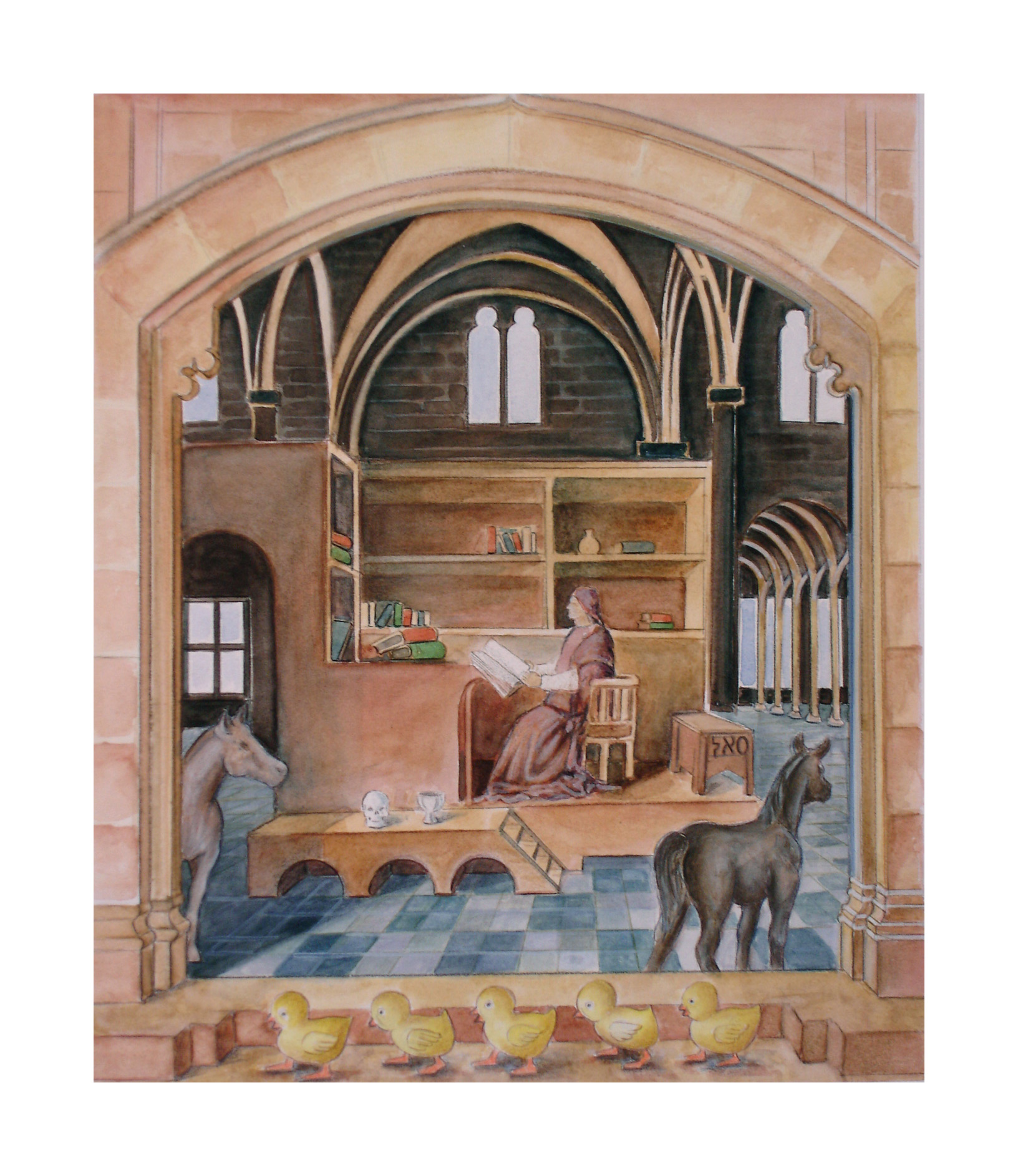
I could spend my days contemplating the inherent nature of existence; I could immerse myself in the eternal flow of life. I would find my center and be at one with all things. You know, like St. Anthony (the ascetic) did.

For nearly forty years Anthony lived a hermetic existence in the desert existing on the rare crust of bread offered him by passing pilgrims. He rid himself of all desires of the flesh in the belief that through asceticism ultimate truth would be revealed to him.

There was one night, though, when hedonistic desires descended upon him like a torrential downpour. He wanted, wanted, wanted: good food, good drink and women of any sort. All night he suffered. He fought back with every ounce of his energy. When morning finally came Anthony was spent from the night’s exertions but was also strengthened in the knowledge he could overcome temptation. His commitment was renewed, but, with it, the fear of even greater tests to come.

I guess one has to assume, then, the contemplative life may not be wonderful all the time; I’ll definitely have to temper the ascetic part.  Still, I relish the possibilities, you know, developing some deeply profound insights. I may even enjoy an occasional hallucination.

temptation of St Anthony 5


Moral Constructivism

I’ve been reading, recently, something that has me thinking about how morality might be most effectively approached these days. The book, which I would categorize as apocalyptic Sci Fi, tells a story of societal breakdown in the not too distant future. Those who can live in gated enclaves as a means of protection against gangs of homeless riffraff without moral qualms of any sort intent on theft, murder and mayhem. As the situation deteriorates and the enclave is over run, our protagonist, a teen age girl of significant capability, is forced to flee.

Our heroine is no ordinary teenager. She has, over her few short years, compiled a book of verse, a spiritual system, defining god in terms of the realities she faces as civilization collapses. Her notion that ‘God is change’ addresses the primary needs of the people who face disruption and displacement in this dark future world. Survival, she understands, will require flexibility.

As the story moves toward resolution, a small group has banded together and seems to have arrived at a moral understanding based on mutual needs and respect. Coexistence demands an ongoing exchange regarding moral priorities; change is the rule and openness to change must always be on the table: God is change.

The reader is left uncertain as to what the future holds for our small group, but, as I think about it, it seems to me their thinking about morality gives them a much better chance of survival than had they latched onto either a moral absolute or a relativist position.

ecstaticvision3


Crowds

I found myself, recently, in the midst of large numbers of people. The atmosphere was festive and most everyone seemed fairly convivial and, I must admit, for a time I found myself pleasantly embraced within the mass of humanity.

But, it wasn’t long before I began to feel a bit uneasy, being, as I am, generally averse to extended time in public. As time went on the pleasant demeanor I sensed in the crowds earlier began to dissipate and take on an ominous malevolence. The gentle jostling I had experienced as people moved toward a better view of the festivities I now found aggressive and unpleasant.  I didn’t feel the need to run for cover exactly but move away from the congestion I did. As I approached the perimeter of the mass of people I stopped and turned to view the crowd. From a distance the mass of humanity was less intimidating and I found my composure restored.

As I now reflect on it all the experience was really more than tolerable and I can again embrace my deeply held empathy for mankind and the difficulties everyone faces, you know, just dealing with daily life. I guess the key for me is to stay off the stage, take a seat in the balcony as long as it’s not too crowded.

existential angst

Entropy in Five Words or Less

I’ve been trying to make sense, lately, of what exactly entropy is. Entropy is apparently a very important concept applied by physicists to help explain the Big Picture, relating to the workings of the universe in sub-atomic terms. I guess it has something to do with heat distribution: how hotter things like the sun give off heat as energy which is absorbed by cooler things in an ongoing move toward systemic equilibrium.

When the Big Bang happened, so the story goes, entropy began, and, over time, continues to increase so that atomic configurations grow ever increasingly complex and chaotic which is the point in time we are right now. But, eventually all this chaotic complexity will blend together in a homogeneous soup and everything will return to a state of equilibrium as the last star blinks out.

Which all seems somewhat understandable, but then we’re told entropy continues to increase even though everything will have been reduced to undifferentiated matter, which is pretty hard to understand. And this is not to mention the idea that entropy measures the amount of work that CAN’T be done using available energy and the whole concept can be reduced to mathematical formulae.

So, my understanding of this illusive concept remains in the shadowy grays if not quite the complete dark, and I’m left with little choice other than reducing the concept to: the measure of change over time. I know this must be terribly simplistic but I’m pretty confident it’s all I really need to know about entropy.

biosphere11


Into the Wilderness with Others

I’ve recently returned from a trip into the wilderness with others. And, while my companions were most congenial, offering, as they did, opportunities to share sights and sounds, I found the experience lacking in ways it’s taken me a while to identify.

Most of my treks into the wilds in recent years have been done solo. Traveling alone means extended times of solitude and contemplation which is really refreshing initially, but, after a while I will inevitably find myself missing conversation. At some point I always seem to experience a descent into psychic depths of a fairly profound nature. And, although these mental travels are not always pleasant they provide me an ultimately refreshing reassessment of my existence. Not exactly an epiphany every time you understand, but usually by the end of my adventures I do sense a nuanced change of perspective.

So, the recent trip with companions to insulate my psyche from its otherwise likely meanderings was a clearly different experience. But, after all, placing one’s self in a situation where nature has the clear upper hand, whether with others or alone I think is pretty worthwhile no matter where one’s psyche might wander off to.

meditation mandala

Story Lines

I’ve been thinking, lately, about the multiple story lines that can be thought of as true regarding one and the same experience. That is, a single experience can be explained by emergent explanations, closed systems within themselves. (That have nothing to do, I might add, with political ulterior motives.)

For instance, the object and actors in any experience are composed of basically the same kinds of atomic particles, the movements of which are a complete story or explanation of the event. One could refer to this idea as the Atomic explanation of the occurrence. Then, we can consider the experience in a biological context, how the natural order will lead the actors to predictable behaviors and interactions related to basic physical survival instincts. This, too, provides a complete story in itself.

A psychological story line would focus on relationships and feelings. How actor #1 responds to actor #2’s need for acceptance by the group and, maybe, how the groups’ social dynamic will thereby be affected. On the metaphysical plane, a supernatural agency will oversee events and will ultimately figure in the experiential outcomes. Faith and belief will be required by the actors who wish to tap into the god’s benevolence for no other means are available to affect their destinies.

I guess it’s pretty clear why conflict is so prevalent these days. It seems to be human nature to seek out those of like perspectives, exacerbating divisiveness. Thankfully there are those who can move between these closed story lines and find and promote understanding of differing views, offering hope of finding some sort of common ground. I’m thinking our very existence may depend on it.

rite of spring 3


Opposing Views

I’ve been reading about the dichotomous philosophical views held by the French in the 19th century. One perspective held the great classical civilizations of Greece and Rome were beyond compare and, therefore, a sound basis upon which to guide one’s life. The views of these Neo-Classicists held to staid ideals of beauty and truth exemplified by the ancients, the message being the past holds the principles by which to live.

The other view extolled the virtues of man’s passions. The spirit of life was seen in the serendipitous nature of human existence. These Romanticists championed the flow and flux living presented to the man truly alive. Living fully in the present was pretty clearly the message here.

Interestingly, these opposing views were manifested in the arts of the time. The Neo-Classicists looked to linear emphasis in the imagery on Greek pottery and to the subdued color they found in the art of the ancients they saw on their pilgrimages to Rome. Their more immediate champion was Nicholas Poussin. The Romanticists relished the baroque twists and turns they saw in the paintings of Peter Paul Rubens. Their preferred palette contained the bright colors they found in the exotic cultures of the Near East.

These op positional views fed off of each other; the first staunchly absolutist and rational the second spirited and life-affirming. The first extolled their virtues against the decadence of the second; the second, their flexibility and pluralism against a rigid didactic ism. A lot of great art was created in 19th century France and I’ll bet a big part of the immense creative output was the result of these tensions.

So, I wonder, if everyone everywhere suddenly witnessed an unmistakable ‘Ultimate Truth’, undeniable in any way, so remarkable that all doubt was erased from every mind, what would be the result? It seems to me, even the idea of peace would be meaningless; without opposition there would be nothing to believe.

I can only hope that sort of truth will never become known.

Elvis in memphis


Cultural Evolution

I was reading recently that cultures with the best chance, over time, of sustainability, most likely to expand and grow, are the ones which nurture an undercurrent of irrationality. When it comes to cultures, dominance depends on size and stability, and in the case of human cultures it appears the ones most likely to excel are those whose practitioners are most willing to sacrifice self-interest to the betterment of what they see as their cultures superiority, as delusional as that may be.

The underlying current driving these successful cultures is, and has pretty much always been religious beliefs that contain a supernatural overseer whose job it is to instill mutual trust, sometimes through a mutual understanding of the dangers of opposition, keep the populace on the straight and narrow and fiercely committed to correct belief and action. Unfortunately, sometimes beliefs turn in to dogma, intolerance develops and anything not orthodox becomes heretical and conflict rules.

I have to wonder if the cultural upsides of these irrational currents override the downside.


medieval vision3