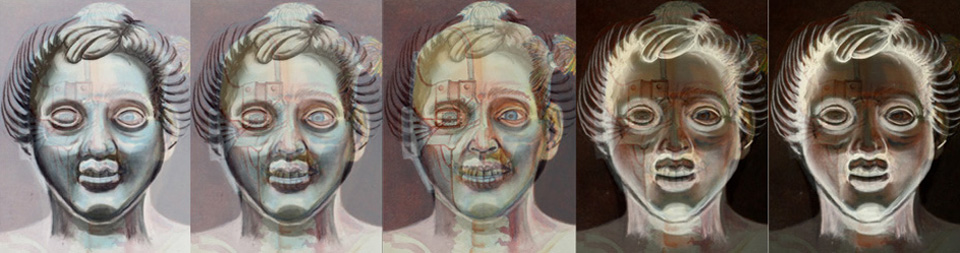
Contemplating Immortality

The human genome has finally been deciphered and connected suggesting that in the future an individual’s genetic flaws may be found and possibly corrected leading to the potential for longer human lifespans. Imagination might lead one to the idea that sustaining life indefinitely is within the realm of possibility.

On the face of it the idea seems pretty uplifting, having all that time to…………… well, do exactly what. Another problem that comes to mind is that the very nature of human Being depends on uncertainty. Awareness of one’s mortality, as subliminal as it may be, is an enlivening prospect, an experiential richness, without which one would likely fall into a debilitating ennui, losing any sense of meaningful life.

It will be some generations, I suspect, before anyone must worry about such things. Meanwhile, realizing mortality will keep us in mind of the preciousness of daily existence.

Reborn in the Seventh Sphere

Does skepticism Inhibit Emotional Development?

I’ve been thinking about two essays I’ve recently read by the 19th century philosopher William James. The essays were delivered to the philosophical society and YMCA at Harvard and Yale, respectively, where, it appears, enlightenment thinking had not surprisingly undermined religious beliefs of many faculty members and students.

The thing that has stuck with me as I think about his essentially pro-faith rationale is his fervent assertion that skepticism about belief in God (in whatever form it may take), if sustained will inhibit emotional growth. One must have the will, he maintains, to choose, make an informed decision and move forward in that belief or disbelief until new experiences lead to reassessment.

I find this position to be counter to my own fairly skeptical nature. My thought processes are organized to entertain possibilities without the need to choose one. So, I guess I must count myself among the timid non-choosers wondering what it must be like living in the rarefied air of firm belief.

The Beauty of Rationalization

I’ve been thinking, lately, about the nature of consumer capitalism and how it tends to disenfranchise tens if not hundreds of thousands of people. Folks who are, on the whole, perfectly functional individuals, who have been caught in an impossible financial bind not always of their own making, find themselves unable to provide basic human needs, particularly shelter.

I’ve been reading about a large sub-culture of nomads living in various mobile vehicles who rely on scant social security payments and taxing seasonal employment to make ends meet. The dilemma has me wondering how these folks, who have not chosen to ‘drop out’ in order to exploit the social safety net but rather work in order to maintain an autonomy, deserve such a tenuous existence.

Convinced as I am of the oppressive predicament suffered by thousands, of whom I’ve been made aware by a dedicated and credible reporter who spent extended time living with these vulnerable folks, I find myself disturbed and righteously indignant at the unfairness of it all.


But, to be honest and upon further consideration I must admit my righteous indignation is pretty hard to sustain, you know, having to suffer such distressing contemplation, which has led me to the rationalization that maybe not all of these folks are such innocent victims, that maybe their dilemmas are the result of irresponsibility on their part; maybe they dealt frivolously with their formal education, blew off consumer math, made bad choices in the selection of spouses.

So now, upon even further consideration I find I must relieve myself of my overly righteous suffering. I find myself able to comfortably return to the placid complacency which is my mien and so proceed with my normal daily routines untroubled by occurrences beyond my control.

A Balanced Nature

I’ve been reading a very interesting article about the tiger population in India. Bengal tigers, considered a threatened species, have been given protections against hunting as well as a large protected reserve in the jungles of Madya Pradesh were they share the land with the indigenous forest villagers. To the east, in the Sundarbans mangrove swamps between India and Bangladesh the growing tiger population, facing a scarcity of traditional food animals ( due in part to human incursions exploiting resources), have turned to humankind as an easily obtained substitute, killing and eating one or more villagers a week.

This got me thinking about the food chain. While we may entertain the notion that we, humankind, have an advantage, a superior position among our animal neighbors in securing our piece of the environmental pie, upsetting the natural balance would seem to be a dangerous ignorance. Logic would have us focus on providing necessary habitat and resources for survival of all species. When one species grows and exploits the earths finite resources beyond what is fair to all, perhaps limits should be imposed.

Just wondering if we might not have a moral obligation, you know, in terms of the health of all earthly inhabitants to encourage the tigers to eat the villagers.

Resisting the Inevitable

Doing my daily stretching regimen the other day and finding it occasionally painful has gotten me thinking about the inevitability of the physical downslope I’m descending. Ageing has a way of putting one’s physical prowess into perspective. Memories of the stamina and flexibility that once were mine have become distant.

So, as a counter measure to deal with this somewhat depressing realization I’ve obtained a wrist mounted device that measures my daily physical activity. I get encouragement sent to me online if I meet certain daily parameters. The device functions as a personal trainer to keep me on task, keep my physical activity reasonably high, keep the calories burning. This athletic enterprise has me, for the time being, feeling pretty good about my physical health, stamina and weight stability. My daily exercises, though, aren’t getting any easier. I remain aware of the reality of my situation, that the best I can hope for is to maintain an equilibrium for awhile.

I’m not giving up. Better, I think, to at least stay mobile. I’m determined to use it until I lose it.

Upon Reflection

I’ve been reading about the history of the mirror: how the idea of ‘reflection’ took on new meaning over time.

Humankind has, of course, been aware of the reflected image since pre-historic man first gazed into a still pond. The dangers of such a discovery became apparent in Greek mythology when Narcissus, realizing his beauty, became obsessed with his reflection, fell into despair his love of self could never be requited, killed himself and was reborn as a flower (curious but fitting, I suppose).

By the Renaissance pretty much everyone had access to mirrors. It didn’t turn all Italians narcissistic but the focus on personal appearance brought about by the availability of the reflected image profoundly affected the way people everywhere thought about themselves. Gazing into a mirror makes the gazer aware of his (or her) unique oneness. Social relationships become more complex. The individual, aware of her (or his) physical attributes easily assumed an expectation of relative worth beyond the status assigned by other means such as social rank, wealth or useful contribution to society. Visual presentation: grooming habits, manner of dress hair styling became increasingly significant and for some cultures border(ed) on the ridiculous.

I must admit to remembering preening in my teen years. Now I purposely avoid mirrors whenever possible. But, as my physical appearance has become less photogenic I find my psychological well-being not as dependent on visual presentation. One of the advantages of ageing, I guess.

The Twisted Contradictory Mottos of Totalitarianism

I’ve been thinking about the George Orwell novel “1984”, how the totalitarian regime in the book implemented catch phrases to secure the minds of the populace. ‘War is Peace’ is used to establish a permanent enemy, a scapegoat, that can be blamed for any and all ills that befall the citizenry. ‘Freedom is Slavery’ discourages individualism, promotes tribalism in order to keep everyone bound to the collective. ‘Ignorance is Strength’ encourages the subservient populace to forego intellectual reflection, follow the dictates of those in power, not think about things to hard and they will realize contented peace. The message is, I guess, that given such ideas along with sufficient deterrents a totalitarian regime turns people into sheep without them realizing it.

It does seem a bit familiar these days but I guess as long as a free exchange of ideas remains in place reasonable responses can happen.


Routine

The idea of routine these days has taken on a sort of oppressive new meaning, limited as we are in our ability to socially interact and move about freely without concern of infection. Before the onset of the dreaded virus relieving a tedious daily cycle was as simple as a museum visit or dinner out with friends, experiences that give life meaning, expand imagination and help us realize possibility.

The conundrum has me thinking about cyclical time, how daily experiences reoccur with a good deal of regularity. Eastern Religions have long understood time to cycle on a cosmic scale which, I suppose, gave hope to those living less fortunate existences (who also looked forward to reincarnation). The philosopher Fredrich Nietzsche came up with a thought experiment he called Eternal Recurrence. The idea is to suppose one is destined to live this life over and over repeating the same experiences forever, an eternal cycle. The implication is, that if such were to be the case, one would want to be very careful that each moment of life was lived to the optimum: as best and as positive as one could make it happen.

What we need to do in covid world, I guess, is find ways to sustain ourselves positively, in uplifting ways. As important as it is to stay centered, alive and present in the moment, distraction may be in order. Many may find solace in readings with happy endings while others may seek the catharsis of apocalyptic disaster literature. Hobbies might be developed. Exercise is always good, solitary sport activities might be explored.

I really don’t have any particular advice for anyone, just trying to work it all out for myself.

Are We Living in a Simulation?

There are certain theoretical physicists contemplating, as I understand it, the idea that perhaps we are not living a base reality but are in a simulation, an artificial reality. We may be, they surmise, virtual beings created by a higher intelligence with infinite computational facility. These cyber-gods’ superior intellect along with our limited capacity to fully understand our world renders it impossible for us to grasp the closed system provided by our overseers.

The overseers, acting as game players, pit us against each other, create inventive situations for us to deal with and suffer through and then play favorites, much as the ancient Greek gods did. The idea is, I guess, our overseers are using us as pawns in the ultimate virtual Game of Life.

Well, if I am existing in a virtual closed system, I really can’t complain too much, reclining, as I am, in my lounger in front of a warming fireplace. I do, of course, face difficulties from time to time: existential psychological eruptions I must deal with, but all in all life is pretty good. If I am a virtual being in a created world it would seem my cyber-gods are fairly benevolent.

Belief in God

As things began spiraling out of control she wondered if belief in God was a viable option.

Well, maybe belief was the wrong word. It seemed to her unlikely one can suddenly ‘believe’ something, but there were remnants of belief she had taken to be credible at some earlier time in life. There were beliefs introduced to her as a child that had drifted along in her sub-conscious all these years until recent existential shock brought them (the beliefs) to the surface, beliefs which seemed, suddenly, to be just the thing these extraordinary times require.

So maybe it was more like expedient, practical to seek and find a supernatural entity to appeal to in these dire times when her resources were strained and uncertainties about her very survival constantly weighed upon her. She had settled, after all, as she had thought about it over the years, on an enlightened agnosticism, resisting the hard atheism embraced by some. God as a concept was elusive but not easily dismissed in totality and now seemed the time to, if not make re-acquaintance, at least allow the embedded idea to come a bit closer to the surface. There is something comforting about the idea of a benevolent overlord, protector, benefactor in these uncertain times.

But finding and maintaining belief, she realized, wasn’t that simple.