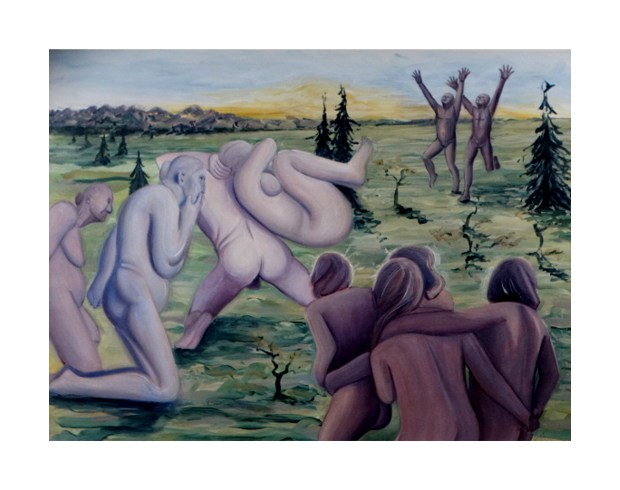
A stable upbringing will usually set most of us on a path to becoming someone worthy of self-respect. Through responsible participation in the mechanisms that contribute to a functional society we will find ourselves woven into the social fabric of our communities, thereby garnering the respect of our peers who share our moral values. Our sense of self-worth will grow into the assumption of political power, of being a man among men.
If, though, pride-in-self becomes excessive one may slide with ease into vanity, a character flaw demanding constant reinforcing kudos. As the need for recognition grows obsession develops, becomes dangerous, finally producing a loss of identity, a non-person results, immoral, prone to unjustified retribution against imagined nemeses. An inglorious fall from grace.
I’ve been reading that everyone has within them the potential to behave in ways that can only be described as wicked. The idea is that although most of us develop moral values that help us remain socially responsible neighbors, (you know, do unto others as we would have them………..), a shadow self that has the potential to cause us to engage in evil behaviors, lurks within us.
Sometimes obsessions driven by envy, pride, greed or lust can turn us away from the moral guidelines that have made it possible for us to live socially responsible existences. If these obsessions grow and fester, continue unchecked, they may disrupt our sense of identity to such an extent we may forget who we are. When this happens the potential for evil behaviors against our fellows becomes all too possible may even lead us to actions that go far beyond the disquiet that led us initially to the obsessiveness, which can result in a total annihilation of what was initially desired and spiral us downward into self-destruction.
I’ve been wondering lately what sort of life events, what kind of social influences one would have to experience to lead him or her to embrace the stringent discipline of fundamentalist religion. Apart from an innate proclivity toward a rigid, reactionary conservatism (can there be such an inclination?), what, I wonder, propels some people toward angry condemnation of any and all perspectives differing from their own?
In fairness, most everyone seeks answers to the big questions: the nature of existence, life’s inherent meaning, but only some of us (a small minority one hopes) determine their answers to be an infallible, absolute truth that leads them to rail against the slightest suggestion that there might be other good answers.
Some of these true believers have come to the conclusion that the life they had lived before finding the Truth was so despicable that a psychic renewal was required: a re-birth into a total acceptance of, commitment to, their recognized god. In order to maintain their new persona and recently acquired cosmic world view, an Opposition, an inherent Evil identified as constant reminder that one’s beliefs are constantly under siege, that life is a battle between the forces of God and Evil. Tension and conflict then become an everyday experience and concern.
There are, of course, degrees of fundamentalist fervor. Not everyone who embraces conservative religious beliefs are overtly hostile to those they might consider infidel or apostate. Still, the idea of immanent cosmic conflict isn’t buried too deeply below the surface.
These are disconcerting thoughts to my mind, but, I guess, in the end, it’s all about being certain where the truth lies: for these folks it’s not within the empirical but rather the cosmic realm. For some the rewards of a promised afterlife tempers the outrage and sustains their vision of the soon to be realized cosmic light.
Political populism appears to be in the ascendance these days. The idea the ‘power’ is in the ‘people’, the ‘people’ being those rightfully in control, dismisses the opposing views of the minority. Opposition is unacceptable, lost elections must be the result of fraud, theft; criticism the purview of ‘intellectual elites’.
Populism simplifies, views differences in terms of power, who’s in charge, distrusts the complexities of democratic structures that require ongoing dialog to self-correct when necessary. The ‘power of the people’ will be placed in the hands of a strongman who will suppress, unde4rmine institutions in order to impose the ‘will of the people’.
The attraction of such a position must have something to do with a sense of social impotency, a lack of faith in a democratic society. The danger is the establishment of totalitarian control.
I’ve been thinking lately about my daily consumption of the news. Anticipating, as I do, the discomfiting nature of what I’m likely to hear I rely on the feeds I get through my phone each morning. I’m realizing my perspective on things is being tainted by the sensational nature of these media soundbites.
As troubling as I find this realization, I will continue my sound bite consumption because I know I will find a more intensive investigation of current events to be more painful than worthwhile.
I’ve been reading about the conflicting philosophical thinking occurring among the dons of Oxford in the early 20th century. Conventional exegesis centered on issues of morality, how to think about the idea of the ‘Good’ in action and deed, whether there existed an intrinsic moral intuition directing man’s behaviors.
In opposition to such thinking, others maintained issues of morality were beyond the realm of obtainable knowledge, had no truth value, since such knowledge is dependent on the opinion, state of mind, of the individual thinker. The only knowledge obtainable, the logicians determined, will be found in mathematically verifiable constructs, truths within the bounds of scientific investigation. The Ethicists responded that man’s behaviors are much richer, rely on moral constructs and consist of a multiplicity of remembrances and inputs not reducible to mathematical formula.
I guess the atrocities of World War II must have brought the discussion of Good and Evil back to the philosophical table for everyone.
The eastern religious principle of Ahimsa proposes that one ‘do no harm’: to achieve enlightened insight one must come to the realization that all things human and animal, animate and inanimate have soul-like presence, deserve respectful consideration.
The Jains are a traditional Indian religious sect that take the principle of Ahimsa very seriously. The deeply spiritual among them practice extreme measures to avoid injuring any living thing, plant or animal, will avoid walking at night so as not to injure unseen insects and mask so as not to inhale any sort of minute flying being. The idea is I guess, that in order to achieve Ahimsa one must get in touch with what one imagines that even the least of life forms has valid meaningful existence.
With this in mind, I found myself recently watching a tiny winged creature walk across my pants leg. I wondered where it might be headed, whether it might be seeking food of some sort. Certainly it must be considered a conscious being aware of the dangers around it and what stone it might find that would willingly harbor it for the night. Would it be able to form a bond with the sheltering rock one might assume has being in itself?
There is something enlightening about acknowledging the validity of our fellow beings.
I’ve been reading about kenosis, the idea that, in order to fully embrace the natural world in all its beauty and complexity it is necessary to suppress the ego. Seems reasonable I guess: if one’s sense of self is excessive the inclination will be to subordinate, view the world as a vast department store where everything is available for the personal satisfaction of the consumer: forests, water, mineral resources, human labor is there to enrich the individual who covets it.
A strong ego may fail to recognize the presence of the Other: the aethereal essence permeating all things responsible for the beauty and complexity of the natural world. As the natural world comes increasingly under threat, in order to temper its decline an effort will be required that may exceed one’s comfortable complacence, demand actions and behaviors of uncommon strength and sacrifice. It’s not like these ideas are new: most all spiritual beliefs have embraced the sacredness of the natural world, honored the food animal sought benevolence from the Other to ensure food production.
Time to disavow our sense of anthropomorphic superiority, work to become one with the natural world.
I’ve been reading, lately, a treatise by the 18th Century philosopher Immanuel Kant in which he determines through his meticulous thought processes that man is evil by nature. He reasons that, while man is aware of moral laws, that there are morally acceptable behaviors toward others one knows should be followed, there is at the same time a natural inclination to favor personal interests above moral concerns for others that may, when push comes to shove, result in evil behaviors.
So, I guess everyone is naturally inclined to be evil, although I suppose one could quantify degrees of evilness: whether one’s self-interest completely undermines rules of morality resulting in despicable behaviors, as opposed to those of us who occasionally find ourselves exaggerating reality for personal gain if we think we can get away with it. The latter doesn’t seem to me to be evil, exactly, but probably merits a certain sense of shame, at least a guilty conscience.
I wonder if Kant thought himself to be evil in any sense. I understand he was pretty reclusive, hardly left his home but for a daily walk around the neighborhood. He probably didn’t have the opportunity to be too evil.
I’ve been thinking lately about some of the public individuals who have been fading from view, have virtually disappeared from the cultural narrative in recent months (or years). Some of these folks have found themselves in disfavor for a variety of reasons: perceived racial bias, sexual improprieties, sometimes simply political incorrectness or holding views found to be inappropriate by the more sensitive of our cultural judges.
I can think of a particularly clever and insightful comedian, a creative radio personality, a talented dramatic actor and several pols who suffer the sins of behaving badly in a moral or ethical sense. There appears to be a particularly virulent group of vigilantes sifting through the pasts of those deemed suspicious seeking condemning information. I suppose condemnation may be in order in some particularly egregious cases even though the perpetrator may have contributed to the public good most of his/her life.
It all makes me think back, wonder if there’s anything there, in my past, that might be brought up, maybe by a disgruntled neighbor or former friend, that I might find embarrassing were it to be revealed.