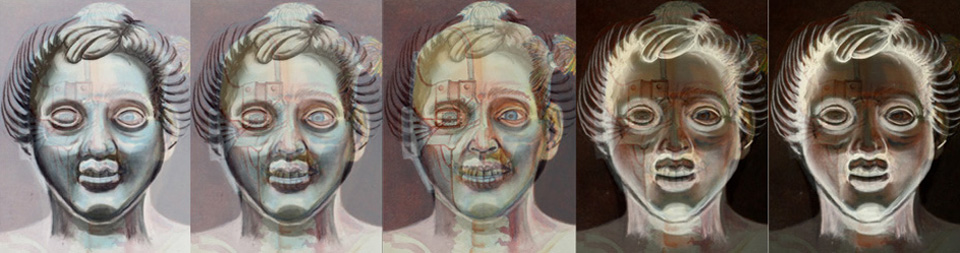
Thinking lately about dentistry: whether those who pursue such an occupation may harbor a sadistic inclination.
Having recently received a new set of dentures after undergoing the physical trauma such a procedure entails. The experience has me wondering whether ulterior motives a practitioner might have, beyond the lucrative salary, might be in play.
One hopes a medical professional would extend a benevolence toward her victims, but I don’t know if such is necessarily the case.
I’ve been thinking lately that days, individual days, sometimes exude a quality of existence that transcends and imposes itself upon individual experience. A day may extend its identity to whole communities of individuals who suffer or exalt according to the qualities the day imposes.
One may awake, for instance, to sunrise beauty, freshness in the air promising positive experiences to come. As one walks through the neighborhood people smile and wave, friendly conversations with total strangers occur. All is right with the world.
Or the overcast morning weighs heavy upon one’s soul, extra effort is required to accomplish the most basic of tasks. People in the streets are sullen, unapproachable, lost within themselves.
Such days, pleasant or painful, impose themselves upon us. Our very being is captive to the quality of the day.
I have a friend who is a school administrator. Although he never complains, it’s apparent the pressures of the job are often trying. He told me once that the job requires him to wear different hats by which I assume he meant the need, sometimes, to act the policeman, other times to accommodate with a smile undeserved criticism, and so forth.
As I think about this, hat wearing, in fact, often carries meaning beyond its basic head-covering function. Political affiliations may be conveyed, products advertised, and humorous familial contexts presented. These presentations of identity along with the desired in-group associations the wearer wishes to convey may also carry an accompanying negative reaction that the hat wearer may not desire. Repulsion and hostility being real possibilities.
So, thinking about it, I intend to be careful what I put on my head.
I’ve been thinking about the plethora of acronyms we all must keep track of these days to stay even remotely in touch with what’s going on in the world. For instance: The MAGA folks have enabled DOGE to fire NIH staff and medical researchers and are pressuring universities to cut DEI programs and suppress support for BLM protests. Enabled by congressional majorities MAGA has exacerbated natural disasters by cutting FEMA staff, has created ICE to arrest and deport BRCs, cut funding to PBS and NPR.
It’s all very difficult to follow. Because of my ADD leading to OCD and, I fear, PTSD, I’m finding it hard to decide on BLT’s or PB&J for lunch.
Samantha Harvey tells the story of a crew of astronauts circling the earth in an international space station. Each crew member contemplates his or her existence with a new awareness, removed as they are from the 24 hour cycle of life one experiences on the planet surface. Circling the globe as many as fourteen times in an earth day, accompanied by fourteen sunrises and as many sunsets, the astronauts watch, god-like, as a cyclone forms above the Philippines. They each come in time to the profound realization their very existence is extremely fragile, dependent upon the celestial body they’re circling.
As they perform their assigned experiments and daily maintenance tasks, over-coming the space sickness and lack of sound sleep, they nevertheless marvel at the constantly changing color and light show they see as they hurdle, weightless behind and around the entity that sustains they’re existences.
Such a perspective must surely overshadow the petty power struggles that define life on planet Earth.
I’ve been thinking about the anxieties that may invade the teen mind as it proceeds by fits and starts into adulthood. Of all the nightmare scenarios an adolescent mind can conjure: torments of bullying, of not measuring up physically, mentally, emotionally, of lacking popularity or whatever other conceived ills may occur to the teen person, all pale in comparison to the absolute horror of finding oneself to be insignificant, a nobody. You realize yourself to be forgotten among your peers not even having achieved sufficient identity to be disliked, or cancelled, you are a perpetual stranger, neither included nor excluded in any sense.
Now, clearly, such an imagined horror will never be fully realized since humankind are social animals and will seek out and find like minds, others who share interests, likes and dislikes. Even the most reticent, anti-social, awkward and unlikeable an adolescent may be there will be someone who can relate, someone to share the misery with. So, buck up, life will be tolerable and school soon a thing of the past.
In 1935 Sinclair Lewis wrote a novel: It Can’t Happen Here, detailing the horrors of a totalitarian dictatorship. In the novel the ‘corpo’ government takes control, restrictions on personal freedoms emerge and the press becomes the voice of the state, dissidents are rounded up and imprisoned or executed and minorities become scapegoats. Young men are conscripted into the quasi-militaristic “Minute Men’ whose task is to seek out and arrest anyone suspected of subversive activities. As people began to realize their loss of freedoms mass demonstrations formed and were brutally put down by the oppressive regime
In America today we see militaristic ICE agents assaulting immigrants deporting them without legal recourse to interminable prison time in Venezuela. We see attempts to suppress free speech in the racist intentions to cancel Diversity Equity and Inclusion programs in colleges and universities. We see ICE agents removing books from public libraries which can only be seen as an attack on education.
This totalitarian wave we’re experiencing is intended to overwhelm us; resistance is necessary; silence is acquiescence.
I’ve been thinking about what happens when life imposes obstacles so overwhelming one loses the hope a better life is within the realm of possibility. A darkness settles in with the realization a livable future doesn’t exist. Socially enabling behaviors, neighborly connections, dissipate, alienation results, hostility develops, obsession finds only the enemy.
Does such a one entertain a death wish or strike back and initiate an evil response?
I’m wondering lately what part morality plays in our social behaviors these days, how morally ambivalent we’ve become in our acceptance of the less that morally stellar actions of some of our public figures. The ‘designer’ morality many of us assume these days lacks the omniscient overseer Christian believers have: an entity able to impose punishment or reward for behaviors well spelled out and without compromise.
However, we draw our moral guidelines it seems pretty clear that lack of any moral truths has dangerous implications for personal well-being and for our relationships with our fellow man. Amorality turns into immorality that leads to evil intent, the inclination to replace social benevolence with Will-to-Power.