The Inadequacy of Reason

I was thinking the other day about different kinds of reasonableness.

There is reasoning that follows the dictates of logic based on falsifiable premises and avoiding contradiction. And, then, sometimes the passions get a hold of a person and things can be believed or acted upon based on poor reasoning-things that don’t follow from the supposed justification of the reasoner.

The philosopher, Immanuel Kant, put forth the idea of practical reason. He thought that a belief in God and after-life was necessary (even though not based on falsifiable premises) in order that man behave moralistically and ethically toward his fellows, since such behavior is more difficult than acting exclusively out of self-interest.

Leo Tolstoy wrote A Confession toward the end of his life during a time of extreme disillusionment regarding the purpose of life and the meaninglessness and insignificance of the part he had played in it. His assumption had always been that reason was the ground of existence; that any and all insight and understanding that might be achievable would be so exclusively through reason. And now reason told him that it was all for naught; his existence made no difference in the grand scheme of things. Better to die, he thought.

When he looked around him he saw people engaged in hedonistic pursuits or religious endeavors, neither of which he felt validated a reasoned life. His awakening came upon considering the peasant who toiled and suffered throughout his life but was able to maintain his will to life positively. Maybe lacking formal education and not having too many big ideas to think about had something to do with it, but in their sense of spirit, irrational as it seemed to be, Tolstoy found the answer to his dilemma: reason must embrace the irrational and sustain a faith in the human spirit.

So, if it is fair to assume logical reasoning will not provide the final answers to life’s big questions is a leap into faith despite the irrationality and or absurdities of such the answer?

I guess I’ll stay open to all possibilities: enjoy the beauties of logical reasoning while embracing the spirit. How can I go wrong?

reasonability

Praise of Folly

I’ve been reading this book called Praise of Folly written by the goddess Folly herself. In this book Folly claims allegiance from just about everybody, by which she means, I guess, everyone is either foolish, ignorant or just unwilling to get serious about life, which, from her point of view is a good thing.

From Folly’s perspective foolish, carefree behavior generally leads to happiness. Of all her followers she ranks at the top those delusional folks so lost in their imaginative worlds as to be oblivious of any sense of reality. Those she finds least enlightened, although clearly foolish are the Stoics and theologians whose strict adherence to reason can only mean a painful and dreary life not to mention lost rewards in the hereafter.

So, anyway, I was beginning to take all this to heart, spending lots of time playing Flappy Bird and watching reruns of Jersey Shore when I discovered the book was meant to be satirical; that the celebration of foolish worldly behavior was really meant to be quite the opposite.

The author of Praise of Folly was the 16th century Catholic priest Erasmus of Rotterdam who was pretty disgusted with the frivolous preoccupation with material wealth and bodily desires of mankind in general (and, I guess, the twisted motives of the Catholic Church in particular). I’m not sure about the current motives of the Catholic Church but I think his opinion of 16th century European culture still may hold pretty true for contemporary western culture altogether.

Anyway, at the end of the book Folly goes to considerable pains to assure the reader that the reader’s spiritual health depends on not thinking about things too much; that remaining a fool is really the only way anyone will gain spiritual redemption.

So I guess I’ll just keep spending loads of time with Flappy Bird and inane television and just wait until the weak-minded inherit the earth.

Elvis in Memphis

Elvis in Memphis

Inner-Glow

I’ve been experiencing this strong sense of inner spirit recently. It’s a feeling of strength within, a sense of groundedness and a confidence that I’ll be able to not only cope with but decisively defeat any adversity that may come my way. I find quite a wonderful peacefulness in this.

But, along with this sense of inner strength comes the nagging thought that my ego may be a bit out of control, having been taught from a very early age the virtues of humility. This realization leads me to consider my own short comings which include but are not limited to average intelligence, unapproachable countenance and various biases and intolerances. This in turn brings me back to the anxiety that has been a predominant aspect of my nature as long as I can remember. Someone said, Martin Heidegger I think, that anxiety is the fundamental mood of existence. Boy, sometimes I can really relate to that.

So, I’m wondering if I’m better off in the possibly delusional world of inner strength or in the anxiety ridden reality of humble me.

I think I’ll bask in the inner glow as long as I can. Here’s to positive thinking.

deidei innerlight

Something or Nothing

I find myself spending a lot of time lately in the black void of the covered toy chest and despite the faint Sounds of Music coming from somewhere in the playroom the situation has got me thinking about the notion of complete nothingness.

People have thought, for a long time, about why there is something rather than nothing. Some have found the question a small problem easily answered by an existent creator God, rationalizing that the order in nature demands a creative intelligence. But, these folks are hard pressed to explain who created the creator.

Over the centuries this intellectual conundrum found temporary ontological solution in the notion of a Self-created Infinitely Perfect Being whose perfection demands existence. But, this, of course, begs the question of how something can come from nothing; an idea that can be thought about in mathematical abstractions but is a lot harder to figure in terms of matter and substance.

In the context of time the eternal is pretty impossible to think through and unless we are willing to abandon the search for a reasonable answer in favor of blind faith the dilemma will probably always remain an enigma………….unless we entertain the solipsistic notion that there is indeed nothing; no material reality at all; only consciousness, which seems initially to work pretty well until I encounter another consciousness. From there it’s only a short mental hop to the collective unconscious and the archetypes that make up our illusory universe.
So, here I lie, in total blackness, contemplating a question I can probably never know the answer to, not knowing whether there is something rather than nothing and unable to get that annoying tune out of my head………………which brings us back to Do, a deer,……………….. or maybe I’m just not an asset to the Abby.

nothingness2

Free Will

I was thinking the other day about the nature of free will-whether it was truly a viable concept given the determinist position that everything we do we do because it’s in our nature to do it and we really have no free choice in the matter.

So, I was thinking that in order to exercise free will I’d have to do just the opposite of what I was inclined to do; so that when making a decision, if it made total sense to do A-that A would be the best choice for my well-being-would be preferable to choice B in every way-that I would instead choose B in order to exercise said freewill even though it would result in a bad outcome for me.

I suppose the determinist would respond that the likelihood was I harbored masochistic tendencies and therefore perfectly natural and predictable that I would choose B.
So, given my said masochistic tendencies I instead choose A, I suppose the determinist would then respond that it is only natural to preserve one’s well-being and therefore no freewill will have been exercised in that case either.

So, what if I embraced the absurd-if I imagined a preternatural essence hovering about me-something that I interact with on a daily basis-a sort of magical companion? That would certainly take the wind out of the determinist’s sails wouldn’t it?

I guess, in the end, the freewill thing might depend on how carefully I listen to my invisible friend.

freefall2

Fertility Rites

Eastra, the doll of the season, was telling me the other day that in ancient times the beginning of spring at or about the time of the vernal equinox was celebrated with fertility rites which were meant to encourage a general fecundity among all living things animal and vegetable.

Many cultures had gods and goddesses honored in these rites; there was Artemis in Greece, Cebele in Phrygia, Diana in Ephesus and Attis the god of ever-reviving vegetation who was believed to have been born of a virgin and who died and was reborn annually.

I was trying to imagine what these rites might have been like. They probably involved a lot of fertilizing of various seeds and things and to get everyone into the mood, to get their energy up, to really get into the re-generation mind set there probably was a bit of strong drink, wild dancing and singing.

I found out Cebele the Phrygian Earth goddess was honored with a procession involving wild, high pitched flute music and drumming, scattered rose petals and clouds of incense followed by priests and priestesses scourging themselves with sharp knives.

But that was mild compared to the cult of Ishtar that may have involved child sacrifice, ritual copulation and virginal girls dancing around large male genitalia.

Whatever the rites involved the celebrants must have thought it worked. Besides the great fun had by all (excepting the sacrificial victim) animals reproduced, babies were born and crops grew. It does seem pretty magical and I guess it was hard for most people to take for granted the resurrection of the dormant (or dead) without providing some sort of penitential assistance even though we all know Mother Earth is a gigantic incubator and really doesn’t need that kind of help.

I think I’ll celebrate Mother’s magic with a nice contemplative walk in the woods.

rite of spring 3

Who Are We?

Celestial Steven was waxing idealistic recently about the tenuous existence of humankind.  He said, that, early on-that is way, way back in time-cooperation among advanced sentient beings was primary.  An individual’s survival depended upon interaction with others.  On an individual level everyone was equal.

Problems, he said, began when the individual started identifying with a particular group; with group identification came conflict with others.  The whole process has continued to grow and fester into the sectarian, racial, and religious conflicts (not to mention the divisive social class distinctions brought about by economic inequities) we now experience.

So, Celestial Steven said, if we could re-establish the one on one or establish an egalitarian collective everything would be peachy.

Mini-Max, being an unapologetic pragmatic conservative, took immediate exception to this idea.  He said it is only human nature to desire the security of association with one’s own kind.  The social security and economic stability of such alliances brings about fair competition between groups resulting in innovation and invention that lead to affluence and raise everyone’s quality of life.

So, I guess what it comes down to is racing blindly toward self-destruction as we fall deeper into our tribal differences in the interests of more for us or waking up, over-coming our jealousy and fear of the other and moving toward a more egalitarian world.

Well, I think collectivity may be the way to go but I would hate having to give up my playhouse.

celstevminmax

Cultural Autism

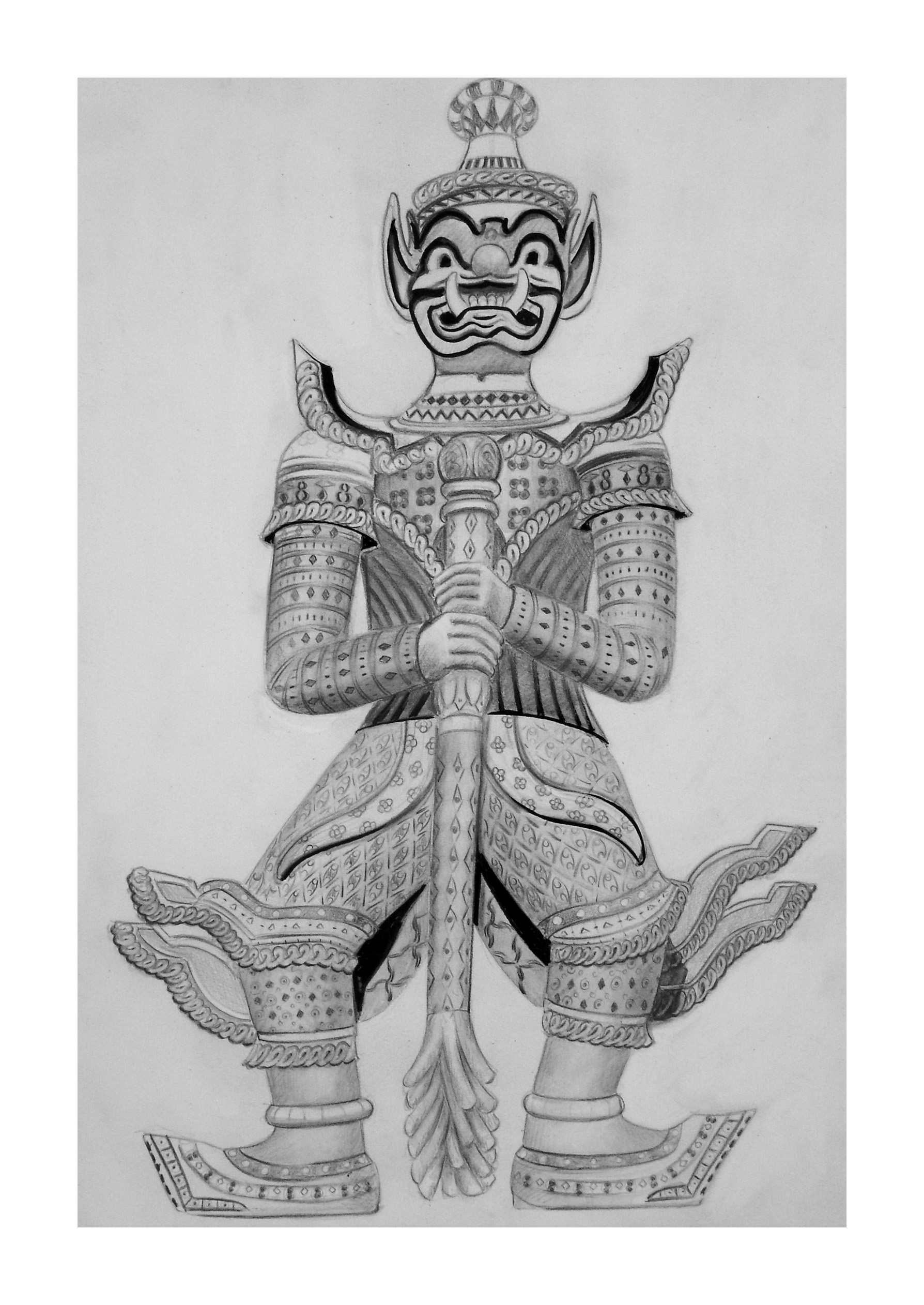
I was thinking the other day about the significance of the temple guardian figures one finds at the entrances of eastern religious shrines and temples.  The guardian, I understand, is the symbolic protector of the sanctity of the sacred space; he stands as defender against essence or evil threatening contamination or dilution of the truth within.

For many, the temple (or church or other social or economic institution) embodies a culture with which they deeply identify.  So I got to wondering what would happen if that culture was compromised.  What would happen if our sacred cultural space(s) were invaded by a malevolence that convinced us the tenets we’ve always held to be irrefutable were in fact not only refutable but quite false; without merit of any sort?

Since so much of who we are, how we identify ourselves to ourselves and others is tied to these now discarded cultural tenets do we become ‘culturally autistic’-blank stare meeting blank stare as we pass on the street unable to relate in any way to our neighbors beyond basic physical functioning?

I’m really not too worried about this happening to us dolls as we’re pretty tightly united by our vulnerabilities.  Here in the playroom, we have managed to maintain our basic values even with a fairly steady influx of new and diverse members.  The rules we set for ourselves focus on maintaining a mutual respect for each other’s self-worth as well as a collective sense of strong group participation that leaves no one out.

So, I think we have pretty good control of the sanctity of our playroom space and I guess we probably don’t need a symbolic guardian figure although there has been some discussion about forming political parties.  Is two too many?

temple guardian3

Dr. Freud and the Superego

Dr. Freud said if you have a strong superego it will help you subdue those baser instincts and depraved inclinations (which he called the id) and keep you on the straight and narrow.

I guess my superego must be pretty good because I’ve pretty much avoided participating in any of the seven deadly sins very much.  As I think about it, I’m pretty modest, my desires are nearly non-existent, I don’t eat very much, am generally pretty good natured and I really try to keep my room clean.

So I guess maybe I might be thought of, in all modesty, as a good role model for the younger dolls, you know, someone to look up to.  They might even find me admirable even saintly, after I’m gone; someone they can place on a pedestal as the paradigm of virtue.  And then maybe they’ll build a temple for me where I can be forever held in the highest esteem-even worshiped.  Maybe the Church will canonize me and actually make me a saint.

Boy, what a thought!  I wonder what Dr. Freud would say.  I hope he wouldn’t think I’m suffering delusions of grandeur.

temple of babydeidei

Medieval Vision

Have you ever had a supernatural experience?

It could have been something you dreamed was going to occur that, later, seemed to really happen.  Or maybe you saw something that you were pretty sure couldn’t really exist in the world as we know it.  Or, as you sat contemplating things a message from beyond seemed to pop up out of nowhere, maybe from an incorporeal being.

Apparently this sort of thing happened to people living in medieval times pretty regularly; the difference for them was they had a more fluid idea of what constituted the real world then we do today.

I was reading the journal of three 12th century monks who set out to find the ‘terrestrial paradise.’  As they traveled to the east they encountered little people ‘no more than two feet high’ and went through a mountain region where there were basilisks, unicorns and dragons.  They passed through a region of constant darkness where ‘mournful shrieking came from sinners drowning in a sea of serpents’ and ‘a giant chained between two boulders’ was being tortured with fire…..  Well, the account goes on and on, one extraordinary event after another.

In my rationalistic way of thinking it all seems very imaginative.  They simply were encountering things they had never seen before and were interpreting them in terms of the magical world in which they lived.

I don’t know if I should be happy in my understanding of the natural world or sad in my inability to realize a truly magical kingdom.

medieval vision3