Winning and Losing in the Material Realm

I’ve been getting caught up in winning and losing lately. The politics, these days,is getting pretty cut-throat and the pressure to take sides, whether regarding sports activities, political discussions, philosophical positions, religious notions, you name it, is increasingly intense. It almost seems as if winning or losing is more the issue than thoughtful reasoning about issues. Winning, it seems, becomes synonymous for many with success.

I read an article recently that suggested one was less likely to succeed if she was overly optimistic. I guess the idea is too much optimism inhibits the drive to compete; to strive for the head of the line, for the promotion or the big raise. The optimist, the writer suggests, assumes good things are in store regardless of how hard she works for them.

It seems to me the whole idea of winning presupposes a common desire which will be satisfied by material reward resulting in an enhanced sense of well-being. This ‘success’ will never be more than temporary which means additional winning will be required to not simply sustain it but to avoid the debilitating depression of ‘failure’, the result being a vicious cycle of competing egos egged on by media hype and recognition. Then, one day I awake to the realization someone else is determining my values for me; my well-being is no longer in my own hands and has become embedded in the competitive, material realm.

Well, I’m not having any of it. I really don’t care how popular success is measured. I’m staying positive and optimistic. I’ll look past the material realm and embrace the purity of beauty and truth. I understand this may require some disassociation.

Zombie Apocalypse

There sure is a lot of negativity in the news these days: gun violence, terrorist threats, economic inequality, ecological degradation; the list goes on and on. Some think the situation is so dire the collapse of civilization as we know it is immanent: apocalypse on the horizon, I guess.

In order to preserve the way of life we’ve come to know, the thinking goes, we must take these world-threatening issues and deal with them. We’re bombarded daily with ideas advocated by the powers that be or would be on how disaster might best be avoided. The solutions offered vary considerably but the goals are the same: to preserve our way of life as we’ve grown to love and tolerate it.

There are other thinkers, however, that believe the harder we try to solve the problem, to prevent the disasters we anticipate, the more quickly we move toward their realization. The suggestion is, I guess, that these dire problems we face are inherent within the paradigmatic social, economic and cultural structures that define our lives. If these innovative thinkers are right, I suppose we might as well suck it up, embrace the imminent demise of the world as we know it and prepare ourselves for a great leap into the unknown, remain open to the unimaginable and to seek a dramatically different reality than the one we now know.

I must admit I’m at a loss as to how to think about all this: if working toward solutions to potential disasters will only hasten the consequences they portend, I suppose I could just ignore the issues of the day all together, but that seems pretty irresponsible. I’ve been reading a lot about zombie infestations lately that I’ll bet have to do with glitches in bio-genetic engineering. Maybe this will be the new reality. I think I’ll start reading apocalyptic sci fi more seriously.

Krishna and the Walking Dead3

Qualia

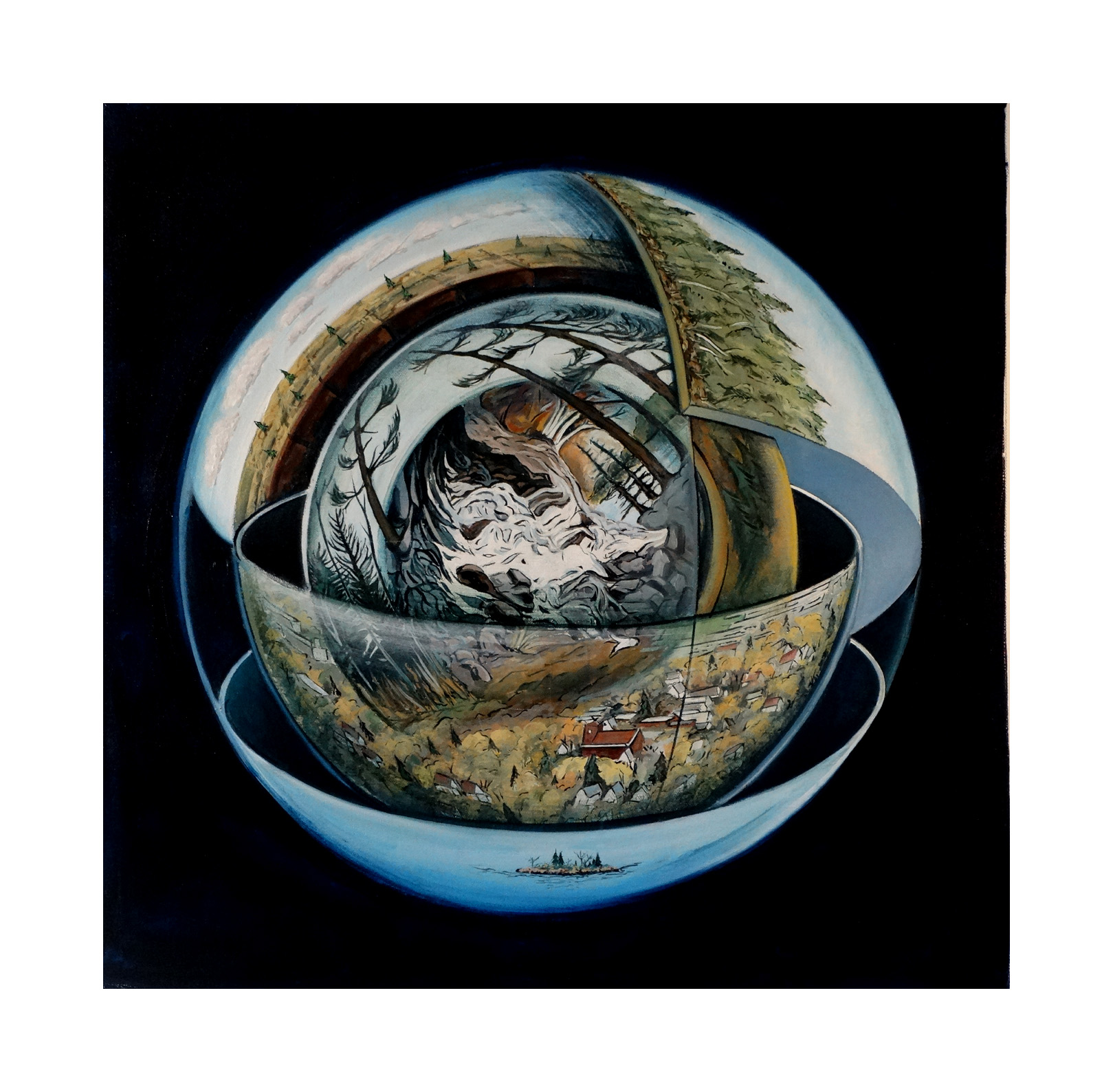
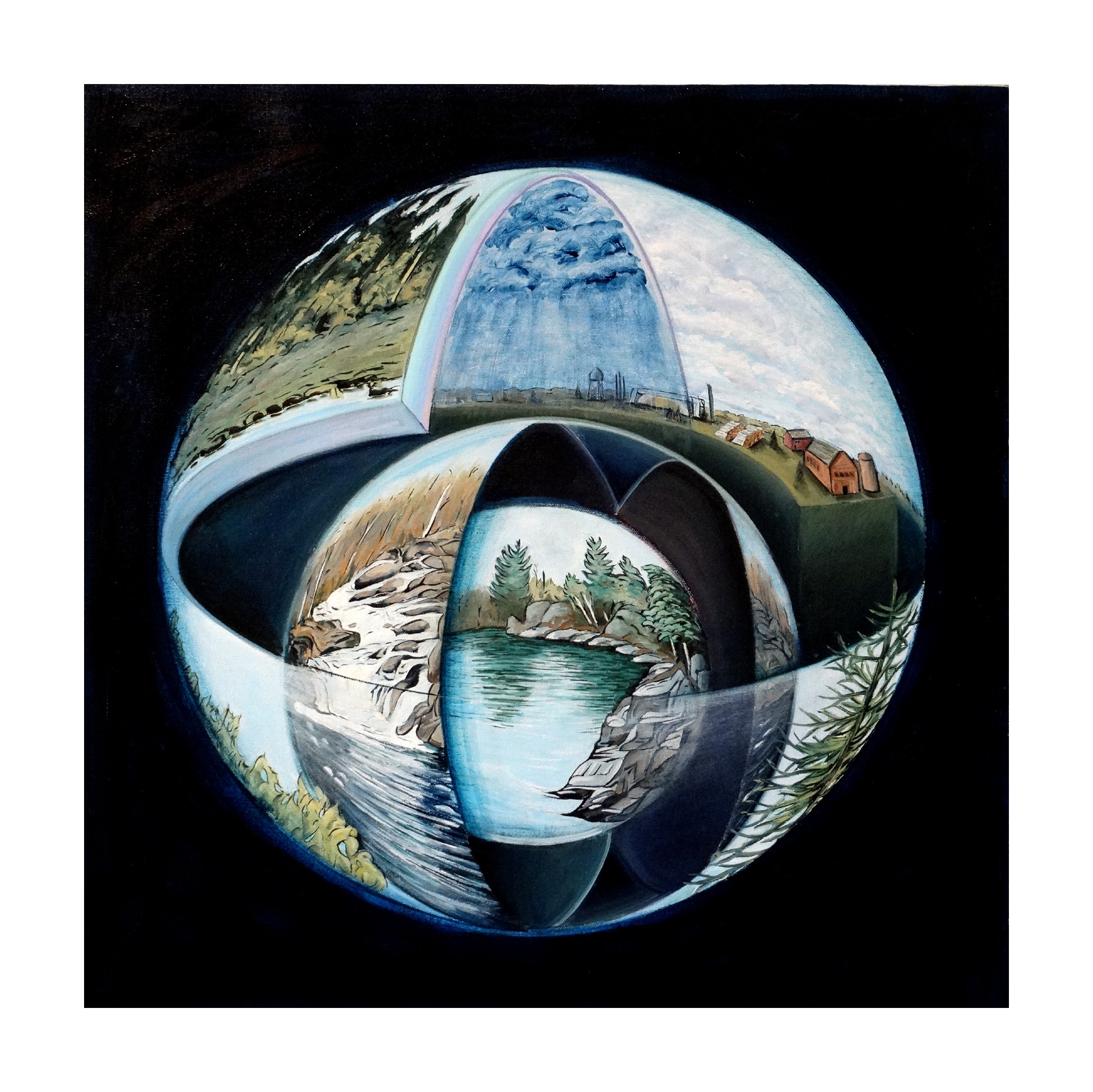
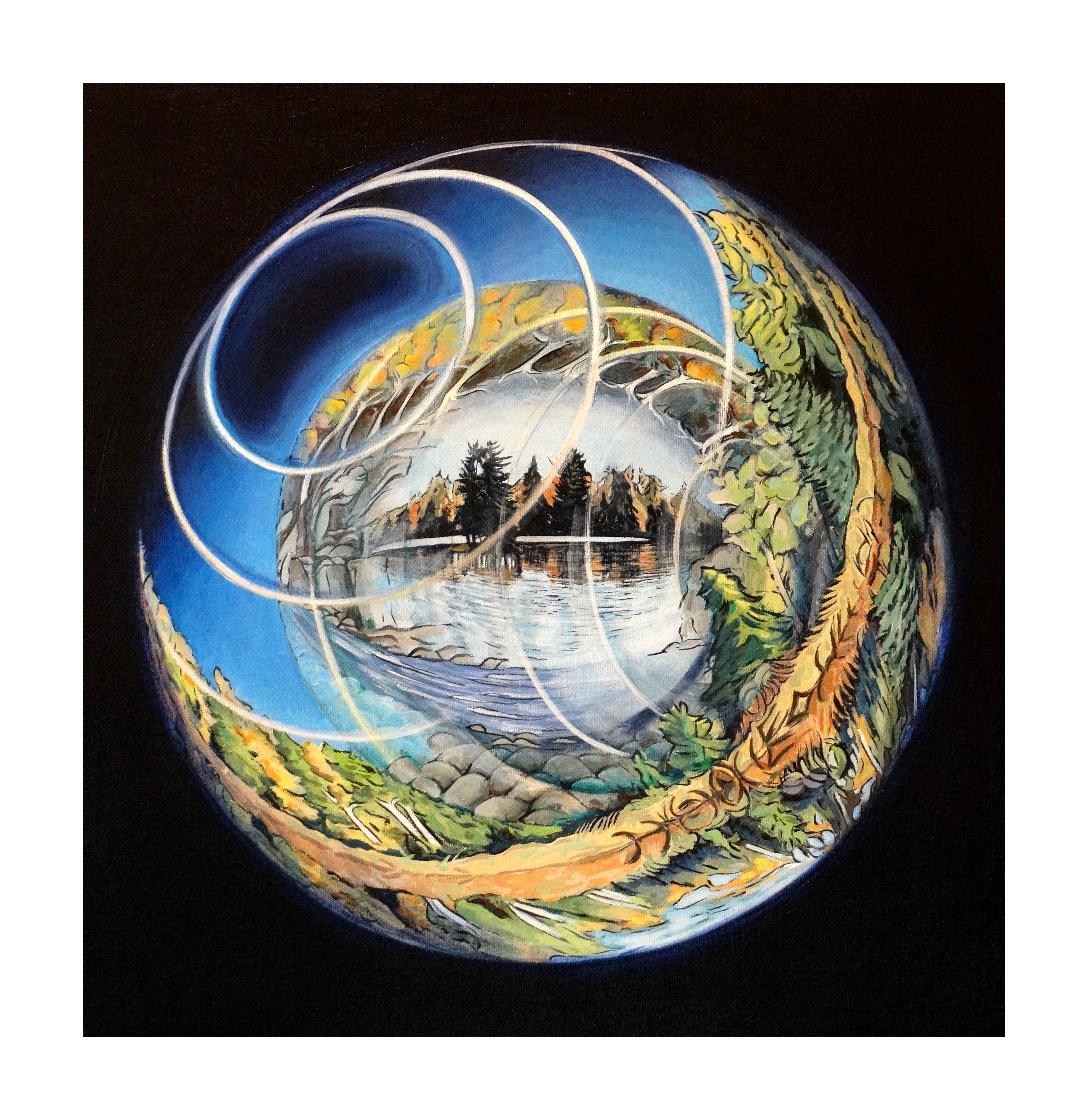
I’ve been making paintings, lately, as foci for meditation. The images in the paintings represent places in my familiar environs that have personal significance for me. What the bases of the deep feelings I have for these places is, is hard to explain.
I suppose reminiscence might be part of it. I’ve visited most of the places depicted in the paintings many times, so one might assume some of the significance the images hold for me has to do with remembered experiences, you know, feelings of nostalgia for an innocent past, even though I’m quite cognizant of the fact that past experiences are often stripped and cleansed of their reality.

Maybe the emotional responses I experience upon viewing the images in these paintings are a result of the physicality of place, the natural beauty, the richness of a supportive environment so favorable to my well-being. Or, perhaps, the significance of these represented places is due to my considerable imagination, whereby I bend the environs to suit my fantasies of an idyllic Shangri-La.

Or, maybe these images are important for no other reason than that they were selected by me and therefore received more attention than I usually pay to the world around me.

As I think about it, no one of the above explanations seems to capture the essence of the deep feelings the places depicted in my paintings elicit in me. The feelings I experience seem to be beyond rational explanation-ineffable, really; a result of my peculiar phenomenal consciousness. Which makes me a unique, special and, dare I say, magical individual.

But, perhaps the significance of these images for me is all explainable in terms of a combination of sensory input, memories, introspection and habit; not one but parts of all the above thoughts are involved; maybe it’s all about mind, not magic.

As much as I might like to recognize my individual uniqueness, it seems much more likely that I, and everyone else, might better be analogized in computational terms rather than thought of as metaphysical curiosities.

meditationdevice6

Altered States

I’ve been having these flashes lately of another time and place. Small things: certain smells and sounds, plays of light, will bring to mind thoughts, sometimes remembrances of earlier experiences, sometimes images of times and places I’ve never been.

Most often these ‘flashes of memory’ elicit almost euphoric feelings in me-a sense of idyllic existence, that, when I think about it, are hard to explain. I say most often because sometimes there’s an ominous foreboding which accompanies these forays into the fanciful.

These experiences are like visions into another reality. They occur with varying degrees of strength and fade and disappear fairly quickly.

Now, I’m no scholar, mind you, but as far as I can tell Martin Heidegger speaks of ‘being’ as a field, an extension of the physical/mental self to include one’s sensible environs. Our extended being can accumulate a lot of the detritus of daily life.  The ever increasing weight of familiarity and of the efforts and energies required to simply exist can be overwhelming. So, by altering one’s being, that is physically relocating, one becomes new and fresh-at least momentarily.

But, rather than actually physically moving, my mental sojourns into past and fanciful places might serve to offer a similar sort of relief.

I’m glad I got this figured out. Now if only I can extend these fantasies and keep them mostly positive.  Maybe I’ll be content to stay put physically while I travel far and wide mentally. I think meditation may be helpful.


Mindfulness Overdone

My daily meditations have me focusing, lately, on mindful attentions. Today, as I arise from my nocturnal slumbers to the feng-shui of my bedroom, I inhale deeply, exhale, and mindfully absorb the world around me. As I turn to the closet I wait, patiently, for the day’s wardrobe to present itself. Today I embrace change; I will become the plaid shirt and striped pants.

In the kitchen I am enveloped by the silence. I inhale the fragrance of freshly brewed coffee. Staring down into the dark, amber liquid I deliberate on the space between my thoughts. Mindfully, I lift the cup and contemplate the anticipated feel of the warm liquid on my palate and dwell for a time on the importance of observation in place of determination.

The tamarack tree outside my window beckons. I feel myself becoming one with its gnarly branches lightly swaying in the breeze and find myself becoming rooted to this place. As the wind begins blowing harder my back twists, fingers bend painfully, needle-like leaves detach. I am aware of the impermanence of existence and I share the suffering and pain of the fragile Larch for whom I shed tears in empathy. I pull away, release my embrace. Life is process not a state of being.

Well, at this point I’ve pretty much killed most of the day as far as doing anything productive goes; my painting languishes, I’m behind in my reading, the sidewalk needs shoveling and forget about the groceries for supper. Maybe part of the discipline of mindfulness needs to be being mindful of what is necessary for basic functioning.

meditationdevice5


Taking Advantage

I’ve been wondering how natural it is for those who are able to take advantage of others. Beside the moral imperative to do to others what one would have done to one’s self and the often stated acknowledgment of the appropriateness of equal rights there seems to be a strong impetus for factions to separate along ideological lines and when those ideologies gain sufficient support, to find in others’ actions and beliefs a corruption deep enough to find those others undeserving of any respect for their contrary views.

So, the factions struggle for political dominance in order to impose their particular values in a way which will be, pretty clearly, disadvantages to the opposition. And, since it’s also pretty clear there will never be full consensus about much of anything, someone will suffer at the hands of the other, which makes me think the potential for discontent and even violence is in the nature of our society. And, the vulnerable minority or passive majority may find their very being twisted and tortured in most inhumane ways.  A benevolent overseer, Plato’s philosopher king maybe, might deal fairly with the most egregious of impositions of one on the other but it seems, ultimately, human nature will prevail; the strong imposing it’s values and beliefs on the weak.

Maybe a good solution, a means of avoiding the discomforts associated with factionalism, would be to remain apolitical, avoid the news of the day, and even, if necessary, maintain one’s being outside of the social milieu.   It’s not an unprecedented move after all; Buddha did it and by all accounts ended up in quite a favorable situation.

evil me

haiku mantras

So, I’ve been thinking, as I continue to pursue my meditation practices, that perhaps, in addition to mandalas as primary visual focus, haikus could be used sort of like mantras as additional mental foci:

Generally, a haiku might emphasize one’s meditative intent:

Be undistracted
Clear, open, alert, focused,
Perfectly present

Or:

Past is no longer
Future remains to be seen
Now is eternal

Or, possibly:

I must be conscious
Enveloped in thought, knowing
What it’s like to be

Sometimes, though, I get caught up in irritations that interfere with my goal of achieving some sort of enlightenment. Perhaps an appropriate haiku might ease or erase the problem:

Cultivate mindful
Compassionate responses
To those you despise

Or:

Inhale deeply, breathe
Expose the fallacies of
Acquired dogmas

Although, I’m not sure if this tact might not exacerbate the problem:

Mean words, hurt feelings
Hypersensitivity
Empowers the weak

Well, you get the idea. I’ll try these out; see which ones help me get nearer my goals. Actually just writing these haikus is quite enlightening.

meditationdevice4

Suffering and Death

I’ve been thinking lately about some of the great thinkers of the not too distant past and how they seem nearly obsessed with ideas of suffering and death.

First, take Arthur Schopenhauer. He was pretty sure we are all slaves to our desires and that satisfying our desires was a pretty short-lived proposition; new desires quickly appear leading to a fairly constant state of dis-satisfaction. Then there was Soren Kierkegaard who maintained despair is the rule for all men, eating away at one’s spirit causing the sickness unto death. He thought the solution was to embrace the absurd and take the leap into faith which, I must admit, makes me wonder a bit.

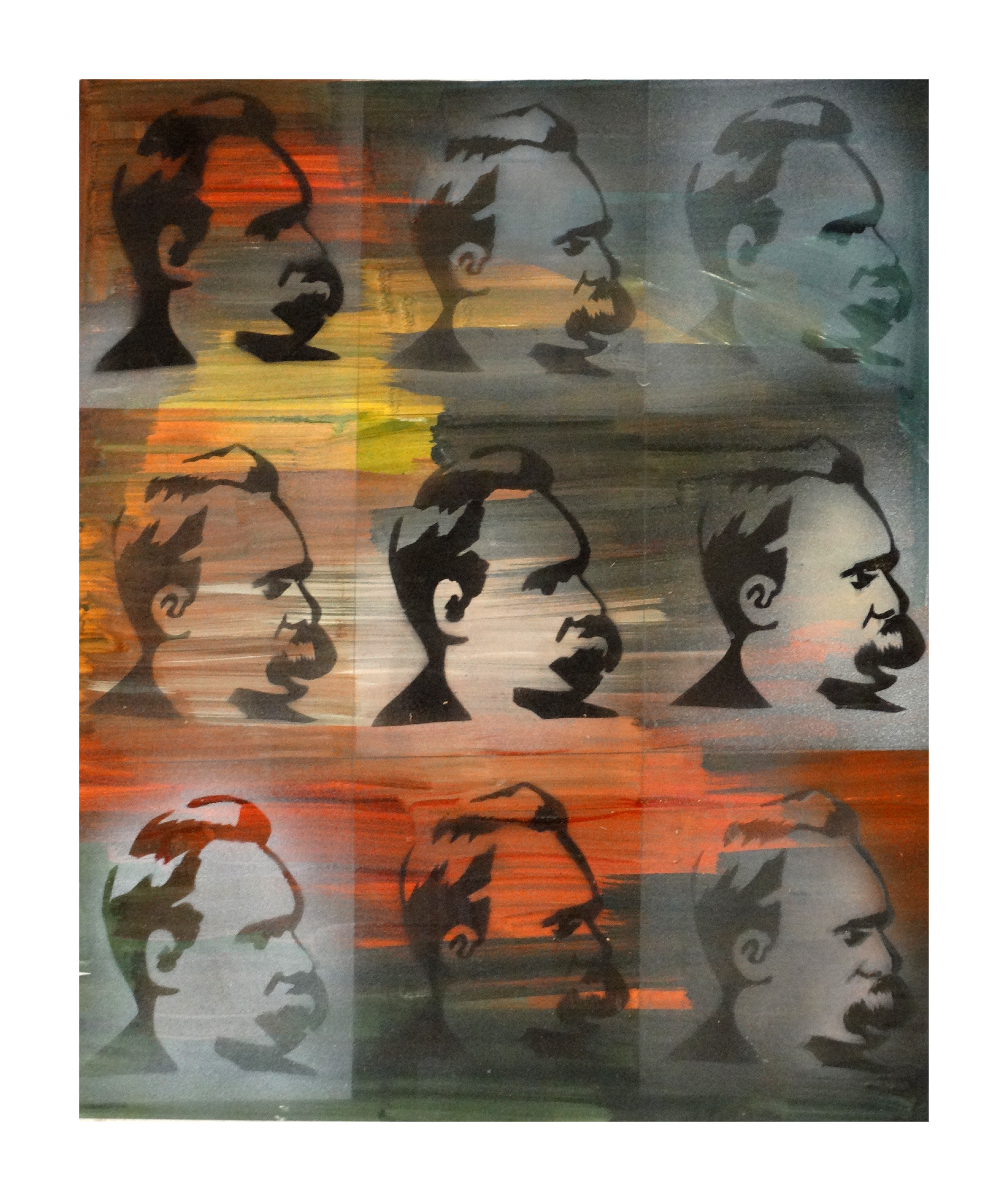
Friedrich Nietzsche’s writings are peppered with ideas on the topic, in part, I suspect, due to his own fairly constant physical infirmities. Rainer Maria Rilke entertained the notion that everyone carries their own Death around with them. He said that when Death’s time comes it gets to express itself in it’s own unique way. I guess no two Deaths are the same just as all people are different. Having Death as a constant companion would probably get a nod of approval from the ancient Stoics.

The Norwegians Knut Hamsun and the painter Edvard Munch, similarly, offer dark visions of man’s predicament.  Hamsun’s writings are filled with existential angst while Munch’s paintings may serve to illustrate the common neuroses of primal fears we all seem to share.

Well, I guess there is the inevitability that eventually suffering and death will occupy each and every one of us but there is the implication among some of these men that perhaps facing up to life’s travails isn’t such a bad thing. Friedrich N. famously declared: ‘That which does not kill us makes us stronger.’ I guess bearing suffering well does demand courage; you know, requires one to step up, see what one is made of and all that.  It seems like most of the suffering I bear these days has to do with minor physical infirmities and fighting myself to avoid judging some of those in the political arena.  The second of these is pretty painful.

All in all I really don’t think I need to suffer more.  I’m really quite satisfied in my contemplation s within the warmth and security of my cozy room. And I feel pretty good about myself, exercising, as best I can, compassion for those around me. As far as getting friendly with my own death goes, I think I have enough social interaction right now without her.  But, I suppose when the inevitable occurs I’ll try to face it with strength and decorum.

nietzsche3

Mandala Haiku

I was reading recently that the psychologist Karl Jung had his patients paint mandalas as a means of treating their various mental difficulties.
He arrived at this notion, I guess, through his identification of what he called the ‘collective unconscious’, which he thought everyone shared. The idea is that, through our evolutionary development, certain symbolic associations occur which are common to all humankind. And one of these symbols is the circle.

According to Dr. Jung, the circle or mandala form conveys a sense of wholeness or self that most everyone can relate to. By immersing themselves in constructing circular paintings, his patients’ psychic problems tended to be relieved. The formations they developed in their paintings created a sort of structure that translated into a greater personal mental stability.

I’m not sure one has to necessarily paint mandalas to benefit; eastern religions have been using circular structures as foci for meditative practices for a long time. And, I’m convinced meditation is a very beneficial endeavor. I am so sure of this I’m inspired to offer a haiku:
Attentive focus
Within the circle of self,
Clear mind, present mind.

Well, it works for me and it certainly can’t be a bad way to spend some time.

meditationdevice3


Beyond the Grave

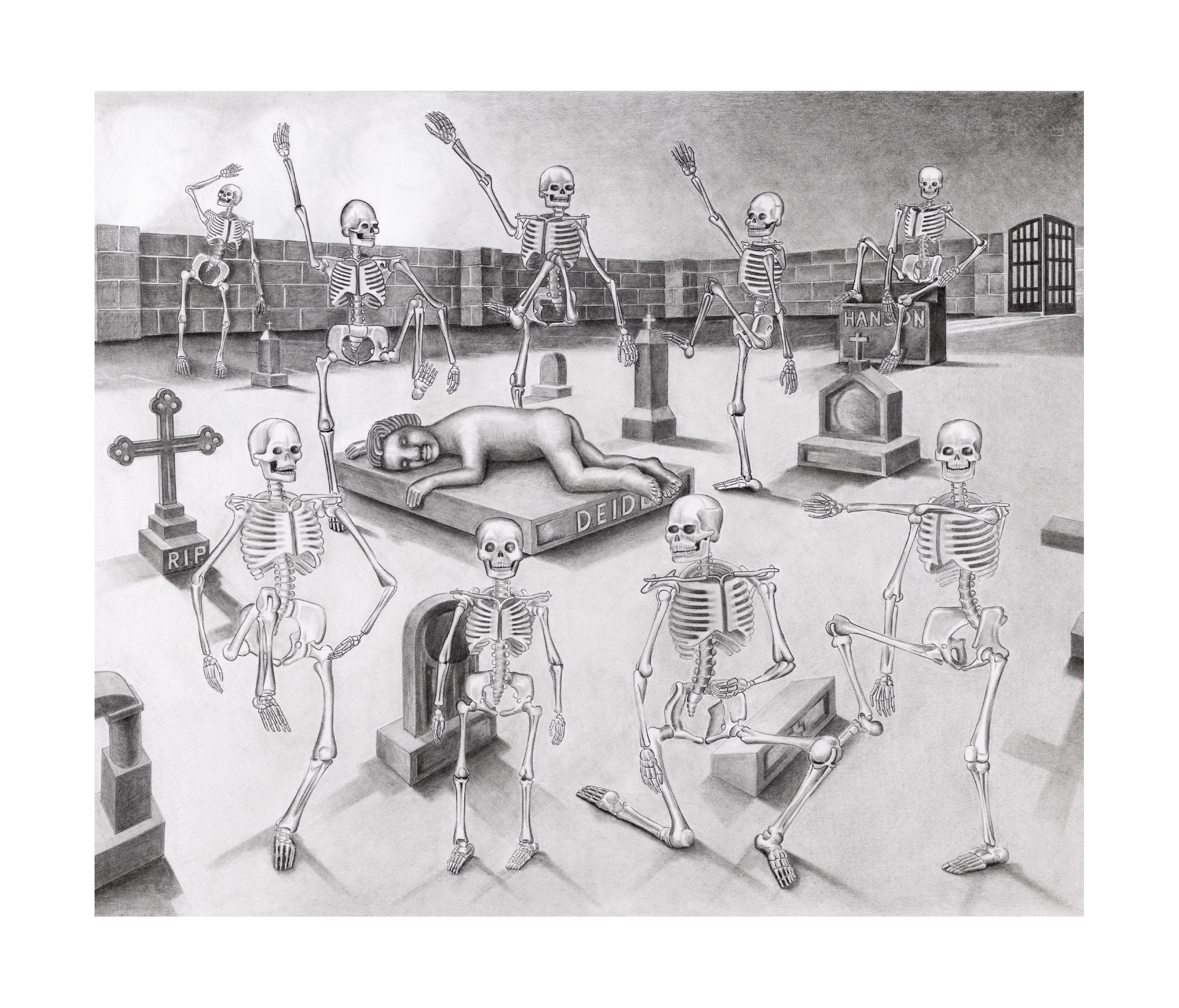
I see by the calendar All Soul’s Day and with it The Day of the Dead is here. Death isn’t something most of us want to think about very much but at this time of the year, with nature racing toward dormancy, the topic tends to come to mind.

In medieval times death was on everyone’s mind daily. The Black Plague invited Death to be a regular visitor if not a live-in house guest. She became so well-known she starred in a regularly performed play called the Danse Macabre. In the play the black Angel would appear and, along with her spirit helpers the psychopomps, invite victims to accompany them beyond the grave; the beyond being, I guess, a promised land of paradise.

Throughout history (and even earlier than that I bet) people have sensed an existence beyond the grave: The ancient Egyptians conceived of a Ka or immaterial double that would live on after the demise of the physical body so the deceased would be able to keep doing the same fun things they had always done when alive.

The philosopher Arthur Schopenhauer was inclined to believe that, upon death, an individual’s will or essence of being would be reunited with its Cosmic origins from which it originated, which is a pretty cool idea of togetherness even though one wouldn’t really be aware of it because one’s memory and ego would cease to exist.

The Hindu people understand the universe to be eternal and that rebirth will continue to happen until enlightenment of the soul propels a leap into the infinite, which, I guess must be a bit like Arthur’s cosmic origins.

Contemporary Trans-humanists anticipate a situation in which one’s brain activity is downloaded to a computer and since the brain is where one’s being resides one can expect to live on forever provided someone is around to keep the batteries charged.

I’m sure I’m like everyone else in hoping the Black Angel stays away for a while but when it does come time for me to leave the realm of the physical, wherever I end up, I can always look forward to new experiences.  Or, perhaps, oblivion.

dayofthedead3