Poetic Naturalism

I was reading the other day that what we are, when it comes right down to it (way, way down I might add) is ‘collections of vibrating quantum fields, held together in persistent patterns by feeding off of ambient free energy according to impersonal and uncaring laws of nature.’* Vibrating one-dimensional strings or sub-atomic particles organize themselves to form our senses and memories, record and qualify our experiences which are then interpreted in language containing personal pronouns which identify self and, voila, we awaken and become conscious of our individual selves.

It’s a great story, a believable narrative that answers a lot of questions about our unique natures and our reality as we conceive it. There are, of course, other narratives. On a macroscopic level our complex beings seek out and find entities beyond the physical that on occasion reach out and touch us, make us aware of the magic in a changing natural world; give us the capacity to embrace beauty, to love others than ourselves, give us courage in the face of adversity, offer a benevolent overseer to rule our very existence.

There are without a doubt other narratives as well. The question we need to ask is: which stories carry the greater validity, answers the most questions, accounts for nature as we know it. I must admit I’m often swayed by a well stated thought which leads me to embrace, for the moment, the ideas of poetic naturalism, seeing as how it is so convincingly backed up by theoretical physics.

So, for now I will embrace the beauty and complexity of a naturalistic view and set aside explanations requiring any sort of supernatural participant. At least until the next new, well-thought-out conception comes my way.

*credit to Sean Carroll for this wonderful summation.

meditationdevice14

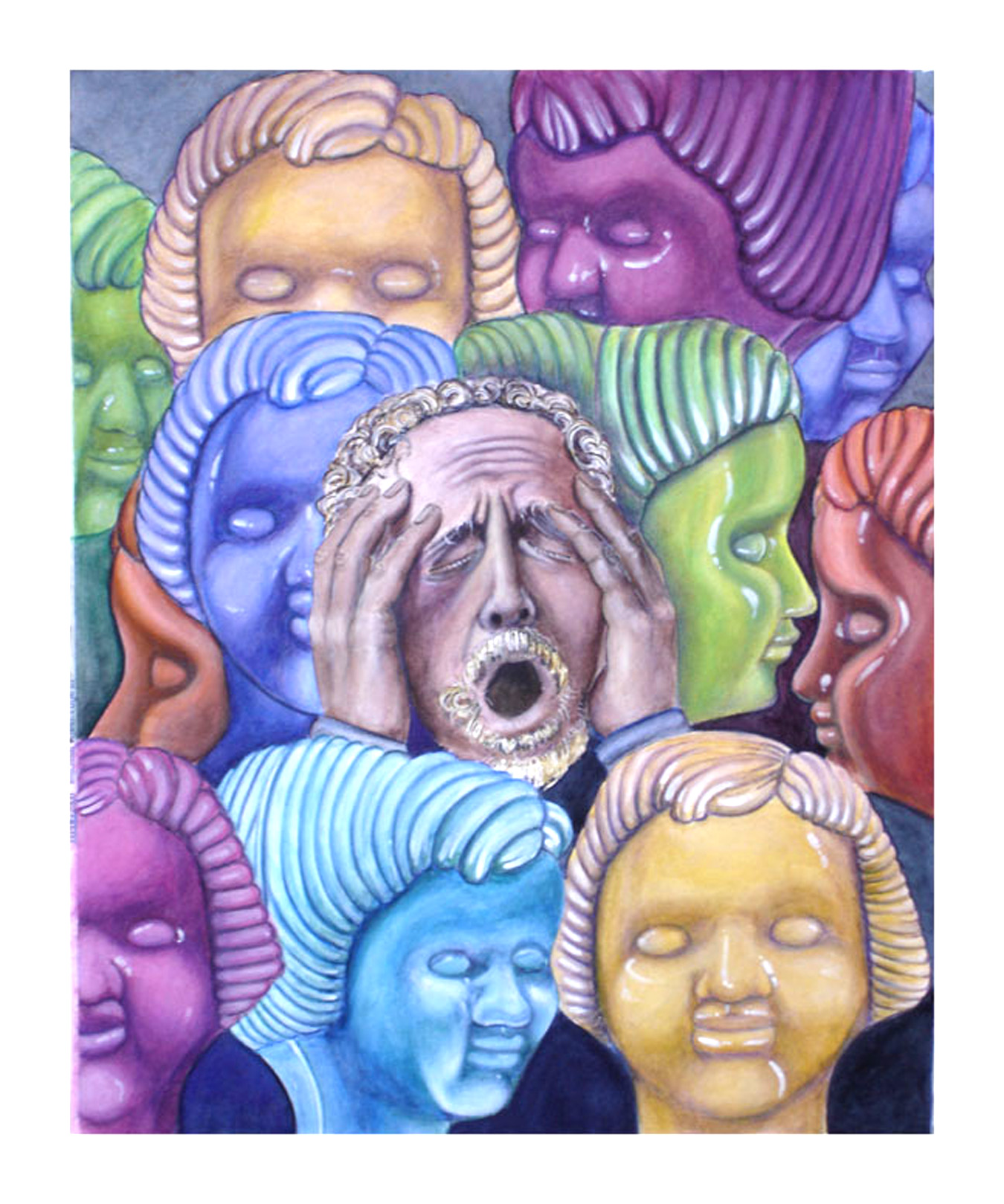
Crowds

I found myself, recently, in the midst of large numbers of people. The atmosphere was festive and most everyone seemed fairly convivial and, I must admit, for a time I found myself pleasantly embraced within the mass of humanity.

But, it wasn’t long before I began to feel a bit uneasy, being, as I am, generally averse to extended time in public. As time went on the pleasant demeanor I sensed in the crowds earlier began to dissipate and take on an ominous malevolence. The gentle jostling I had experienced as people moved toward a better view of the festivities I now found aggressive and unpleasant.  I didn’t feel the need to run for cover exactly but move away from the congestion I did. As I approached the perimeter of the mass of people I stopped and turned to view the crowd. From a distance the mass of humanity was less intimidating and I found my composure restored.

As I now reflect on it all the experience was really more than tolerable and I can again embrace my deeply held empathy for mankind and the difficulties everyone faces, you know, just dealing with daily life. I guess the key for me is to stay off the stage, take a seat in the balcony as long as it’s not too crowded.

existential angst

Entropy in Five Words or Less

I’ve been trying to make sense, lately, of what exactly entropy is. Entropy is apparently a very important concept applied by physicists to help explain the Big Picture, relating to the workings of the universe in sub-atomic terms. I guess it has something to do with heat distribution: how hotter things like the sun give off heat as energy which is absorbed by cooler things in an ongoing move toward systemic equilibrium.

When the Big Bang happened, so the story goes, entropy began, and, over time, continues to increase so that atomic configurations grow ever increasingly complex and chaotic which is the point in time we are right now. But, eventually all this chaotic complexity will blend together in a homogeneous soup and everything will return to a state of equilibrium as the last star blinks out.

Which all seems somewhat understandable, but then we’re told entropy continues to increase even though everything will have been reduced to undifferentiated matter, which is pretty hard to understand. And this is not to mention the idea that entropy measures the amount of work that CAN’T be done using available energy and the whole concept can be reduced to mathematical formulae.

So, my understanding of this illusive concept remains in the shadowy grays if not quite the complete dark, and I’m left with little choice other than reducing the concept to: the measure of change over time. I know this must be terribly simplistic but I’m pretty confident it’s all I really need to know about entropy.

biosphere11


Into the Wilderness with Others

I’ve recently returned from a trip into the wilderness with others. And, while my companions were most congenial, offering, as they did, opportunities to share sights and sounds, I found the experience lacking in ways it’s taken me a while to identify.

Most of my treks into the wilds in recent years have been done solo. Traveling alone means extended times of solitude and contemplation which is really refreshing initially, but, after a while I will inevitably find myself missing conversation. At some point I always seem to experience a descent into psychic depths of a fairly profound nature. And, although these mental travels are not always pleasant they provide me an ultimately refreshing reassessment of my existence. Not exactly an epiphany every time you understand, but usually by the end of my adventures I do sense a nuanced change of perspective.

So, the recent trip with companions to insulate my psyche from its otherwise likely meanderings was a clearly different experience. But, after all, placing one’s self in a situation where nature has the clear upper hand, whether with others or alone I think is pretty worthwhile no matter where one’s psyche might wander off to.

meditation mandala

The God Particle

I’ve been trying to make sense, lately, of what science, particle physics in particular, tells us is the underlying structure of the universe and everything in it. Apparently, there is a “core theory” which informs us that the sub-atomic building block of all matter is something referred to (simplistically according to Mr. Higgs) as the God Particle, which, as I understand it, is a really, really small item that has never actually been seen by anyone.

To further complicate things these incredibly tiny particles occur as wave lengths in vibrating fields which make up everything from the planet Jupiter to the fly currently resting on my living room window. The whole system is in a constant state of flux driven by energies like gravity and electromagnetism.

As mysterious as this all seems, and physicists freely admit there are many questions still unanswered, the underlying consensus is that Quantum Field Theory is sound as far as describing what kinds of things can’t occur in nature as we know it. Certain supernatural powers, such as telekinesis, QFT tells us, simply can’t occur because the energies manipulating the universe on a sub-atomic level aren’t strong enough to allow anyone’s mind to bend a spoon or send knives flying across the room while sitting sedately at the kitchen table.

I think, though, the jury’s still out on mind on mind occurrences like extra-sensory perception. Who’s to say all those quarks and things flying around electromagnetically in vibrating fields aren’t interconnecting Mind somehow. Anyway, I certainly find it all fascinating to think about. I look forward to our noble physicists finding more answers to the big puzzle.


Intuitive Thinking/ Analytical Thinking

I was reading the other day that psychological research suggests that those folks who think intuitively are more likely to embrace a personal god than people of a more analytical mind set. Apparently, as it turns out, those who base their thoughts on instinctual understanding are inclined toward a mind/body dichotomy, a separation of the mental and physical that presupposes an existence beyond mortality and lends itself well to religious belief. On the other hand, the analytically minded, using reason to frame reality are far less inclined to figure in any sort of supernatural agency when defining the Big Picture.

I’m inclined to think that most of us harbor a bit of both mindsets, at least, I know that I do. I, alternately, seek to reason and understand and sense and accept the presence of the unknowable. Psychology suggests it’s far easier to embrace the intuitive, which is a more natural mental state, while analytical thinking requires hard work, pushing the intellect to find order in the complexities of the world. Finding a balance, for me, isn’t so easy. I can peacefully revel in the beauty of nature where the supernatural lies in wait and then find myself working pretty hard to make logical sense of what I experience around me.

I guess I’ll just have to let my mind go where it will, relax in intuitive oblivion or analytically battle the difficulties before me, as my energies dictate. I have time for both.

intelligent design 3


Worlds within Worlds

I’ve been wondering about this most incredible idea, that, quantum mechanically speaking, there may exist any number of universes. As hard as I try to visualize such an idea in my limited three-dimensional capacity to imagine spatially it all seems pretty much beyond comprehension. When I add time to the mix I can sort of get an idea of it all. After all, the world as it is right now is not quite the same as the world as it is right now. A micro-second in the past or the future might define an entirely separate reality, a parallel existence.

I wonder if these separate realities float around, bump into each other and maybe intersect for brief periods. Is it possible the remarkable sparkling landscape you saw last week was of another world never to be seen in your reality again? Maybe realities are nested within each other. Do the places you glimpse through the trees and bushes on that familiar winding trail through the woods have a certain other-worldly feel?

I find such thoughts intriguing. I revel in the possibilities, and, as long as I don’t think too hard about trying to define the multiverse in three-dimensional terms, I remain content in the limitations of my understanding.

meditationdevice13a

Are Watched People Nice People?

I’ve been reading that there are a number of scientifically sound studies in psychology that suggest people tend to be good, more generous, altruistic when they’re being watched. And, more specifically, when they are thinking about God, or gods, or other supernatural entities people are more inclined to behave nicely toward others.

I’ve recently been made aware of the fact that a quite large percentage of prisoners in American prisons suffer from one sort of disability or another. According to the report, one of the most common disabilities among the incarcerated is something called ‘executive function disorder’. What this means, I guess, is that those who suffer from EFD are unable to organize themselves well enough to take care of those basic actions required to function successfully, you know, get the things done that need to be done. These folks are apparently unable to get in step with their fellow citizens, or, to put it more simply, they don’t follow the rules, which seems to me a pretty good explanation as to why they’re incarcerated.

I wouldn’t be surprised if these incarcerated individuals thought about God quite a bit, at least in the beginnings of their time behind bars. I wonder if this means, being watched as they are with great care, these folks are nicer, more generous and cooperative with each other than they might otherwise be.

horrors of war

Totalitarianism

I’ve been thinking about totalitarianism lately. This, in part I guess, because I’ve been reading about the philosopher Hannah Arendt who escaped Nazi Germany in the 1940’s and, as a Jew, gave considerable thought to the subject.

Ms. Arendt determined that a successful totalitarian regime is able to establish a commitment to certain idealisms, such as racial purity or nationalistic solidarity, at the expense of basic human rights. By creating and enforcing with a heavy hand certain rules and laws focused on idealisms, plurality and individuality are undermined and an undifferentiated populace is championed. Faced with being ‘for us or against us’ the individual trying to go about his business taking care of family, putting food on the table and such will understandably become fearful. The fear of being perceived as an outsider tends to push ordinary citizens to embrace and participate in the extreme right wing political agenda. And, before long, most everyone is on board except, of course, those chosen as scapegoats to represent all that is evil and in opposition to the selected ideal truths.

As I think about it, it seems to me most all political structures, even those that declare democratic rule, have a bit of an inclination to push idealisms and demonize an opposition. Hopefully, individual strength and perseverance will hold such totalitarian impulses at bay. One must be careful, thought, not to take individual freedoms for granted, I think.

shriners3

In Groups/Out Groups

I’ve been reading, lately, how evolutionary theory offers insights into human behavior. Apparently, deeply ingrained within our genetic make-up, we survivors have certain inherent inclinations that, despite how desperately we may want to rationalize them away will always be with us. Our ultimate evolutionary need to pass on our genes has embedded within our psyches the drive toward group membership: like-minded individuals to share values and reciprocal support and the presupposition of a supernatural agency. I guess what happens over (a long, long, long) time is that the group establishes an identity: cultural, moral, spiritual, that separates it from other groups.

So, what this must mean is that we all will forever be divided into in-groups and out-groups. In the best of times, I suppose, toleration will reign, there will be peaceful co-existence. But even when such periods exist, the Ins will know that they are the trustworthy ones who recognize the true supernature, which means that there will always be a sort of tension between Ins and Outs that could, and sometimes does, fester and erupt into violence. And such a situation will be more likely to happen, I further suppose, when one group feels its existence is threatened if political power becomes imbalanced. And, as much as one might like to disassociate oneself from this ridiculous op positional stance, you really can’t since you wouldn’t be here to even think about it all if your ancestors hadn’t passed on the necessary survival genes.

I guess this evolutionary perspective explains a lot about the nature of the world today. I will try to remember that as evolution continues to slowly and erratically move along, in some distant future perhaps it will catch up to an intellectual enlightenment.

born-again-3.jpg