Absolute Truth and Moral Relativity

I’ve been contemplating, lately, how one might think about the idea of absolute truth. Apparently the philosopher Rene Descartes had a couple of pretty firm ideas about it: he was sure about his own existence and also that of God. I guess, over the ages, religions have latched onto the notion, believing firmly in certain supernatural entities as well as applying the idea to morality. Unfortunately the irrefutable absolute beliefs of one group doesn’t usually translate to the absolute beliefs of those in the next church. The disharmony that arises from the differences isn’t simply friendly rivalry.

There are, of course, secular moral absolutes, too, having to do with murder and theft and other anti-social behaviors seen to undermine the greater social well-being. The trouble with absolutes, moral or otherwise, is that one can usually come up with plausible exceptions: taking a life to protect another, stealing food to feed the hungry and so forth. And then there’s God’s elusive nature throwing into question that particular absolute truth.

I guess such discrepancies are what encourage some hasty thinkers’ leap directly into the embrace of relative truth and morality. This, even though, given some thought, moral relativity will be found to be a poor position to support a thriving, well-functioning society (no matter what some crony capitalists might want us to believe).

So, maybe what makes the most sense is moral diversity and truth seeking rather than truth grasping. If we recognize that different people at different times are experiencing unique and varied situations that have led to ethical frameworks quite different than our own perhaps we need to cut them some slack. If their moral ground is embraced by the populace and provides a safe nurturing environment who are we to complain?

Absolute Truth

Absolute Truth

High Comedy

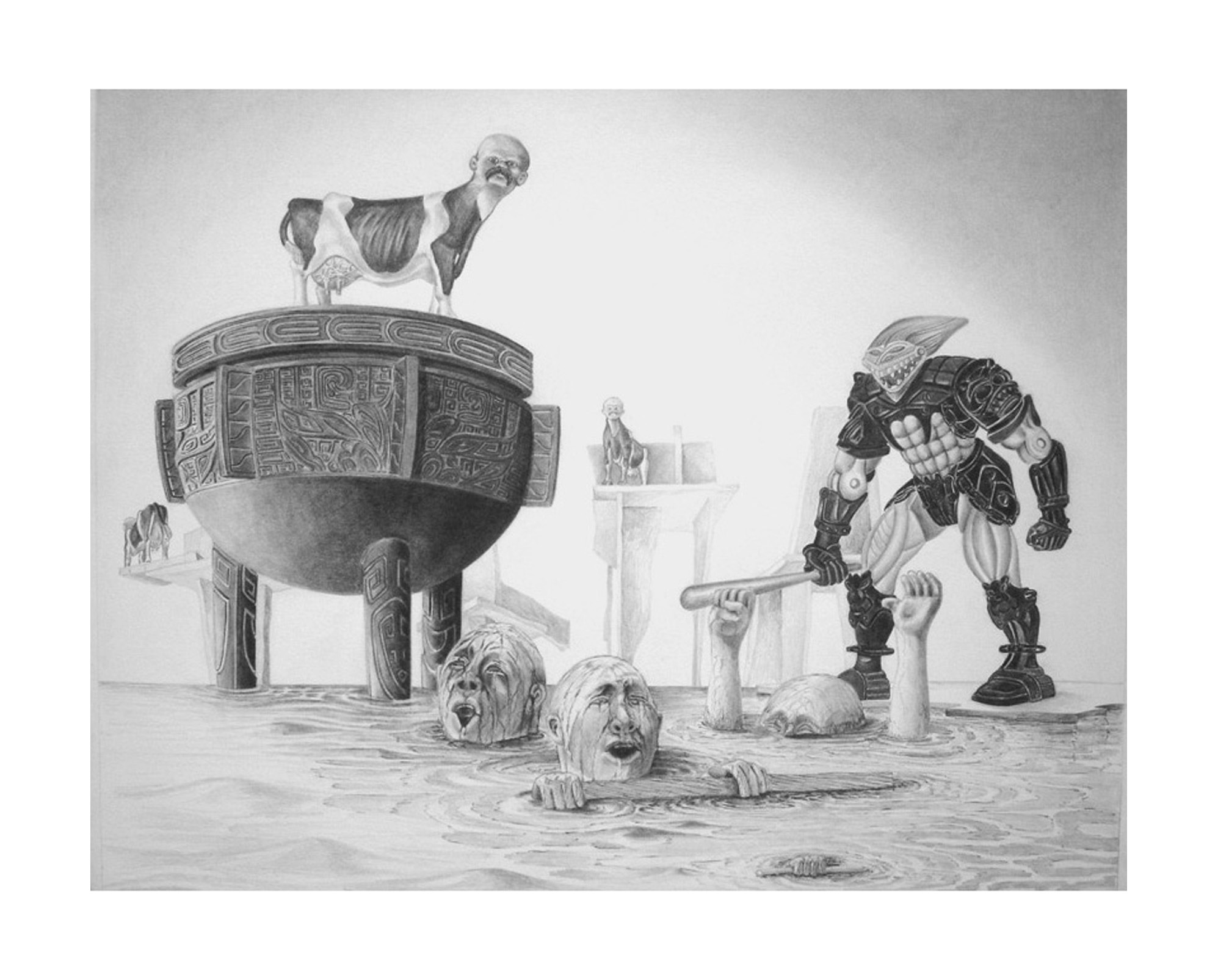
As abrasive, ugly and, I guess, pretty comical  public debate has become these days (although it’s probably always been such, visibility being exacerbated by our competitive media outlets) maybe it’s time to extol the virtues of the high energy levels our contentious philosophical exchanges generate. However distasteful, things are certainly better than the situations censorious political structures in other parts of the world impose on their populations.

Still, I have to question motivations sometimes. I’m afraid rather than championing fairness and what’s best for all, it appears, often, the primary concerns center on me and mine, my own situation and how it measures up to what I see around me; seems like arrested development sometimes; a perpetual adolescence.

The 19th century philosopher John Stuart Mill reminds us that in any debate, both positions will contain a certain degree of truth; issues are never simply black and white. So, it’s up to us all, I guess, to try to make reasonable sense of the oppositional view rather than mindlessly rely on logical fallacies, strawman simplifications and ad hominem put-downs to bind us with our allies and reinforce what we wish to be the right and only view.

As I contemplate these ideas I’m fully aware of my own complicity, my own inclination to jump on my preferred band wagon, you know, thumb my nose at the opposition. But, at least it gets my blood pumping, raises the old energy level; better than wasting away in lethargy ville I suppose.

ship of fools


Limbo

I seem to be existing, these days, in a state of limbo, not knowing, when I awake in the morning, whether the weather demands long johns or permits short sleeves. Well, it’s not just the weather. It’s also the whether, loose ends and multiple mental directions that have interrupted my normally productive routine.

I understand that, theologically, Limbo has a lot to do with Original Sin. It is, I guess, a place reserved for those who, having given up the ghost but who haven’t had the opportunity to participate in those actions necessary to ensure residence in either the heavenly realm or The Deeps, must go to wait awhile. Maybe a long while, so I understand.

I don’t see the limbo I’m experiencing to be quite so serious. I’m pretty sure I’ll snap out of it soon. Maybe when the weather improves so I can spend more time outside I’ll be able to pull myself together.

dreamsoffreedom4


The Seven Deadly Sins

I’ve been thinking about the goings-on in the political realm, lately, in terms of the seven deadly sins the fourth century church fathers saw fit to impose on their faithful practitioners. I suppose those early church leaders may have been thinking of the moral health of the people, at least to some degree, while imposing a social order that was disregarded under penalty of mortal oblivion.

It appears the current flock are not as concerned about sinful mortality as they might have been centuries ago considering what appears to be widespread desires for more, more, more, material excesses and gluttonous consumption while basking in the vegetative state.

But, it seems to me these indiscretions are pretty minor compared to the behaviors of some of those seeking public office these days. What it all appears to come down to is hubris of monumental dimension, which, if we are to give credence to Dante, who gave this issue considerable thought, placed the prideful in the deepest bowels of his Inferno. Not scary anymore, I guess.

Philosophical Thoughts

A couple of recent upheavals in my otherwise serene existence have me thinking about the wisdom of the ancient Stoics and the idea of balancing my placid life with a daily dose of worst-case scenario.  According to the philosopher Epictetus such a position will ensure than while one may be sick, yet will be happy, in peril yet happy.

One might complain, I suppose, that waiting for the roof to fall in isn’t exactly an optimal philosophical perspective, but I have to hand it to those old Stoics as well as Cynics and Epicureans, that their ideas might have been less than perfect but their concern for living life meaningfully and well was above reproach.

Which is more than can be said for certain later philosophical thinkers; apparently, there were individuals, more than a few, I guess, who, in order to catch the attention of their peers, wrote in a most obscure manner employing a convoluted prose filled with misleading, faulty logic and leading to pseudo-profundities having little to nothing to do with living life.

This information has been quite an eye-opener for me, considering the difficulty I’ve had over the years trying to make sense of certain philosophical readings. Not being a scholar, myself, I’m not absolutely sure whether my difficulties are a result of misdirection or simply a lack of subtlety of understanding; nuances, I think, are often lost on me.

Nevertheless, I’m going to revisit the ancients. I’m pretty confident that what they sought, that is the nature of our human existence, carries the kind of meaning important to me.

greek philosophers

Delusions of Well-Being

According to the Romanian philosopher Emil Cioran a person would be better off not to have been born. He determined suffering is the rule in life and there is absolutely nothing anyone can do about it. All actions, he says, are or will be cause for regret.

The notion of well-being for Emil is an illusion that many people will harbor off and on during their lives but will in the end be unable to sustain. Apparently Emil thinks it would be better to be, now, where he was before he was born-which is where he must be since he died in 1995.

I guess Emil spent most of his life under a dark cloud; his mother told him at one time, had she known he was going to be so unhappy she would have aborted him. The notion of the accidental nature of his existence seems to have been somewhat of a lift, leading him to the idea that, potentially, suicide is always a possibility.

Emil’s lack of empathy for his fellow man led him to embrace the totalitarian politics of World War II Europe; no doubt he has to be seen as the quintessential misanthrope. Still, he had good friends, companionship and wrote quite beautifully in a lyrical style. He was an artist, really.

It makes me wonder if there wasn’t a certain Stoic resignation in Emil’s behavior; perhaps writing all those negatives provided the opportunity to not have to think about them so much.

eithoror3

The Absolute

I’ve been thinking lately, about the idea of the Absolute, you know, in an abstract sense: the Origin of all, the monad, the axis mundi, the metaphysical first cause; God, if you will.

I have this notion that if one embraces the idea of an existing absolute with enough conviction they may very well realize the presence of such an entity, perhaps, even, on a daily basis. In which case, one questioning such an existence would have to concede that for the believing individual the Absolute does, indeed, exist.

I suppose if I were to assume the position of the doubter, I could argue our believer is mistaken and has deluded herself into believing something that isn’t real, that simply doesn’t exist. But, since proof of such a position is not to be obtained, the ensuing argument would be futile, because the fact is the believer believes absolutely in the Absolute. And, as vehemently as I might point out the lack of empirical or logical justification for their belief in an Absolute the more vehemently I will become absolutely convinced I’m right in my denial of the Absolute.

But, then, doesn’t my belief that absolutely there can be no Absolute become a belief in an Absolute?

I wonder if that’s the game the pre-suppositional apologists play.

deideivis2

Winning and Losing in the Material Realm

I’ve been getting caught up in winning and losing lately. The politics, these days,is getting pretty cut-throat and the pressure to take sides, whether regarding sports activities, political discussions, philosophical positions, religious notions, you name it, is increasingly intense. It almost seems as if winning or losing is more the issue than thoughtful reasoning about issues. Winning, it seems, becomes synonymous for many with success.

I read an article recently that suggested one was less likely to succeed if she was overly optimistic. I guess the idea is too much optimism inhibits the drive to compete; to strive for the head of the line, for the promotion or the big raise. The optimist, the writer suggests, assumes good things are in store regardless of how hard she works for them.

It seems to me the whole idea of winning presupposes a common desire which will be satisfied by material reward resulting in an enhanced sense of well-being. This ‘success’ will never be more than temporary which means additional winning will be required to not simply sustain it but to avoid the debilitating depression of ‘failure’, the result being a vicious cycle of competing egos egged on by media hype and recognition. Then, one day I awake to the realization someone else is determining my values for me; my well-being is no longer in my own hands and has become embedded in the competitive, material realm.

Well, I’m not having any of it. I really don’t care how popular success is measured. I’m staying positive and optimistic. I’ll look past the material realm and embrace the purity of beauty and truth. I understand this may require some disassociation.

Taking Advantage

I’ve been wondering how natural it is for those who are able to take advantage of others. Beside the moral imperative to do to others what one would have done to one’s self and the often stated acknowledgment of the appropriateness of equal rights there seems to be a strong impetus for factions to separate along ideological lines and when those ideologies gain sufficient support, to find in others’ actions and beliefs a corruption deep enough to find those others undeserving of any respect for their contrary views.

So, the factions struggle for political dominance in order to impose their particular values in a way which will be, pretty clearly, disadvantages to the opposition. And, since it’s also pretty clear there will never be full consensus about much of anything, someone will suffer at the hands of the other, which makes me think the potential for discontent and even violence is in the nature of our society. And, the vulnerable minority or passive majority may find their very being twisted and tortured in most inhumane ways.  A benevolent overseer, Plato’s philosopher king maybe, might deal fairly with the most egregious of impositions of one on the other but it seems, ultimately, human nature will prevail; the strong imposing it’s values and beliefs on the weak.

Maybe a good solution, a means of avoiding the discomforts associated with factionalism, would be to remain apolitical, avoid the news of the day, and even, if necessary, maintain one’s being outside of the social milieu.   It’s not an unprecedented move after all; Buddha did it and by all accounts ended up in quite a favorable situation.

evil me

Beyond the Grave

I see by the calendar All Soul’s Day and with it The Day of the Dead is here. Death isn’t something most of us want to think about very much but at this time of the year, with nature racing toward dormancy, the topic tends to come to mind.

In medieval times death was on everyone’s mind daily. The Black Plague invited Death to be a regular visitor if not a live-in house guest. She became so well-known she starred in a regularly performed play called the Danse Macabre. In the play the black Angel would appear and, along with her spirit helpers the psychopomps, invite victims to accompany them beyond the grave; the beyond being, I guess, a promised land of paradise.

Throughout history (and even earlier than that I bet) people have sensed an existence beyond the grave: The ancient Egyptians conceived of a Ka or immaterial double that would live on after the demise of the physical body so the deceased would be able to keep doing the same fun things they had always done when alive.

The philosopher Arthur Schopenhauer was inclined to believe that, upon death, an individual’s will or essence of being would be reunited with its Cosmic origins from which it originated, which is a pretty cool idea of togetherness even though one wouldn’t really be aware of it because one’s memory and ego would cease to exist.

The Hindu people understand the universe to be eternal and that rebirth will continue to happen until enlightenment of the soul propels a leap into the infinite, which, I guess must be a bit like Arthur’s cosmic origins.

Contemporary Trans-humanists anticipate a situation in which one’s brain activity is downloaded to a computer and since the brain is where one’s being resides one can expect to live on forever provided someone is around to keep the batteries charged.

I’m sure I’m like everyone else in hoping the Black Angel stays away for a while but when it does come time for me to leave the realm of the physical, wherever I end up, I can always look forward to new experiences.  Or, perhaps, oblivion.

dayofthedead3