Opposing Views

I’ve been reading about the dichotomous philosophical views held by the French in the 19th century. One perspective held the great classical civilizations of Greece and Rome were beyond compare and, therefore, a sound basis upon which to guide one’s life. The views of these Neo-Classicists held to staid ideals of beauty and truth exemplified by the ancients, the message being the past holds the principles by which to live.

The other view extolled the virtues of man’s passions. The spirit of life was seen in the serendipitous nature of human existence. These Romanticists championed the flow and flux living presented to the man truly alive. Living fully in the present was pretty clearly the message here.

Interestingly, these opposing views were manifested in the arts of the time. The Neo-Classicists looked to linear emphasis in the imagery on Greek pottery and to the subdued color they found in the art of the ancients they saw on their pilgrimages to Rome. Their more immediate champion was Nicholas Poussin. The Romanticists relished the baroque twists and turns they saw in the paintings of Peter Paul Rubens. Their preferred palette contained the bright colors they found in the exotic cultures of the Near East.

These op positional views fed off of each other; the first staunchly absolutist and rational the second spirited and life-affirming. The first extolled their virtues against the decadence of the second; the second, their flexibility and pluralism against a rigid didactic ism. A lot of great art was created in 19th century France and I’ll bet a big part of the immense creative output was the result of these tensions.

So, I wonder, if everyone everywhere suddenly witnessed an unmistakable ‘Ultimate Truth’, undeniable in any way, so remarkable that all doubt was erased from every mind, what would be the result? It seems to me, even the idea of peace would be meaningless; without opposition there would be nothing to believe.

I can only hope that sort of truth will never become known.

Elvis in memphis


Cultural Evolution

I was reading recently that cultures with the best chance, over time, of sustainability, most likely to expand and grow, are the ones which nurture an undercurrent of irrationality. When it comes to cultures, dominance depends on size and stability, and in the case of human cultures it appears the ones most likely to excel are those whose practitioners are most willing to sacrifice self-interest to the betterment of what they see as their cultures superiority, as delusional as that may be.

The underlying current driving these successful cultures is, and has pretty much always been religious beliefs that contain a supernatural overseer whose job it is to instill mutual trust, sometimes through a mutual understanding of the dangers of opposition, keep the populace on the straight and narrow and fiercely committed to correct belief and action. Unfortunately, sometimes beliefs turn in to dogma, intolerance develops and anything not orthodox becomes heretical and conflict rules.

I have to wonder if the cultural upsides of these irrational currents override the downside.


medieval vision3

Intuitive Thinking/ Analytical Thinking

I was reading the other day that psychological research suggests that those folks who think intuitively are more likely to embrace a personal god than people of a more analytical mind set. Apparently, as it turns out, those who base their thoughts on instinctual understanding are inclined toward a mind/body dichotomy, a separation of the mental and physical that presupposes an existence beyond mortality and lends itself well to religious belief. On the other hand, the analytically minded, using reason to frame reality are far less inclined to figure in any sort of supernatural agency when defining the Big Picture.

I’m inclined to think that most of us harbor a bit of both mindsets, at least, I know that I do. I, alternately, seek to reason and understand and sense and accept the presence of the unknowable. Psychology suggests it’s far easier to embrace the intuitive, which is a more natural mental state, while analytical thinking requires hard work, pushing the intellect to find order in the complexities of the world. Finding a balance, for me, isn’t so easy. I can peacefully revel in the beauty of nature where the supernatural lies in wait and then find myself working pretty hard to make logical sense of what I experience around me.

I guess I’ll just have to let my mind go where it will, relax in intuitive oblivion or analytically battle the difficulties before me, as my energies dictate. I have time for both.

intelligent design 3


Worlds within Worlds

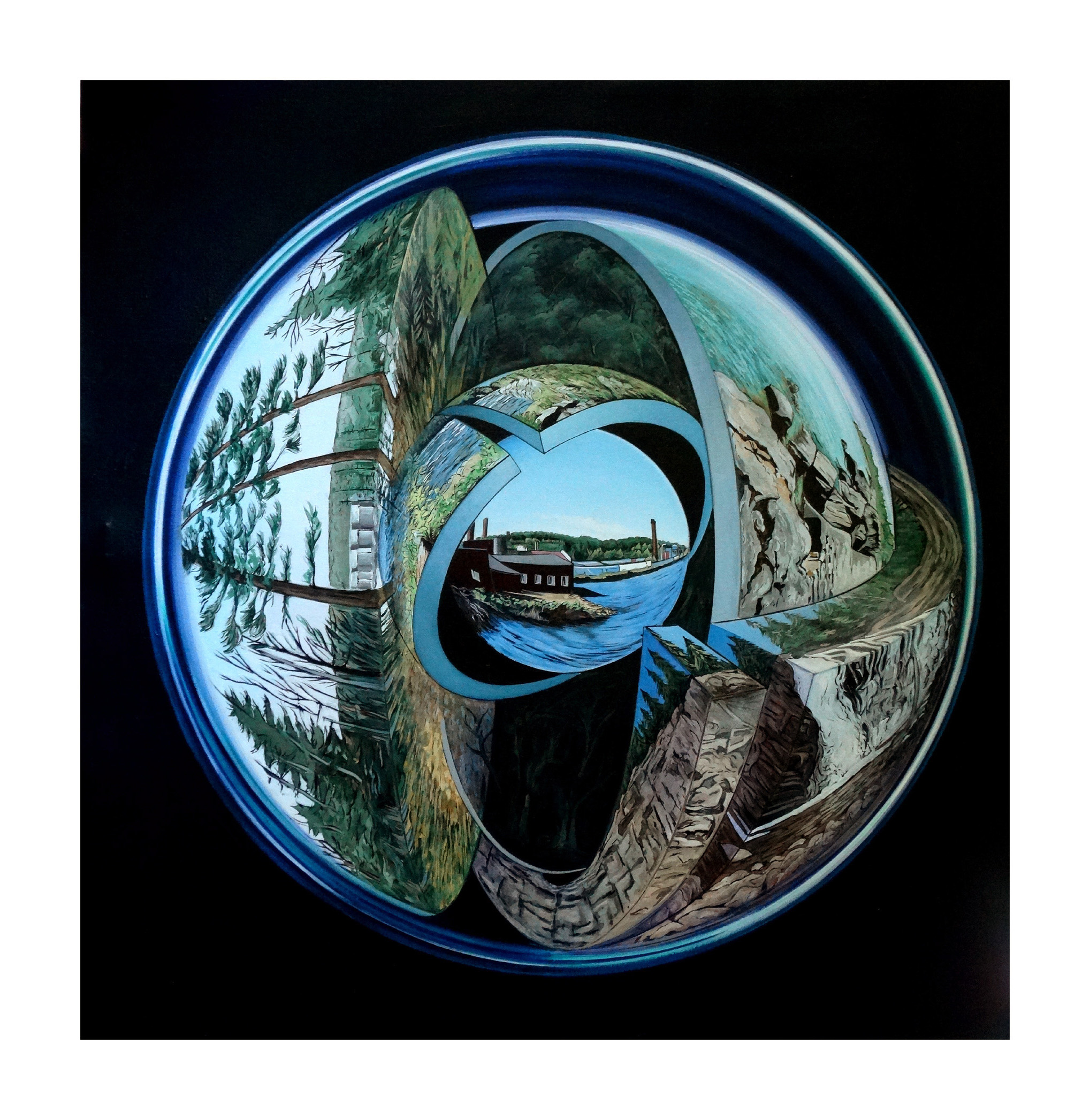
I’ve been wondering about this most incredible idea, that, quantum mechanically speaking, there may exist any number of universes. As hard as I try to visualize such an idea in my limited three-dimensional capacity to imagine spatially it all seems pretty much beyond comprehension. When I add time to the mix I can sort of get an idea of it all. After all, the world as it is right now is not quite the same as the world as it is right now. A micro-second in the past or the future might define an entirely separate reality, a parallel existence.

I wonder if these separate realities float around, bump into each other and maybe intersect for brief periods. Is it possible the remarkable sparkling landscape you saw last week was of another world never to be seen in your reality again? Maybe realities are nested within each other. Do the places you glimpse through the trees and bushes on that familiar winding trail through the woods have a certain other-worldly feel?

I find such thoughts intriguing. I revel in the possibilities, and, as long as I don’t think too hard about trying to define the multiverse in three-dimensional terms, I remain content in the limitations of my understanding.

meditationdevice13a

Are Watched People Nice People?

I’ve been reading that there are a number of scientifically sound studies in psychology that suggest people tend to be good, more generous, altruistic when they’re being watched. And, more specifically, when they are thinking about God, or gods, or other supernatural entities people are more inclined to behave nicely toward others.

I’ve recently been made aware of the fact that a quite large percentage of prisoners in American prisons suffer from one sort of disability or another. According to the report, one of the most common disabilities among the incarcerated is something called ‘executive function disorder’. What this means, I guess, is that those who suffer from EFD are unable to organize themselves well enough to take care of those basic actions required to function successfully, you know, get the things done that need to be done. These folks are apparently unable to get in step with their fellow citizens, or, to put it more simply, they don’t follow the rules, which seems to me a pretty good explanation as to why they’re incarcerated.

I wouldn’t be surprised if these incarcerated individuals thought about God quite a bit, at least in the beginnings of their time behind bars. I wonder if this means, being watched as they are with great care, these folks are nicer, more generous and cooperative with each other than they might otherwise be.

horrors of war

Totalitarianism

I’ve been thinking about totalitarianism lately. This, in part I guess, because I’ve been reading about the philosopher Hannah Arendt who escaped Nazi Germany in the 1940’s and, as a Jew, gave considerable thought to the subject.

Ms. Arendt determined that a successful totalitarian regime is able to establish a commitment to certain idealisms, such as racial purity or nationalistic solidarity, at the expense of basic human rights. By creating and enforcing with a heavy hand certain rules and laws focused on idealisms, plurality and individuality are undermined and an undifferentiated populace is championed. Faced with being ‘for us or against us’ the individual trying to go about his business taking care of family, putting food on the table and such will understandably become fearful. The fear of being perceived as an outsider tends to push ordinary citizens to embrace and participate in the extreme right wing political agenda. And, before long, most everyone is on board except, of course, those chosen as scapegoats to represent all that is evil and in opposition to the selected ideal truths.

As I think about it, it seems to me most all political structures, even those that declare democratic rule, have a bit of an inclination to push idealisms and demonize an opposition. Hopefully, individual strength and perseverance will hold such totalitarian impulses at bay. One must be careful, thought, not to take individual freedoms for granted, I think.

shriners3

Neuroses and Evolutionary Survival

It has occurred to me lately to wonder how we, being survivors of countless generations of evolutionary perfection, having obtained the genetic wherewithal to be alive at this point in time, can be so prone to suffering from various psychological malfunctioning.

I wonder this because it has come to my attention that a significant number of us suffer from a neurotic emptiness attributable to inadequate nurture. That, while physically healthy, more or less, psychologically many experience a profound emptiness (which, I suspect, may explain, to some extent, the prevalence of religious involvement.)

Anyway, there’s a concept the German’s call sehnsucht, defined as the inconsolable longing in the human heart for we know not what, which seems apropos to consideration of a malady which is likely to again lead to religious involvement, and seeing as how we evolutionary survivors have a predilection to belief in the supernatural anyway, it’s pretty hard to deny some sort of spiritual investment.

My particular inclination is to cultivate a deeper engagement with nature. There’s nothing as spiritually uplifting, for me, as a contemplative walk in the woods.

freefall2

Absolute Truth and Moral Relativity

I’ve been contemplating, lately, how one might think about the idea of absolute truth. Apparently the philosopher Rene Descartes had a couple of pretty firm ideas about it: he was sure about his own existence and also that of God. I guess, over the ages, religions have latched onto the notion, believing firmly in certain supernatural entities as well as applying the idea to morality. Unfortunately the irrefutable absolute beliefs of one group doesn’t usually translate to the absolute beliefs of those in the next church. The disharmony that arises from the differences isn’t simply friendly rivalry.

There are, of course, secular moral absolutes, too, having to do with murder and theft and other anti-social behaviors seen to undermine the greater social well-being. The trouble with absolutes, moral or otherwise, is that one can usually come up with plausible exceptions: taking a life to protect another, stealing food to feed the hungry and so forth. And then there’s God’s elusive nature throwing into question that particular absolute truth.

I guess such discrepancies are what encourage some hasty thinkers’ leap directly into the embrace of relative truth and morality. This, even though, given some thought, moral relativity will be found to be a poor position to support a thriving, well-functioning society (no matter what some crony capitalists might want us to believe).

So, maybe what makes the most sense is moral diversity and truth seeking rather than truth grasping. If we recognize that different people at different times are experiencing unique and varied situations that have led to ethical frameworks quite different than our own perhaps we need to cut them some slack. If their moral ground is embraced by the populace and provides a safe nurturing environment who are we to complain?

Absolute Truth

Absolute Truth

In Groups/Out Groups

I’ve been reading, lately, how evolutionary theory offers insights into human behavior. Apparently, deeply ingrained within our genetic make-up, we survivors have certain inherent inclinations that, despite how desperately we may want to rationalize them away will always be with us. Our ultimate evolutionary need to pass on our genes has embedded within our psyches the drive toward group membership: like-minded individuals to share values and reciprocal support and the presupposition of a supernatural agency. I guess what happens over (a long, long, long) time is that the group establishes an identity: cultural, moral, spiritual, that separates it from other groups.

So, what this must mean is that we all will forever be divided into in-groups and out-groups. In the best of times, I suppose, toleration will reign, there will be peaceful co-existence. But even when such periods exist, the Ins will know that they are the trustworthy ones who recognize the true supernature, which means that there will always be a sort of tension between Ins and Outs that could, and sometimes does, fester and erupt into violence. And such a situation will be more likely to happen, I further suppose, when one group feels its existence is threatened if political power becomes imbalanced. And, as much as one might like to disassociate oneself from this ridiculous op positional stance, you really can’t since you wouldn’t be here to even think about it all if your ancestors hadn’t passed on the necessary survival genes.

I guess this evolutionary perspective explains a lot about the nature of the world today. I will try to remember that as evolution continues to slowly and erratically move along, in some distant future perhaps it will catch up to an intellectual enlightenment.

born-again-3.jpg

What it means to be an Intellectual

It has occurred to me recently that people who identify themselves as being intellectual, or are thought of in that way, are often considered arrogant. There seems to be an elitist connotation associated with intellectualism. The image, I guess, is one of out of touch academic ideologue lacking a pragmatic real world outlook.

And this, despite the fact that intellectualism is really nothing more than an attitude of exploration and investigation; an open perspective to ideas and positions of all sorts. Questioning is the essence of the intellectual stance, which, when healthy, stops short of blanket skepticism to arrive at the best possible answers at the moment, aware, always, that better answers may certainly appear in the future.

According to Richard Hofstadter, former Pulitzer Prize winner and history professor at Columbia, anti-intellectualism has probably always been with us but was exacerbated in America by frontier expansion which left behind the social structures of education, religion and government resulting in social regression. The early pioneers found themselves in a more primitive social situation where rule of law was replaced by retributive payback and moral relativism replaced trusting reciprocity between neighbors. By the time religion finally caught up to the westward expansion the unlettered populace responded to a revivalist approach that undermined education in favor of pure passionate religious response.

What makes all this so fascinating to me is the fact anti-education, anti-intellectual sensibilities have not only not dissipated but, judging by current political occurrences gained strength, at least in some quarters. I wish I knew what it would take to get more people to think things through a little better. I don’t think one has to be an intellectual to do that.

root people 3